
IOSF: The Cost Paradox of Video AI - Why Is Generating Cheaper but Final Cuts Still Expensive?

 Prefer us on Google
During Game 3 of the NBA Finals on June 2025, Kalshi aired a rather chaotic TV ad: a farmer floating in a pool filled with eggs, an alien drinking beer, and a man wrapped in an American flag shouting about Indiana. Director PJ Accetturo created the ad using Google’s Veo 3, costing about $2,000 and taking only three days from conception to airing. Previously, the production company quoted Kalshi a price in the "six to seven figures." He generated 300 to 400 times before getting 15 usable clips.
Ten months later, OpenAI shut down the Sora app on April 26, a TikTok-like platform dedicated to AI-generated video feeds. TechCrunch cited a Wall Street Journal investigation reporting that the app's daily operating costs were about $1 million, with user numbers dropping from a peak of around 1 million to less than 500,000. The Sora developer API was also shut down in September, and there are currently no video models listed on OpenAI's developer price list.
These two events summarize the state of video AI in 2026: using AI to create videos has become cheap enough to change the way advertisements are produced; however, simply watching AI-generated videos has yet to become a business.
Core
Perspective
Video AI has already become a real business: several companies that disclose their revenues collectively earn about $2.3 billion annually, targeting marketers, creators, and enterprises as clients. It is not a scaled-down version of the large language model market: the cost of a one-minute video is thousands of times that of a one-minute text, with the highest revenues coming from applications rather than model vendors. The first to be impacted are industries that purchase "sufficient" videos in bulk: stock footage, advertising, training, and short dramas. Film special effects follow. Gaming and robotics are last, as they rely on physical laws, and currently, the best models score about half of real images in physical tests.
Revenue Rankings: Companies Disclosing Data Have a Combined Annual Revenue of About $2.3 Billion
IOSF Research
A few companies have disclosed their revenues, and they are growing rapidly:
- Higgsfield's ARR grew from $200 million at the end of 2025 to $700 million by August 2026.
- Kuaishou's video model Keling surpassed $118 million in revenue in the second quarter, more than doubling year-on-year.
- Fal, a platform aggregating video and image models, had an ARR of about $400 million in March 2026, doubling since last October.
- HeyGen's ARR broke $200 million in June.
- Runway's ARR surpassed $200 million in September.
According to our calculations, the visible revenue totals about $2.3 billion annually. Part of this is image revenue, and another part is double-counted since applications also procure from fal. This figure does not include Google’s Veo, ByteDance’s Seedance, and several Chinese labs, which have not disclosed their video revenues separately. The error is two-way: image revenue and double-counting inflate the total, while undisclosed labs lower it. Therefore, $2.3 billion can only serve as a scale reference, not a calculated market size.
Video Generation Costs Are Thousands of Times Higher, with Major Revenue in Applications
IOSF Research
Video AI is often informally described as "a few years behind the large language model market." However, data does not support this claim, as the differences between running language models and running image/video models are substantial.
In simple terms, language models write like a person types: one word at a time, with each word being a small guess at the next. You can start reading while it is still writing. Image or video models are more like architects: they start from a random noise and iteratively refine the entire picture, usually needing 20 to 50 rounds until a clear image appears. Each round processes all pixels simultaneously, and nothing can be used until the last round is complete. Video multiplies the workload: one second is about 24 frames, and each frame must remain consistent with the previous ones; the cup must stay in the same position, and the face must always be the same. A piece of text only has a few hundred small units. This is why a tested open-source model requires about 350 seconds of chip computation time to generate one second of video, and why the cost of one minute of video is thousands of times that of one minute of text.
Anthropic told investors that its annualized revenue reached $65 billion by the end of July, while OpenAI's was about $40 billion. The revenues of just these two labs are about 45 times the visible total revenue from video.
In the large language model field, most revenue goes to model labs; in the video field, the highest revenue comes from applications. The largest language model application is the programming tool Cursor, which reportedly had an annualized revenue of about $4 billion in June, roughly one-sixteenth of Anthropic's. In the video field, Higgsfield leads with $700 million, with applications encapsulating other companies' models (Higgsfield, HeyGen, Synthesia, Magnific) accounting for over half of the visible total revenue. Text clients buy the intelligence of the model directly for use. Video clients purchase the final cut for specific tasks, which require editing, consistency, and supporting workflows, and applications are built around these needs, forming a video workstation.
A Picture Is Worth a Thousand Words
As of October 22, the recorded lowest price for every minute of video is about $3, coming from Veo's cheapest tier, differing from the highest tier by about 7,600 times.
There are also a few distinctions worth noting: code is the largest market for large language models, which can be automatically validated; video relies on human judgment, which is more subjective. Text is purchased by token; video is purchased by clips, corresponding to production budgets.
Who Is Paying: Public Evidence Points to Corporate Clients
IOSF Research
Higgsfield claims to be a platform "for creators, marketers, brands, agencies, and production companies," stating that it "provides visual content production support for 390 Fortune 500 companies" (Higgsfield). HeyGen claims that 85% of Fortune 100 companies are using it (HeyGen). Neither company has broken down revenue by use, so based solely on public data, it is unclear how much revenue comes from individuals making videos for entertainment purposes. All publicly available evidence points to corporate buyers.
Further segmenting buyers reveals a divergence in business models. People may watch a lot of AI videos, but what they pay for varies, as do their quality requirements.
- Short drama apps sell stories by the episode, so quality determines whether viewers continue to pay. Their biggest cost is customer acquisition, not production: according to Media Partners Asia, the largest short drama platform ReelShort allocates 55% of its estimated $785 million revenue in 2025 to user acquisition and marketing (Indian Television). Marketing takes up 55% of revenue, and all other costs, including generation, must be covered by the remaining 45%. Thus, cheaper models can only compress the smaller portion of the budget. Better models affect the profitable part: whether viewers are willing to continue paying for the next episode. ReelShort has not disclosed its generation expenditures, so this is our interpretation of its cost structure, not a measured breakdown.
- Viewers discover these dramas through social feeds (a survey by Meta and Ormax shows that this proportion is 89% among Indian viewers), and producers are also rapidly turning to AI: according to Owl & Co, about two-thirds of new vertical short dramas outside China in the third quarter were AI-generated, up from only 3% in the first quarter (The Hollywood Reporter).
- AI companion apps sell emotional connections rather than visuals. Users return repeatedly for this relationship, so the videos only need to be "sufficient." The key is cost and speed, as each user requires a large volume of videos.
Cheap Production Does Not Equal Viewership: Value Shifts to Decision-Makers in Content Distribution
IOSF Research
The music industry has already taken this step. According to Deezer, on peak days in June, fully AI-generated tracks exceeded half of all new uploads on the streaming platform, with nearly 90,000 new tracks added daily. However, they only account for 1% to 3% of total plays.
Deezer excludes detected AI tracks from recommendations and playlists, making the gap between uploads and plays visible. This pattern reflects what economist Herbert Simon described in 1971: when information becomes abundant, attention becomes a scarce resource. When production is nearly free, supply will flood, and value shifts to those deciding what content is seen. Two researchers referred to the quality threshold set by viewers for AI content as the "slop ceiling."
Which Industries Are Most Affected First: Stock Footage and Advertising Lead, Gaming and Robotics Follow
IOSF Research
Today’s $2.3 billion is still small compared to existing video expenditures, and funding will not shift evenly. Ranking by the proportion of video work that current models can accomplish:
- Stock Footage and Images. Generated clips can directly replace licensed materials. The two major stock photo agencies, Getty Images and Shutterstock, generated approximately $2 billion in revenue last year, making this the most affected vertical sector.
- Advertising and Product Videos. WPP Media estimates that global advertising revenue will be around $1.3 trillion this year. Only a small portion of this is used for producing ads, but Kalshi's advertising indicates how much this expenditure can be reduced as generation costs decline, eliminating a significant amount of indirect costs associated with live-action ads.
- Training and Explainer Videos. In 2025, U.S. institutions are expected to spend $102.8 billion on training (Training magazine). This is the market for HeyGen and Synthesia, where teleprompter-driven videos are the easiest to generate.
- Short Dramas. In China, revenue from micro-dramas (produced for mobile, with episodes lasting one to two minutes) is expected to reach $9.4 billion by 2025, surpassing the national box office. These producers have accepted the quality of mobile footage, and demand is high.
- Visual Effects. IMARC estimates that the market size will be around $11 billion by 2025 (IMARC), although estimates vary widely. Producers are already using generated shots (see below).
- Film and Television. Ampere Analysis estimates that global content spending will reach $255 billion by 2026. AI is entering this field shot by shot, rather than for entire works.
- Gaming and Robotics. According to Newzoo, the gaming industry is expected to generate $201.6 billion in revenue by 2025. Video models will only be effective here once they learn to simulate the world, which is the focus of the last section of this article.
How AI is Changing Video Production Costs: Both Completion Rates and Unit Prices Matter
IOSF Research
The most obvious impact is on costs. Aside from Kalshi's ads, the OpenAI-supported animated feature Critterz had a budget of less than $30 million and a production cycle of nine months; a large animated film typically requires $100 million to $200 million and about three years.
Prices are decreasing by tier, not universally.
The next round of cost reduction is already appearing in research. A practical study by Hugging Face researchers found that generating a 5.4-second clip with a large open-source model on a flagship GPU takes 1,875 seconds, which translates to about 350 seconds of computation time per second of video. Distillation directly addresses this issue. One team increased the frame rate of a small open-source model by about 22 times, making it fast enough for real-time streaming generation on a single chip. The significant cost reduction needed for companion apps will come from here: generating at low resolution first, then performing super-resolution.
The price for generating one second of video is only part of the cost. The director of the Kalshi ad retains about 1 out of every 20 to 27 clips, so for him, the cost of usable video per second is 20 to 27 times the listed price. This is on the high side. A summary from a video tool vendor shows that for a three-minute animated series, 1 out of every 4 clips is retained (41 out of 164). No one has yet published independent statistics on completion rates. Consistency directly affects completion rates. If a model can keep characters, products, or camera movements consistent across multiple generations, fewer generations are needed; halving the number of generations also halves the cost of usable video per second. Lower prices simply make each generation cheaper.
Our Test: Same Prompt, Three Models. On November 2, we used Runway's API to give three models the same prompt: a phone on a glass table lighting up and vibrating towards the edge of the table, bouncing once on the concrete floor after falling. Each segment was 8 seconds, 720p, silent, and each model generated once, costing a total of $4.80.
▲ From left to right: Wan 3.0, Seedance 2.5, Veo 3.1
- Wan 3.0 ($0.80, ranked first) performed the best. The phone moved forward, fell, and stopped, but the shot tilted down to follow it.
- Seedance 2.5 ($2.40, the most expensive of the three) had the most realistic vibration effect but switched to a new shot before the fall, and the screen went black.
- Veo 3.1 (silent version $1.60, ranked 22nd) started with the phone upright instead of flat, and it bounced several times on the ground like rubber. Its screen text was the clearest among the three. (We continue to track Veo because Google has the clearest price history, not because it leads. In terms of quality, it is now behind cheaper models, as our test indicates.)
None of the three models fully executed the prompt, with each segment taking 2 to 4.5 minutes to generate, which is 15 to 34 times the length of the segments (by our calculation). The three segments do not tell us much, but the result ranking is consistent with the leaderboard, not with the prices.
The Next Turning Point: Cost and Latency
IOSF Research
Cheaper models are one path. Another path is to replicate existing film and animation production methods: rough first, then fine.
First produce a low-cost draft, then render only once.
Animators solved this problem decades ago. They do not start animating until the story is sorted out; instead, they first draw storyboards and create rough animatics. AI video can do this too. A rough cut of one or two frames per second is sufficient to judge the story and shots, similar to a comic strip; the selected and most suitable shots are then rendered by the best models.
This also addresses the completion rate issue mentioned above. If most generated results will be discarded, it is best to discard them while they are still cheap.
ByteDance has already turned this practice into a product. Seedance 2.5's Draft mode went live on fal on October 30, quickly generating low-resolution previews before completing the same video in full HD. Only the retained segments are paid at full price. The price difference accumulates quickly (fal):
- Preview (480p): about $0.22 per second
- Full HD (1080p): about $1.16 per second, about 5 times the preview
- Completing the draft into a finished piece: fal does not list the price. In our team's tests, the cost was 6 to 8 times lower than directly generating full HD segments.
The trade-off is quality. Finished pieces completed from drafts look slightly softer than directly generated full HD segments, but it also corrected a strange last frame in the preview. The savings are significant when scaled up. If 1 out of every 25 generations is retained (completion rate of 4%), the cost of one hour of full HD finished video would be:
- Generating full HD every time: about $105,000
- First producing drafts, then completing the retained segments: about $20,000 (by our calculation)
Hybrid processes are already emerging.
Producing low-cost drafts is one shortcut. Another is to combine old tools with new ones. Creators now first build scenes in the 3D design tool Blender using gray geometries, place objects and camera angles with OpenAI's GPT-6 Astra, and then convert a still frame from the scene into a realistic first frame, generating the finished piece with Seedance 2.5 (Kapwing tutorial, ByteDance's Dreamina).
The two tools complement each other's shortcomings. Relying solely on 3D is too slow for realism; relying solely on AI video is difficult to control. When combined, the 3D draft determines layout and shots, while the video model is responsible for visual quality.
Real-time generation is on the horizon.
The final step is speed. Watching and rendering video is no longer just a laboratory demonstration:
- Runway Characters (March): A video model capable of real-time conversation, based on Runway's GWM-1 (Runway)
- Runway Solaris (August 31): Runway's first "Interface World Model" (Crypto Briefing)
- Decart (May): Instantly converts real-time video streams into generated scenes; raised $300 million at a valuation of about $4 billion (bne IntelliNews)
- Zoom Virtual Avatars: Replaces camera footage with realistic virtual avatars that mimic your expressions as you speak, with functionality depending on the plan and region (Zoom)
Once video generation speed can meet the needs of real-time conversations, the challenges for companion apps will change: it will no longer be about how much it costs per minute, but how quickly the next frame can arrive.
Beyond Marketing: In Film, Television, and Effects, AI Can Do Special Effects Shots but Not Long Projects
IOSF Research
Hollywood is testing whether video AI can step out of the advertising realm.
So far, producers have mainly used it in two ways: first, to create shots that the budget could not originally cover; second, to license their characters and earn revenue when others use them.
First, creating shots that were originally unaffordable.
Recently, two shows used AI to complete scenes that would have otherwise been cut.
- Netflix's The Eternaut: This Argentine series completed a building collapse scene using generative video. Co-CEO Ted Sarandos stated that the speed of completing this shot was ten times faster than traditional effects, and using traditional methods would be "completely unfeasible" within the show's budget.
- Amazon's House of David: The second season of this biblical-themed series used 350 to 400 AI-generated images, compared to about 70 in the first season (TheWrap). The showrunner indicated that without AI, he could not afford those battle scenes.
Other production companies have gone further by collaborating directly with model vendors. Lionsgate invested in Runway in June (the shareholding ratio was not disclosed) and plans to create a short series based on its film library (Runway). AMC Networks has also signed a contract with Runway (Hollywood Reporter).
Secondly, generating revenue from character licensing.
The bigger contention is over who owns the characters. Disney's approach reflects two sides:
- June 2025: Disney and Universal sued Midjourney for copyright infringement.
- December 2025: Disney agreed to invest $1 billion in OpenAI and licensed Sora to use over 200 of its characters (Disney).
- After Sora closed: The agreement was terminated, and Disney stated it would seek other AI partners (Blooloop).
The conclusion is simple: production companies want to be compensated when their characters are used, and they will sue those who use them without payment.
Japanese copyright holders have gone the furthest, shifting from blocking AI to licensing AI, driven by money. Japanese animation sells well overseas, but many production companies are struggling:
- According to preliminary statistics from the Japan Animation Association, overseas revenue in 2024 is 2.17 trillion yen, surpassing domestic revenue (gamebiz).
- In 2025, 34.6% of animation production companies are expected to incur losses (Teikoku Databank, via GameBusiness).
In October 2025, CODA, representing Japanese copyright holders, demanded that OpenAI stop using its members' works to train Sora 2 without permission (Automaton).
In less than a year, the attitude changed. On September 11, the Chinese AI lab MiniMax and Japanese company KAGAMIAI launched the H3 IP Edition in Tokyo. Creators can use it to produce videos with licensed Japanese characters, each character comes with approved materials, usage rules, and commercial terms, and reports usage back to the copyright holders. MiniMax claims over 60 companies have expressed interest (MiniMax).
Previously, KAGAMIAI conducted a pilot with Captain Tsubasa, using another Chinese video model PixVerse, which showed the potential demand (source same as above MiniMax page):
- About 126,000 creators
- Approximately 330,000 works produced in 45 days
- Over 99% of activities came from outside Japan
Licensing fan creations may become the first mass consumer market from which AI video character copyright holders can earn revenue.
The pattern is: AI can do special effects, but cannot handle long-form projects.
In all the above cases, AI handled shots that medium-budget series could not afford: wide shots, crowds, destruction scenes, and environmental settings. The rest of the production is still done by humans. Computer graphics technology entered film in a similar way, with special effects becoming widespread long before Toy Story proved that an entire feature could be made using it in 1995.
A test result also points in the same direction. In the physical benchmark tests described below, the scores of the Odyssey-3 Pro model depend on the starting point:
- Continuing real footage: 63 points, single generation
- Starting from a single image: 50 points
AI video performs better when based on real material, which is exactly how special effects work: each generated shot is embedded in real footage. This test does not measure duration. No one has yet released a test on whether models can maintain consistency across multiple shots, and this test would explain why long-form projects still cannot be achieved.
Will specialized labs emerge? They already have, video companies are diversifying into three types
IOSF Research
Specialized labs have emerged, and three types of video companies are diversifying:
General giants. Google (Veo), ByteDance (Seedance), and Kuaishou (Kua Ling) have the most computing power and data. They compete on quality and price, with most applications reselling their models.
Production studio-type labs. Runway currently has Lionsgate as a shareholder and is developing products for film and television. Moonvalley only uses licensed footage to train its Marey model, having raised $154 million by July 2025, and its production department Asteria uses this model to make films. These labs can provide three things that are difficult for giants to offer: training data acceptable for production methods, fine control over each frame, and tools that can integrate with existing special effects processes.
Application layer. Higgsfield, HeyGen, and Magnific package models from other labs and sell them to specific clients.
New labs and their betting directions. The largest investments we found for 2026 are flowing into labs developing interactive models or world models: AMI Labs' $1.03 billion seed round, Runway's $315 million financing (Runway claims it will be used for world models), and AMD's $8.2 billion acquisition of World Labs. We have not accounted for all financing in the video field for the year; the table below mixes financing rounds, an acquisition, and product updates:
The breakthroughs most likely to occur in the next 12 months also come from this table: video generation with real-time capabilities sufficient to support calls and games, interactive worlds instead of fixed segments, and scalable licensed character generation.
In the film and special effects field, production studio-type labs are most likely to win. Production companies cannot bear the litigation risk for a key shot (hero shot), need to accurately replicate the director's intent, and must collaborate with union crews; general vendors that only provide the strongest raw models can only compete on price.
The bigger opportunity is the world, not segments
IOSF Research
In this round of intelligent development, the largest market for video models may ultimately not be video at all. A model that can predict the next frame of a scene may be learning how the world moves, which would be very useful for gaming and robotics.
Runway released GWM-1 in December 2025, calling it a general world model, with three versions: an explorable world, a conversational virtual avatar, and a robot model used to predict what the camera will see after each robot action. It generates 720p images in real-time for up to two minutes. When Runway raised $315 million at a $5.3 billion valuation in February, it stated that the money would be used to develop more powerful world models.
Plato described this bet in the allegory of the cave in The Republic.
The prisoners can only see the shadows on the wall, and they honor those who "most keenly observe the passing shadows" and can best predict which shadow will appear next. The video model is a shadow predictor that can win awards but has never seen the object casting the shadow. Plato's point is that this skill is not knowledge. For video models, the question is whether predicting the next frame means understanding how the world moves; Physics-IQ is one way to test this.
Physics-IQ is a benchmark test hosted by Google DeepMind: it shows the model the beginning of a real physical event and then evaluates how closely the generated subsequent frames match the real situation. A score of 100 means it is as close as another real shoot. According to the original scoring, the best single-image video model improved from 23 points in February 2025 to 44 points in May this year. In the re-scored rankings, the top single-image video model scored 51 points, while Google's Veo 3.1 Fast (30 points) was on par with an open-source model from 2024 (32 points). The paper's own finding is that physical understanding is unrelated to whether segments look real.
Looking real has basically been solved, behaving real has not. In this test, the best models are still about halfway between 0 points and another real shoot. Since it has been proven that realism and physical performance are unrelated, better-looking footage will not automatically reduce this gap.
If this score approaches 100, video labs will become simulation companies, selling products to game studios and robotics manufacturers; in this market, first-mover advantage in the video field will be very important.
Conclusion: Three numbers determine the direction of this industry
IOSF Research
Most of the questions left by this article can be answered by three numbers:
How many generated results are adopted? Currently, the only data we have is: Kalshi ads are 4% to 5%, and an animated series is 25%. I personally believe that consistency will have a greater impact on this number than original image quality, and labs will develop in this direction: building environments that can manage consistency and support large contexts for generation, rather than pursuing outstanding single generations.
How much does it cost to produce one hour of footage? Divide the price by the retention ratio. At today’s prices, the cost of the same hour of video may be:
- Veo 3.1 Lite (original price): $720 to $4,500
- Seedance 2.5 Full HD: $16,800 to $105,000
According to this formula, doubling the production rate and halving the price have the same effect on cost reduction. The difference lies in how much space each has left. Based on the current production rates of 4% to 25%, a model that makes every generation usable could reduce costs by 4 to 25 times. Prices have already dropped, and the reductions are uneven across tiers. We judge that the production rate will be a greater lever in the next two years. If the next batch of announced production rates remains around 4%, while prices continue to drop, this judgment will be incorrect.
- Can Physical Performance Stand Up? Physics-IQ is the only public test that examines whether model movements align with the real world, with the best models scoring about half of the real footage; in scenarios where models are based on real footage, the gap will narrow first.
Two years ago, the question was whether AI-generated videos could look good enough. This question has largely been answered: Kalshi's ads aired during the NBA Finals, and Netflix has incorporated generated visuals into officially launched series.
Now, the unresolved issues are about money and control:
- Who gets the money? Producers want to receive a share when their characters appear or establish a royalty-like mechanism. The authorization of characters, individuals, or idols for fan creations may see significant growth.
- What new possibilities will emerge? If the physical gap narrows, video models will no longer just be fragment generators but will become simulators. Our judgment: the first intersection to generate paid demand will be robot training, which involves extending real camera footage with models. This is currently the highest-scoring scenario (63 points vs. 50 points), and Runway's GWM-1 is already selling such products. Gaming will come later because games require models to start from scratch and maintain consistency over hours. By 2027, we expect the simulator market to still be smaller than the advertising and production markets it derives from. If a game studio releases works based on generative world models before then, this judgment will be incorrect.
This content is provided for general informational purposes only and doesn't constitute financial, investment, legal, or tax advice. Any events, rewards, online promotions, or related information mentioned herein should not be considered a recommendation, solicitation, or invitation to purchase, sell, trade, or otherwise deal in any crypto assets. Crypto assets are highly volatile and may result in loss. The availability of WEEX services, products, and related events may vary by region. You are responsible for ensuring that your participation is in accordance with applicable local laws and regulations.
You may also like
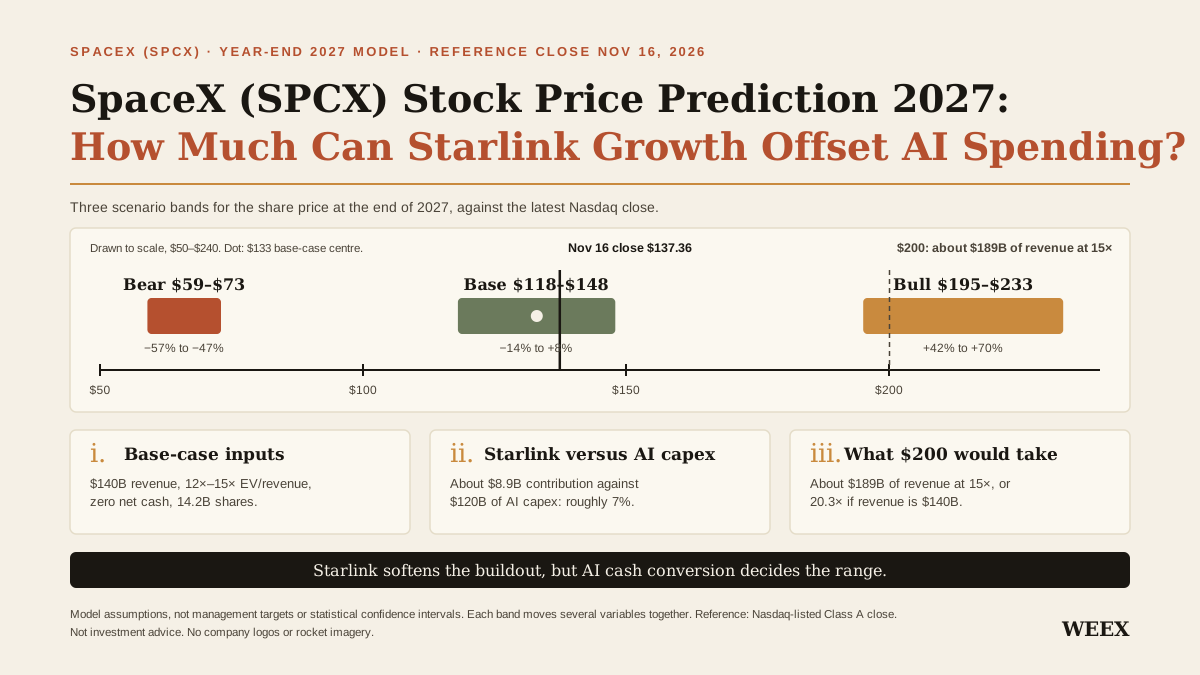
SpaceX (SPCX) Stock Price Prediction 2027: How Much Can Starlink Growth Offset AI Spending?
SpaceX stock price prediction for 2027: See the $118–$148 base case, how much Starlink could offset AI spending, and what it would take to reach $200.

Chevron Expands in the Gulf of Mexico with Plans to Acquire Majority Stake in Oil Field for Over $5 Billion
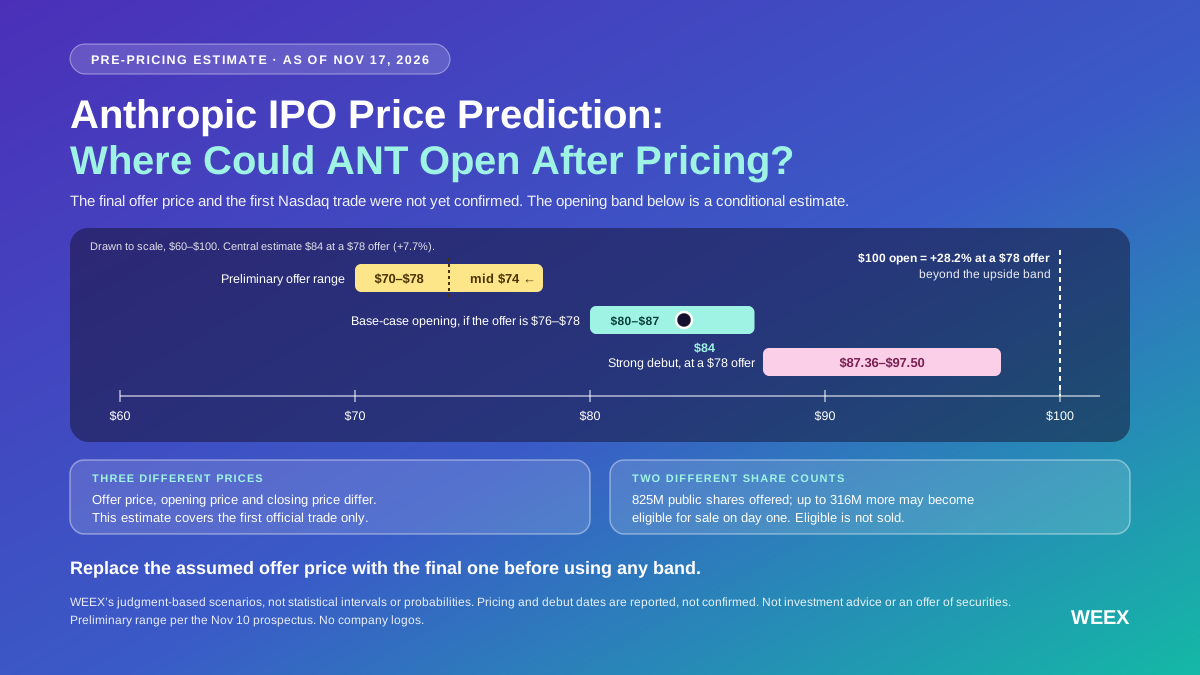
Anthropic IPO Price Prediction: Where Could ANT Open After Pricing?
Anthropic IPO price prediction: See ANT’s $80–$87 base-case opening range, how the final offer price changes it, and what could push shares above $90.

Will the $50 billion request materialize? The U.S. transportation system urgently needs funding for upgrades, but Congress has become a "lame duck"

Japan Proposes Establishing an 'Asian Version of the International Energy Agency' to Enhance Southeast Asia's Oil Storage Capacity in Response to Energy Crises

Federal Reserve Warns Korean Investors About Leveraged ETF Risks

Mercado Bitcoin Withdrawal Update: Pix Restart and Crypto Suspension
Mercado Bitcoin set November 17 for Pix deposits and withdrawals in Brazilian reais. Read the withdrawal rules and the background to the crypto suspension.

Reasons Why Cryptocurrency Kiosks Face Increasing Regulation

The Q3 Market in Turmoil: How Much is Circle Worth?

A Decade of a Crypto Neutral Fund Manager: A High-Pressure Way of Life

JPMorgan and DBS Enable On-Chain USD Payments! 24-Hour Cross-Border Transfers, Ant International Becomes First Client

XRP holders demand Ripple burn 31.1 billion tokens by March 2027

Major Indexes Close Lower, Nvidia Earnings Are Imminent | WEEX Daily Market Brief (November 17, 2026)
At the November 16 close, the three major indexes all finished lower. Technology-stock selling continued, with the chip sector leading declines. Bitcoin’s weekend selloff showed signs of stop-loss hunting; it is currently around $64,000. Backpack received regulatory approval. On November 17, watch for October retail sales data and earnings from Nvidia, Home Depot, Disney, and JD.com.

Cardano vs Solana: Which Blockchain is Superior?

Surge in Drone Demand Drives Swiss Defense Group to Accelerate U.S. Market Expansion

25 million stolen in 12 seconds: the MEV brothers acquitted

Citi Updates Preferred List of U.S. Software Stocks: Box, Navan, and Roper Technologies Take the Top Three Spots

JPMorgan and MIT Map More Than 150 Requirements for Institutional Blockchains

J.P. Morgan Chief Global Strategist: Tech Stock Trading Enters a Phase of Volatility and Uncertainty, Investors Should Diversify AI Holdings

One Hundred Million Dollars in Floating Profit Goes to Zero: A Contract Trader's Dilemma

Figment to Support Staking Through BNY’s Digital Asset Custody Platform
Crypto: Tether Gold (XAU₮) Receives Unqualified Audit from KPMG

Pony Ma's Internal Speech: The Wave of AI Has Already Hit, Tencent Must 'Transform from Army to Navy' and Get Everyone on Board

Uniswap freezes $300,000 in stranded fees, halting automatic token burns
NVIDIA Employees Warn Board of Potential Loss of "Irreplaceable" Talent

What Are Value Indicators Beyond Money? Considering 'Sweat' (Inside 'So That's Blockchain' Ep.24)

The Arrogance and Prejudice of a16z

Backpack Founder’s Latest Speech: Solana Will Become the API of American Finance, Welcoming the Era of Neobrokerage

If a Bear Market Is Coming, History Says This Is the Safest Investing Move You Can Make

Ethereum test exposes flaw that lets transactions skip payments
SpaceX (SPCX) Stock Price Prediction 2027: How Much Can Starlink Growth Offset AI Spending?
SpaceX stock price prediction for 2027: See the $118–$148 base case, how much Starlink could offset AI spending, and what it would take to reach $200.
Chevron Expands in the Gulf of Mexico with Plans to Acquire Majority Stake in Oil Field for Over $5 Billion
Anthropic IPO Price Prediction: Where Could ANT Open After Pricing?
Anthropic IPO price prediction: See ANT’s $80–$87 base-case opening range, how the final offer price changes it, and what could push shares above $90.
Will the $50 billion request materialize? The U.S. transportation system urgently needs funding for upgrades, but Congress has become a "lame duck"
Japan Proposes Establishing an 'Asian Version of the International Energy Agency' to Enhance Southeast Asia's Oil Storage Capacity in Response to Energy Crises
Federal Reserve Warns Korean Investors About Leveraged ETF Risks
Latest articles
Latest coin listings on WEEX


