
Treasury’s cash plan points to a possible December liquidity window for Bitcoin

 Prefer us on Google


Treasury's new financing calendar gives Bitcoin's liquidity hopes a possible December window, with projected cash peaks on either side. Its Nov. 4 refunding statement anticipates cash peaks near $1,025 billion in late November and late January, with a lower balance assumed at December's close.
That sequence sharpens the timing of potential reserve relief. If Treasury spends down its account at the Federal Reserve, it can return reserves to banks, all else equal. But the planned December reduction in bill auction sizes partly reflects expected tax receipts, which move cash the other way. That makes December's net cash movement the first test of the funding case.
Two cash peaks frame December
In its refunding statement, Treasury estimates that the Treasury General Account, its operating account at the Fed, could peak at $1,025 billion, plus or minus $50 billion, in both late November 2026 and late January 2027. It assumes an $850 billion balance at the end of December.
The Nov. 2 borrowing estimates also assume a $1 trillion cash balance at the end of March 2027.
The bill schedule adds a seasonal mechanism. Treasury expects to maintain current benchmark bill auction sizes into late November and may issue a short-dated cash management bill around month-end. It then expects to reduce shorter-dated bill auction sizes during December, citing projected corporate and non-withheld tax receipts around the middle of the month.
January reverses that issuance direction: Treasury anticipates increasing auction sizes across the bill curve as seasonal fiscal outflows rise. It retains the ability to adjust those plans as borrowing needs change.
The paired cash peaks and bill sequence add timing within the refunding quarter to the quarter-end framework covered in CryptoSlate's earlier Treasury analysis. A December respite could therefore sit inside a broader replenishment cycle rather than mark sustained easing.
Two projected cash peaks frame a possible December respite
Treasury projects late-November and late-January peaks around a lower assumed December close. Tax receipts complicate the bill-supply signal.
Projected Treasury cash peaks around an assumed December low CASH CHECKPOINTS / USD BILLIONS80090010001100$1,025bn± $50bnLATE NOV 2026Projected peak$850bnDEC 31, 2026Assumed close$1,025bn± $50bnLATE JAN 2027Projected peak$1,000bnMAR 31, 2027Assumed closeCash axis starts at $800bn. Separate checkpoints, not a daily cash path.
Treasury cash checkpoints with forecast peaks and assumed closing balances CASH CHECKPOINTS / USD BILLIONSLATE NOV 2026Projected peak$1,025bn ± $50bnDEC 31, 2026Assumed close$850bnLATE JAN 2027Projected peak$1,025bn ± $50bnMAR 31, 2027Assumed close$1,000bn8001,0001,100Cash axis starts at $800bn.Checkpoints, not a daily cash path.
Why fewer bills alone do not prove relief
Why fewer bills alone do not prove reliefTreasury spendingTax receipts
Payments from Treasury's Fed account support bank reserves, all else equal.
Treasury spending supports bank reserves all else equal Treasury accountCash leaves Bank reservesReserves increaseTreasury spendingAll else equal; other Fed assets and liabilities can offset the result.
Treasury spending supports bank reserves all else equal Treasury spending Treasury accountCash leaves Bank reservesReserves increaseAll else equal; Fed offsets can change the total.
Tax receipts help explain December's expected bill reductions, while cash entering Treasury's account drains reserves, all else equal.
Tax receipts move cash toward Treasury and drain reserves all else equal Treasury accountCash enters Bank reservesReserves declineTax receiptsAll else equal; other Fed assets and liabilities can offset the result.
Tax receipts move cash toward Treasury and drain reserves all else equal Tax receipts Treasury accountCash enters Bank reservesReserves declineAll else equal; Fed offsets can change the total.
A cash drawdown can support reserves, all else equal. Lower bill auction sizes alone do not establish Bitcoin buying.
All future balances are projections or assumptions, not observations. Dates are not equally spaced in time. Tax receipts and other Fed balance-sheet changes can offset reserve support. No Bitcoin buying or price effect is established.
Sources and evidence
Sources
- Treasury refunding statement, Nov. 4
- Treasury borrowing estimates, Nov. 2
- Federal Reserve liability accounting
- Federal Reserve H.4.1, October 29
Supporting facts
- Treasury's November 4 refunding statement estimates that its General Account could peak at $1.025 trillion, plus or minus $50 billion, in late November 2026 and late January 2027. [1]
- Treasury assumes an $850 billion end-December 2026 cash balance and a $1 trillion end-March 2027 balance in its November 2 borrowing estimates. [2] [1]
- Treasury expects reductions to shorter-dated bill auction sizes during December, citing projected mid-December corporate and non-withheld tax receipts, and anticipates increases across the bill curve in January as seasonal fiscal outflows rise. [1]
- When Treasury spends from its General Account, bank reserve balances increase, all else equal; tax receipts moving into that account drain reserves, all else equal. [3]
- Federal Reserve securities purchases and lending can increase reserves, all else equal; currency demand, reverse repos and other deposit changes also affect the reserve balance. [3] [4]
- December bill-auction reductions do not by themselves establish easier funding because the tax receipts Treasury cites can also drain reserves as they reach its account. [1] [3]
- Treasury's financing calendar and reserve accounting do not establish Bitcoin purchases or a guaranteed Bitcoin price response; any transmission to crypto demand remains conditional. [1] [3]
Method
USD billions. Isolated checkpoints use a cash axis from $800 billion to $1,100 billion; peak whiskers show Treasury's stated plus or minus $50 billion range, not probabilities. No daily path is interpolated. Native selectable diagrams show all-else-equal accounting direction, not measured flows.
Scope
All future balances are projections or assumptions, not observations. Dates are not equally spaced in time. Tax receipts and other Fed balance-sheet changes can offset reserve support. No Bitcoin buying or price effect is established.
Infographic by CryptoSlate
The Fed's accounting explanation describes the reserve channel. Treasury payments transfer balances from its account into banks' accounts at the central bank, increasing reserves, all else equal. Tax payments flowing into Treasury's account drain those balances.
That distinction matters for December. Expected tax receipts help explain why Treasury can reduce bill auctions, but those receipts can also absorb reserves. Smaller auctions alone cannot establish that the combined cash flows will ease funding.
The realized net movement in Treasury's account already incorporates financing, receipts and spending. Subtracting issuance again from that net cash change would count the financing effect twice. Fed securities purchases, lending and movements in currency, reverse repos or other deposits can also alter the final reserve total.
Nor should the refunding's gross size be read as wholly new cash demand. Treasury plans to sell $125 billion against approximately $97 billion of privately held notes and bonds maturing Nov. 15, raising approximately $28 billion in new private cash. The three-year, ten-year and thirty-year auctions are scheduled for Nov. 9, 10 and 12, respectively. All settle Nov. 16, the relevant date for the cash exchange.
The December test for Bitcoin
Treasury's latest reported closing cash balance was $938 billion on Nov. 3, according to its operating-cash data available early Nov. 5. The Secured Overnight Financing Rate, or SOFR, was 3.97% on Nov. 3, the latest date available in that release. It measures overnight borrowing against Treasury collateral.
The Fed's Oct. 29 balance-sheet release reports bank reserves of about $2,895 billion on Wednesday, Oct. 28. The cash, reserve and rate figures provide dated baselines rather than a synchronized signal that funding has eased.
For Bitcoin, the useful test begins with actual Treasury cash movements, followed by the reserve and funding outcome after other Fed balance-sheet changes. Whether easier funding translates into Bitcoin buying remains a separate, unproven step.
A realized December cash decline alongside steadier reserves and easier funding would strengthen the temporary-relief case. A cash drawdown offset elsewhere on the Fed's balance sheet would weaken it. Any December improvement could face another test if Treasury rebuilds cash toward its projected late-January peak while increasing bill auction sizes.
-- Price
This content is provided for general informational purposes only and doesn't constitute financial, investment, legal, or tax advice. Any events, rewards, online promotions, or related information mentioned herein should not be considered a recommendation, solicitation, or invitation to purchase, sell, trade, or otherwise deal in any crypto assets. Crypto assets are highly volatile and may result in loss. The availability of WEEX services, products, and related events may vary by region. You are responsible for ensuring that your participation is in accordance with applicable local laws and regulations.
You may also like

Tokenized collateral brings custody and settlement closer together

A Counterintuitive Logic: The Anti-AI Movement Won't Eliminate Demand, But It Gives the Industry More Time to Absorb the Bubble

Bank of England Raises Interest Rates: What Changes for Investors
Net Inflows into Spot Bitcoin and Ether ETFs in the US

TradingBeats Launches New Version, Upgraded to Information Stream Format

Is Trump Media selling Bitcoin? 4,259 BTC moved to Crypto.com

Trading Volatility Without Guessing Price Movements: What New Strategies Does Paragon's Power Perps Bring?

Gold Token 2026: Why Move Gold on Chain?

Economy: The People's Bank of China Tightens Currency Rules to Calm the Yuan

Trust Wallet user reports losing funds without approving transaction

HashKey Uses Standard Chartered's Digital Deposits for Money Movement

Has Wall Street Broken the Mechanism That Made Bitcoin Soar?
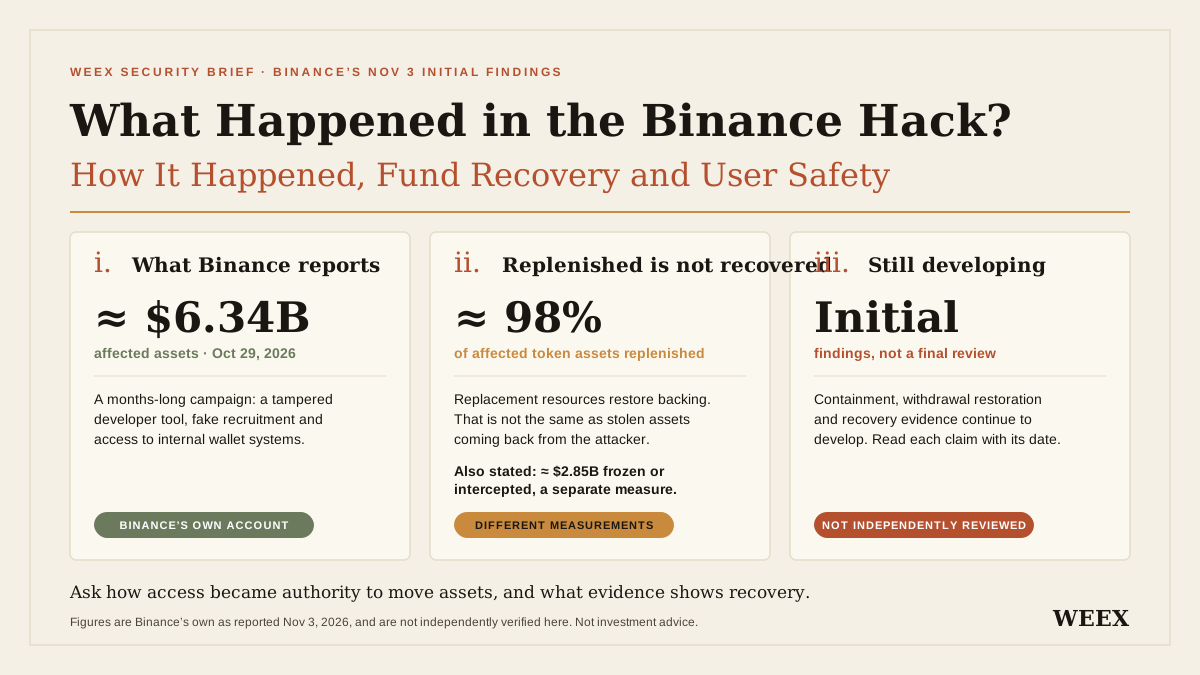
What Happened in the Binance Hack? How It Happened, Fund Recovery and User Safety
What happened in the Binance hack? Review the attack timeline, latest fund replenishment, recovery limits and practical steps to protect your account.

Horizen (ZEN) Migration Deadline: What to Move Before November 4 and What Happens If You Miss It
Horizen (ZEN) migration closes November 4. Check asset-specific bridge routes, wallet requirements, recovery exclusions and what to do if you miss it.

Bitcoin’s year-end liquidity hopes face a projected $150 billion Treasury cash rebuild

DMG Says Client Assets Are Secure and Highlights Layered Transaction Controls
Solana study finds wider spreads outside aggregators at five of six sampled pools
Crypto: Gate Freezes Two Accounts Linked to Binance Hack

BlackRock’s Ethereum fund sheds 580K ETH as monthly exits mount

How T7X Is Building the Infrastructure for a New Era of Capital Markets

The End of the Seasonality Myth. Why September and October Surprised Investors?

Hong Kong plans stablecoin trials for tokenized government debt

Ownership of Bitcoin in the Qian Zhimin Case and Victim Compensation

Polygon expands US banking access to Solana's 15 billion stablecoin market

Sui Puts Enforced Spending Limits at the Center of Its AI-Agent Design

Apple Reclaims Top Market Cap as Silver Nears $50: WEEX TradFi Market Brief
Vitalik's Latest Thoughts: We Need a Digital Minimalism Movement

RLUSD supply fell 29% on XRPL. One XRP trading pool barely changed

Mercado Bitcoin Plans Sui Asset Access in Brazil With Lending and Tokenization Links

Bitcoin Volatility Calendar: Which Events Really Shake the Market?
Tokenized collateral brings custody and settlement closer together
A Counterintuitive Logic: The Anti-AI Movement Won't Eliminate Demand, But It Gives the Industry More Time to Absorb the Bubble
Bank of England Raises Interest Rates: What Changes for Investors
Net Inflows into Spot Bitcoin and Ether ETFs in the US
TradingBeats Launches New Version, Upgraded to Information Stream Format
Is Trump Media selling Bitcoin? 4,259 BTC moved to Crypto.com
Contents
Latest articles


Latest coin listings on WEEX


