
What Happened in the Binance Hack? How It Happened, Fund Recovery and User Safety

 Prefer us on Google



What Happened in the Binance Hack? How It Happened, Fund Recovery and User Safety
The Binance hack was an October 29, 2026 attack on the exchange’s hot-wallet infrastructure that affected approximately $6.34 billion in digital assets, according to Binance’s latest initial findings. The company’s November 3 account describes a months-long campaign involving malicious software, fake recruitment and compromised internal systems. Binance says it will absorb the financial impact, has replenished approximately 98% of affected token assets, and is continuing recovery efforts. Replenishment, however, does not mean the stolen assets have all been recovered.
Our view is that the central lesson extends beyond keeping private keys secret. An attacker can cause serious damage by obtaining the authority to request signatures or by establishing permissions that survive an internal shutdown. Understanding the incident therefore requires three separate questions: how the attacker gained access, how that access became transaction authority, and what evidence demonstrates recovery.
What Is Newly Known About the Binance Hack?
The account has developed substantially since the first security notice. Early reporting focused on a potentially compromised engineer’s laptop. Binance’s November 3 disclosure describes a broader sequence, including software supply-chain exposure, social engineering and access to internal wallet infrastructure.
Reuters reported that the company’s initial investigation now connects a tampered developer tool in June, a malicious recruitment assignment in September, and subsequent access through an internal AI tool before the October 29 theft.
This changes how readers should interpret older articles. “A compromised laptop caused the hack” is an incomplete summary of the latest explanation. A device compromise can provide an entry point, but additional failures must explain how an attacker reaches systems capable of authorizing large transfers.
The disclosure remains Binance’s initial investigative account. It should be distinguished from an independently completed forensic review. New detail improves the public record without establishing that every contributing cause has been resolved.
For readers comparing updates, the verified Binance News summary of the initial findings provides the latest company account reviewed for this article.
How Did the Attack Develop?
The reported sequence shows why a convincing interaction with a person or a familiar software tool is not sufficient evidence of safety.
In its November 3 briefing, Binance described attackers building access over several months. CoinDesk’s account of that briefing provides the following sequence.
| Period | What Binance Described | Security Question Raised |
|---|---|---|
| June 2026 | An engineer encountered a tampered Homebrew installation while seeking an AI coding tool | How were software sources verified? |
| September 2026 | A fake recruitment process led another engineer to download a malicious coding assignment | Could an external interview task reach a work environment? |
| October 20 | A compromised machine and an internal AI tool were used to reach wallet engineers’ systems | What authority did internal tools and credentials provide? |
| October 29 | Stolen credentials supported deployment of a container and execution of a malicious script | What prevented deployment access from becoming wallet authority? |
The final column is our analysis of the disclosed sequence, not an additional allegation about an undisclosed control.
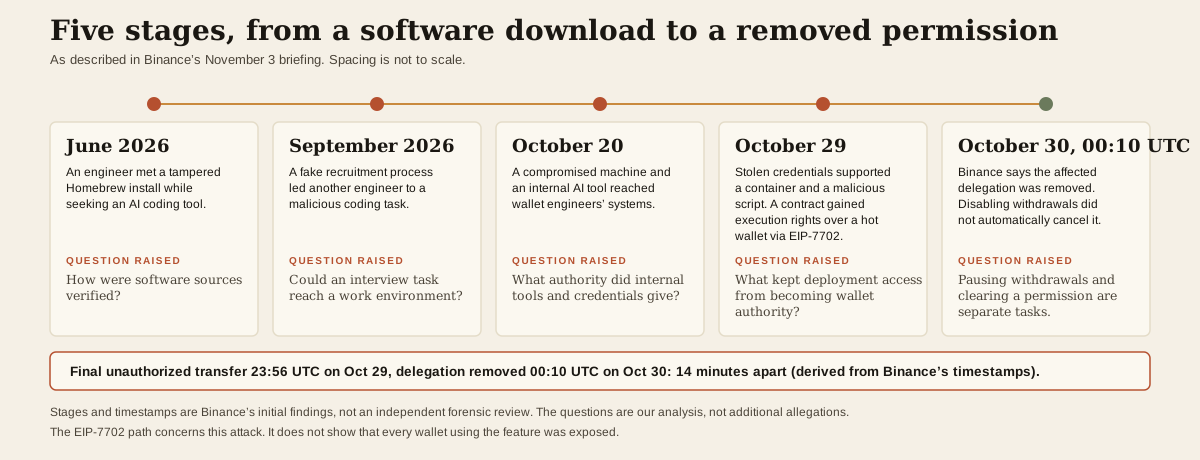
A useful incident review follows each transition. Detecting malware on one device is different from establishing whether related credentials, sessions or reachable systems remain exposed. Similarly, replacing a device does not automatically prove that every consequence of the original intrusion has been removed.
For ordinary users, the relevant lesson is practical: a video interview, a professional profile and a plausible assignment do not authenticate executable code. Keep unfamiliar software away from devices used to manage financial accounts.
How Could Funds Move Without a Confirmed Private-Key Leak?
A valid blockchain signature does not establish that the asset owner intended the transaction.
Binance’s October 30 update said it had found no evidence of wallet private keys being leaked. Blockchain researchers nevertheless observed transfers carrying valid signatures. These statements are not inherently contradictory.
There are at least two different security failures to consider. An attacker might obtain secret key material and sign independently. Alternatively, the attacker might misuse a system authorized to produce signatures while the underlying secret remains protected.
The second possibility is similar to gaining access to a payment approval service without extracting the secret it uses. Protecting the secret remains essential, but the requests reaching that service also need authorization and transaction-level controls.
TRM Labs assessed that the cross-chain activity pointed toward a compromise of hot-wallet signing infrastructure. That is a research assessment based on its observations, rather than a substitute for the exchange’s full forensic findings.
The distinction matters because “no evidence of a key leak” does not mean “no compromise of spending authority.” It describes one part of the investigation.
-- Price
What Role Did Ethereum (ETH) Permissions Play?
The incident also involved authority recorded on-chain, rather than only access inside Binance’s systems.
Binance’s latest account says the attacker used EIP-7702 to give a malicious contract execution rights over a hot wallet. The EIP-7702 specification describes a mechanism through which signed authorizations allow an account to execute delegated code.
The important implication is persistence. An internal service can stop accepting requests while a previously established on-chain permission still exists.
Binance reported that disabling withdrawals did not automatically invalidate those authorizations. Its summary places the final unauthorized transfer at 23:56 UTC on October 29 and removal of the affected delegation at 00:10 UTC on October 30.
These timestamps illustrate separate containment tasks. Stopping a user-facing withdrawal service, restricting access to a signer, and clearing an on-chain permission are not identical actions.
This is not evidence that every wallet using the same feature was compromised. The incident concerns the permissions and access involved in this attack. Users should avoid interpreting a specific exploitation path as proof that every account on a blockchain faces the same exposure.
Why Could Transfers Continue After Withdrawals Were Suspended?
A withdrawal pause is an operational control. Its effectiveness depends on which paths it actually blocks.
The following framework helps explain why stopping normal customer requests may not stop an attacker who already holds a different form of authority.
| Control Layer | What It Can Restrict | What Still Needs Verification |
|---|---|---|
| Customer withdrawal interface | New requests through the normal user flow | Whether other transaction paths remain available |
| Internal signing access | Requests reaching signing infrastructure | Previously signed transactions or authorizations |
| On-chain permissions | Execution rights already recognized by the network | Whether the relevant permission was actually removed |
| Receiving-asset controls | Movement of certain assets at identified addresses | Whether assets moved or changed form beforehand |
This is an explanatory model, not a reconstruction of every internal component at Binance.
Its value is in making containment measurable. “We shut down withdrawals” should be evaluated alongside evidence about unauthorized signing paths and existing permissions.
For users, it also separates an exchange infrastructure incident from a personal login compromise. Changing your password is useful account protection, but it does not revoke a permission held by an exchange-controlled wallet. Institutional remediation and individual account hygiene address different risks.
How Much Was Stolen, Frozen and Replenished?
Several figures describe different parts of the incident. They should not be combined as though they were one recovery total.
The table below identifies the meaning of the main figures in the sources reviewed on November 3.
| Figure | Reported Meaning | What It Does Not Establish |
|---|---|---|
| Approximately $6.34 billion | Binance’s latest stated value of affected digital assets | A final independently audited loss calculation |
| Approximately $2.85 billion | Assets Binance says were frozen or intercepted | That the same amount has been returned to Binance |
| Approximately 98% | Affected token assets Binance says it replenished | That 98% of stolen funds were recovered from the attacker |
| More than 100% of required funds set aside | Binance’s stated financial allocation to cover the loss | That every required token was already sourced or every service restored |
Earlier statements used approximately $6.3 billion for the impact and approximately $3 billion for frozen assets. Different observation times, asset prices and reconciliation can affect such figures. The sources reviewed do not provide a complete bridge between every published estimate.
Similarly, earlier recovery updates cited 90% or 95% coverage. The later initial-findings account uses 98% and references an earlier date. Readers should preserve both the statement date and its reference date rather than reconstructing a smooth daily progression that the publications do not establish.
Why Replenishment Is Different From Recovering Stolen Funds
Replenishment restores assets backing customer balances using replacement resources. Recovery returns stolen property through tracing, intervention, cooperation or another authorized process.
These activities can proceed at the same time.
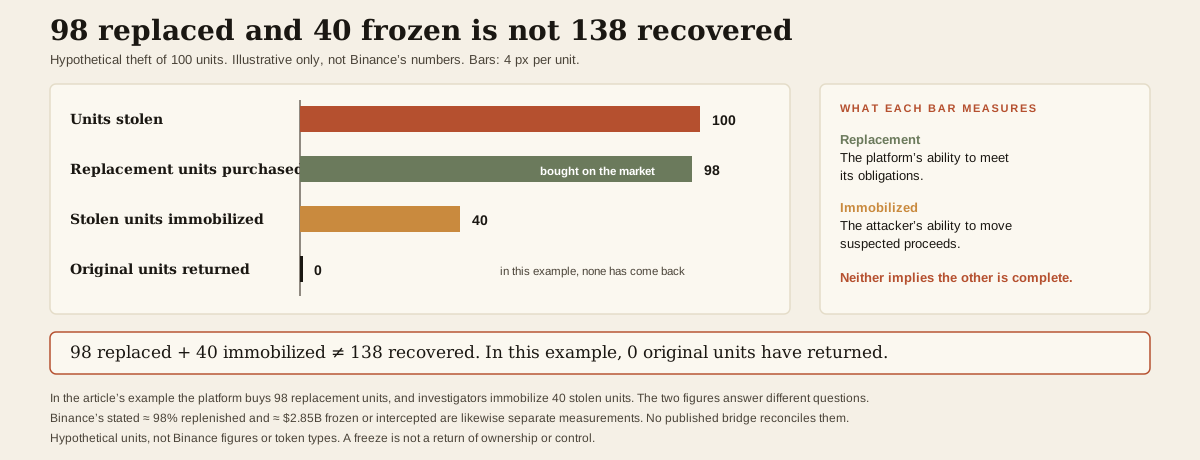
Consider a hypothetical theft of 100 units. If the platform purchases 98 replacement units, it has replenished 98 units even if none of the original units has returned. If investigators also immobilize 40 stolen units, that does not create a total of 138 recovered units.
The two measurements answer different questions. Replacement assets concern the platform’s ability to meet obligations. Immobilized assets concern the attacker’s ability to move suspected proceeds.
Binance’s earlier updates describe sourcing affected assets through market and over-the-counter channels. That is consistent with replenishment requiring the correct assets in the required quantities, rather than simply allocating a headline dollar amount.
For customers, the practical evidence includes the backing of balances and access to services. For investigators, the evidence includes custody and disposition of stolen assets. Neither track should be used to imply completion of the other.
What Does “Frozen” Mean in Practice?
A freeze can prevent further movement without returning ownership or operational control to the original holder.
Circle’s published blocklisting guidance, for example, describes restrictions on an address sending or receiving supported stablecoins in specified circumstances. That is different from reversing a completed transfer.
The Arbitrum response provides another concrete distinction. Its Security Council’s October 30 emergency-action notice says exploit-linked assets were moved into a holding address and that further movement requires an ArbitrumDAO governance vote.
That is meaningful containment. It is not, by itself, evidence of a completed return to Binance.
A useful recovery record therefore needs more than a frozen-address announcement. It should identify the asset, amount, observation time, current control, release conditions and evidence of any eventual return.
The same reasoning applies to dollars quoted against frozen tokens. A price change can alter their reported value without changing the token quantity. A precise update should say which measurement changed.
Why Following the Money Can Produce Misleading Totals
Stolen assets can move repeatedly without creating a new theft each time.
Bitquery’s November 3 investigation describes transfers, swaps and later holdings across the trails it followed. Its observation window and chain coverage differ from TRM’s earlier report, illustrating why research totals require a defined scope.
For readers, the first question is whether a number measures initial outflows, transaction activity, current holdings or restricted assets.
Lending activity adds another complication. LlamaRisk’s October 30 response records an attacker-linked position that supplied roughly $60 million in stablecoin collateral and borrowed assets worth approximately $44.6 million at the time.
The borrowed amount should not automatically be added to the original Binance theft. The position contains both assets and debt.
In a simplified example, someone holding 100 units could pledge 60 and borrow 40. Their gross assets could appear to reach 140, but a 40-unit debt remains. Repeated transfers of those assets can generate an even larger activity total without increasing the original amount stolen.
This is why a credible investigation reconciles assets, liabilities and transfers instead of adding every visible transaction.
Did Binance Users Lose Their Account Balances?
Binance says it will absorb the financial impact rather than pass the loss to users. That commitment should be assessed alongside subsequent evidence.
An account balance, the assets backing that balance and withdrawal availability are three distinct things. A platform can maintain its customer ledger while replacing assets and restoring operational services.
An unchanged balance therefore does not prove that no platform assets were stolen. Conversely, a platform-level theft does not establish that every user’s personal credentials were compromised.
If the exchange replenishes backing centrally, the process may not appear as a separate compensation credit in each customer’s account. Users should follow official instructions rather than assume that an unchanged balance requires an external claim.
If you observe unfamiliar orders, withdrawals or devices, treat those as specific account-security signals and contact official support. Do not attribute them automatically to the infrastructure incident without investigation.
Are Binance Withdrawals Fully Restored?
The latest operational announcement reviewed describes progressive restoration, not a blanket reopening of every route.
Recovery Update #6 schedules additional asset-and-network withdrawals from November 3 at 04:00 UTC. It instructs users to confirm availability in the selected withdrawal interface or official network status page.
Check your intended route directly. If you already submitted a request, distinguish the sending-side status, blockchain result and receiving-platform credit.
This section is deliberately limited to the operational consequence of the incident. A successful withdrawal is useful evidence about that transaction, but it does not establish completion of the technical investigation.
Likewise, a restricted route should be investigated using its current message. It does not, on its own, demonstrate a new theft.
What Does the Updated Proof of Reserves Show?
Binance’s November 2 update says the zero-knowledge proof for its October 31 snapshot was completed, allowing users with covered assets to perform verification.
Read the snapshot time and coverage before interpreting the result. A proof concerning specified balances at one moment is different from continuous confirmation of all assets and obligations.
The PCAOB’s investor advisory also cautions that Proof of Reserves engagements are not equivalent to financial-statement audits. Their scope can leave important questions about liabilities, asset availability and internal controls unanswered.
For this incident, reserve verification and the technical review provide complementary evidence. One concerns a defined financial snapshot. The other must explain how unauthorized authority arose and how the relevant paths were contained.
Neither should be presented as a substitute for the other.
What Should Users Check Now?
Begin with your own evidence. Open the official service directly and inspect account activity, withdrawal records and security notifications.
If something is unfamiliar, record the transaction or activity reference and contact support through the official interface. Protect your email account as well, because it may be involved in account recovery and security confirmations.
If you plan a transfer, verify the receiving instructions before submitting it. Match the asset, network, address, required identifiers and delivered amount. Do not rush into an unfamiliar route simply because another route is temporarily restricted.
For self-custody, device hygiene and signature review become particularly important. A hardware device does not make every requested approval appropriate. You still need to understand the destination and authority involved.
For platform custody, review account controls and public evidence separately. Strong personal authentication and strong institutional wallet controls serve different purposes; responsible users need to understand both.
Beware of Fake Compensation and Recovery Assistance
The aftermath of a public incident creates an opportunity for impersonators.
Binance’s security warning describes offers to accelerate withdrawals, sell priority processing, help claim compensation or move assets into supposedly protected wallets. Users should not pay an unsolicited contact to unlock access.
Distinguish a fee displayed in an official transaction flow from a private demand for a recovery payment. Also question any request to connect a separate wallet or authorize spending merely to check an exchange account’s status.
For WEEX-related communications, use the WEEX Contact Verifier to check supported contact types. It verifies WEEX-related channels; it does not authenticate representatives of another platform.
A legitimate-looking message is still a message. Navigate independently before acting on requests involving funds or credentials.
How WEEX Users Can Apply These Security Lessons
WEEX users can review available protections through Security Settings, including passkeys, authentication options, anti-phishing codes and device management.
Choose settings based on the actual options available to your account. Do not interpret an unauthenticated page or a generic illustration as a report of your personal security configuration.
For broader platform information, the WEEX Trust Center connects reserve, protection-fund, security and verification resources. Review the scope and conditions of each item rather than treating a headline figure as a guarantee.
This incident is not a basis for declaring any custody model universally safe. Platform custody places substantial responsibility on institutional systems. Self-custody places substantial responsibility on the holder’s keys, devices, backups and transaction decisions.
A useful choice starts with understanding those responsibilities and the evidence available to evaluate them.
WEEX Editorial View
The latest Binance findings show why an incident cannot be understood through a single device, headline loss or recovery percentage.
The most important security question is how an attacker’s access became authority to move assets—and which parts of that authority persisted during containment. The most important financial distinction is between replacing customer backing and recovering stolen property.
Binance’s disclosed replenishment and recovery work are material developments. They should be evaluated alongside independent review, specific remediation evidence and operational restoration, with each claim tied to its scope and date.
For users, the practical response is verification: inspect your account, navigate through official channels, understand transfer instructions and decline shortcuts offered by strangers.
FAQ
1. When Did the Binance Hack Happen?
The unauthorized outflows occurred on October 29, 2026. Binance’s initial findings describe preparatory compromises over preceding months.
2. How Did the Binance Hack Happen?
Binance describes a multistage campaign involving malicious downloads, fake recruitment, compromised devices and internal access that reached wallet-signing infrastructure. Independent review remains important.
3. Has Binance Recovered All the Stolen Funds?
The latest account says approximately 98% of affected token assets were replenished. That is different from recovering the original stolen assets. Frozen or intercepted funds also require separate treatment.
4. Does the Incident Mean Every User’s Password Was Stolen?
No. A compromise of platform wallet infrastructure does not establish that every customer’s login credentials were exposed. Investigate any suspicious activity specific to your account.
5. Do Users Need to Pay a Fee to Receive Compensation?
Do not pay unsolicited compensation, priority-processing or withdrawal-unlock demands. Follow instructions available through the official platform and contact support directly if necessary.
This content is provided for general informational purposes only and doesn't constitute financial, investment, legal, or tax advice. Any events, rewards, online promotions, or related information mentioned herein should not be considered a recommendation, solicitation, or invitation to purchase, sell, trade, or otherwise deal in any crypto assets. Crypto assets are highly volatile and may result in loss. The availability of WEEX services, products, and related events may vary by region. You are responsible for ensuring that your participation is in accordance with applicable local laws and regulations.
You may also like

Who really controls a crypto project? Inside the SEC’s new guidance

Reflections After the Binance Heist: Who Should We Trust with Our Crypto Assets?

Solana study finds wider spreads outside aggregators at five of six sampled pools

Is it theft or fraud when the coins in the wallet remain but are changed to multi-signature by someone else?

Anthropic is Frenziedly Competing for Computing Power: $895.4 Billion Commitment, Even Old Coal Plants Are Not Spared

Tom Lee sees Ethereum's 4% drop post-Binance hack as bullish sign

Ornn, a Computing Power Trading Platform, Negotiates Series A Financing, Valuation May Exceed $1 Billion

Vitalik is making private Ethereum payments without a crypto website
Comparison of Security Among Four Perpetual DEXs: Who Can Truly Enable User Self-Rescue?

Is Issuing Tokens Still Necessary for Crypto Projects Focused on Revenue?

Will the Republican Party Lose the Elections? Cryptocurrencies May Benefit...

Nvidia May Guarantee Billion-Dollar AI Data Center Debt

Pi Network rolls out 4 developer updates ahead of November summit
DeFi DNS attack hits 12 sites as Blockaid flags Step Drainer

CDI was the only refuge in October: what this reveals

Binance Attacker Accidentally Transfers $3.5 Million in Tokens to NEWT Contract Address

The Golden Age of Hackers

Polkadot OpenGov #1961: dotUSD Supply Bug and $1.3M Treasury Loss Explained

A Review of Global CEX Theft Incidents from 2014 to 2026

Hackers drain 9,400 SOL from bot wallets, and a copied key is blamed

Google Cloud Previews Institutional Crypto Key-Security Service as Custody Risks Grow
a16z Survey of 100 CISOs: Why is Cybersecurity Budget Experiencing a 'Revenge' Growth in the AI Era?
Collector Crypt CEO: The Real Threshold of Digital Card Drawing Platforms Lies in These Four Aspects
U.S. Treasury Buys $6 Billion in Bonds, Bitcoin Drops Below $80,000

French Sovereign Debt Reaches 5%, Alarming Spread with Germany

When will the next crypto bull run happen?

BlackRock and SBI Sign Memorandum to Explore Collaboration on Yen Stablecoin and Tokenized Funds

Stellar launches cross-chain messaging with ethereum through VIA Labs
Hacker Leaks Information of 40,000 Employees from the U.S. Department of Homeland Security via Okta

Best Blockchain APIs for Developers in 2026: Expert Review
Who really controls a crypto project? Inside the SEC’s new guidance
Reflections After the Binance Heist: Who Should We Trust with Our Crypto Assets?
Solana study finds wider spreads outside aggregators at five of six sampled pools
Is it theft or fraud when the coins in the wallet remain but are changed to multi-signature by someone else?
Anthropic is Frenziedly Competing for Computing Power: $895.4 Billion Commitment, Even Old Coal Plants Are Not Spared
Tom Lee sees Ethereum's 4% drop post-Binance hack as bullish sign


