
Why Did Avalanche (AVAX) Rise? What the NYSE Settlement Plan Means for AVAX Demand

 Prefer us on Google


Key Takeaways
- The NYSE announcement was a likely catalyst for the AVAX rally. After the Nov. 9 announcement, CoinMarketCap reported AVAX at $8.59, up 6.68% over 24 hours, in its Nov. 10 market update.
- Avalanche was selected for a specific job: settlement. Its technology will provide the core ledger for the clearing firm supporting a planned NYSE digital trading venue. The launch remains subject to applicable regulatory approvals
- The settlement chain is separate from Avalanche’s public C-Chain. Stocks can be issued on other networks under the proposed design, and the announcement did not disclose what asset will pay the settlement chain’s transaction fees.
- The next signal to watch is who pays fees, in what asset, and how often. The dollar value of settled stocks cannot, on its own, tell you how much AVAX the system might consume.
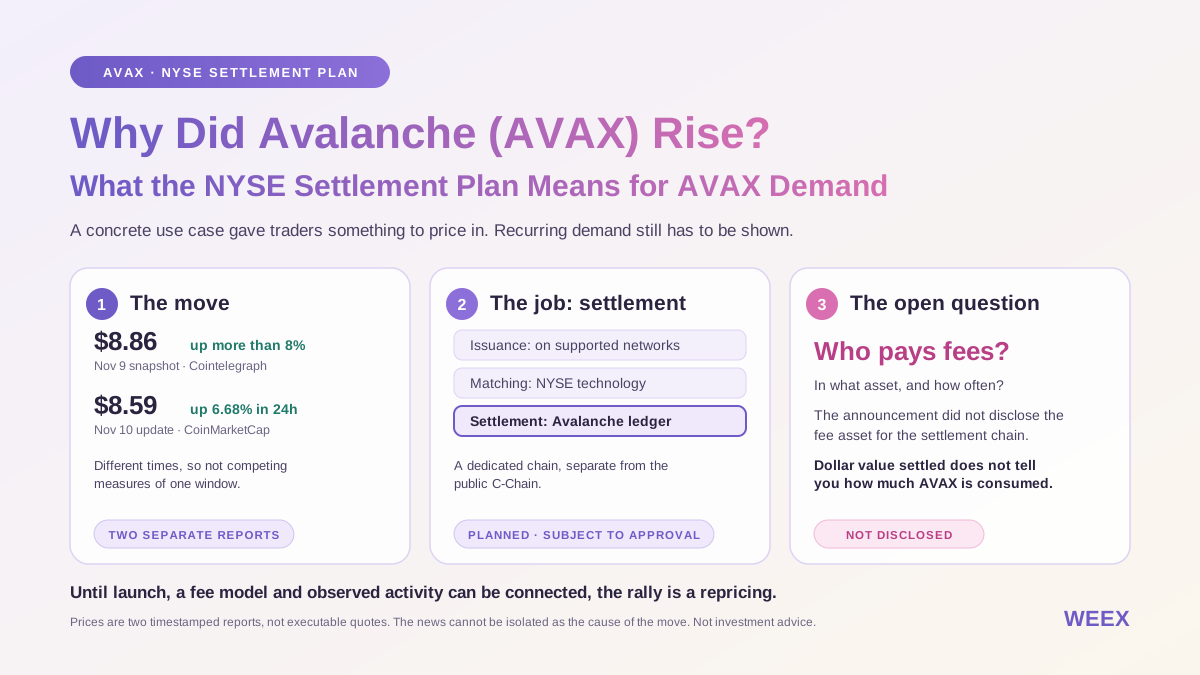
Avalanche (AVAX) rose after Ava Labs announced that its blockchain technology would support settlement for the New York Stock Exchange’s planned digital trading venue. The news gave traders a concrete institutional use case to price in. Whether that use case creates recurring demand for AVAX depends on how the dedicated settlement chain pays for transactions, how its validators operate, and how much activity the venue actually processes once it launches.
Why Did Avalanche (AVAX) Rise After the NYSE Announcement?
The announcement gave traders a reason to reassess Avalanche’s role in tokenized equities. Ava Labs named a specific part of the workflow: the core ledger used by the clearing firm for the NYSE’s planned digital alternative trading system, or ATS. Settlement is where a trade’s obligations are completed. That makes the ledger’s role more concrete than a broad announcement about exploring tokenization.
The price move was visible across several reports. Cointelegraph reported AVAX at about $8.86, up more than 8%, at its Nov. 9 snapshot. CoinMarketCap’s Nov. 10 update reported $8.59 and a 6.68% gain over the preceding 24 hours. The two reports use different observation times, so their percentages should not be treated as competing measurements of the same window. They show that AVAX rallied around the announcement; neither isolates how much of the move the news caused.
The distinction matters if you are following the rally after the headline. Traders can reprice a token as soon as they see a new use case. Recurring token demand takes longer to demonstrate: a system has to launch, process activity, and use AVAX in a way that can be measured. The rally came before that evidence.
What Will Avalanche (AVAX) Do for the NYSE’s Tokenized Stock Platform?
The announced design calls for a dedicated settlement chain built with Avalanche technology. That chain is intended to support the clearing firm behind the new venue. Reporting on the plan also indicates that NYSE matching technology will pair buy and sell orders, while the proposed venue can support equities issued across multiple blockchains. Those are three distinct jobs: issuing the stock token, matching the trade, and settling it.
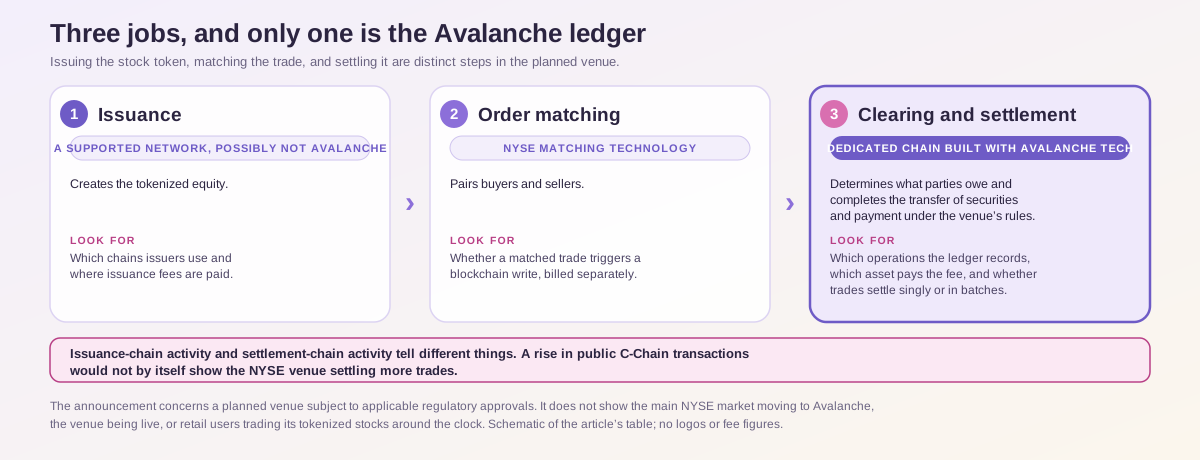
| Part of the workflow | What it does | What to look for when assessing demand for Avalanche (AVAX) |
|---|---|---|
| Issuance | Creates the tokenized representation of the equity on a supported network. | Which chains issuers use and where issuance fees are paid. |
| Order matching | Pairs buyers and sellers using the venue’s trading technology. | Whether a matched trade triggers a blockchain write, and whether that write is billed separately. |
| Clearing and settlement | Determines what parties owe and completes the transfer of securities and payment under the venue’s rules. | Which operations the dedicated ledger records, which asset pays the fee, and whether trades settle individually or in batches. |
A stock token could therefore be issued on one supported network while a trade involving it settles through the dedicated Avalanche ledger. The issuance chain’s activity and the settlement chain’s activity would tell you different things. Likewise, a rise in public C-Chain transactions would not, by itself, show that the NYSE venue was settling more trades.
The announcement concerns a planned venue. It does not establish that the main NYSE stock market is moving to Avalanche, that the new venue is live, or that retail users can already trade its tokenized stocks around the clock. The proposed 24/7 trading, clearing, and settlement model remains subject to applicable regulatory approvals.
Will NYSE Settlement Create Demand for Avalanche (AVAX)?
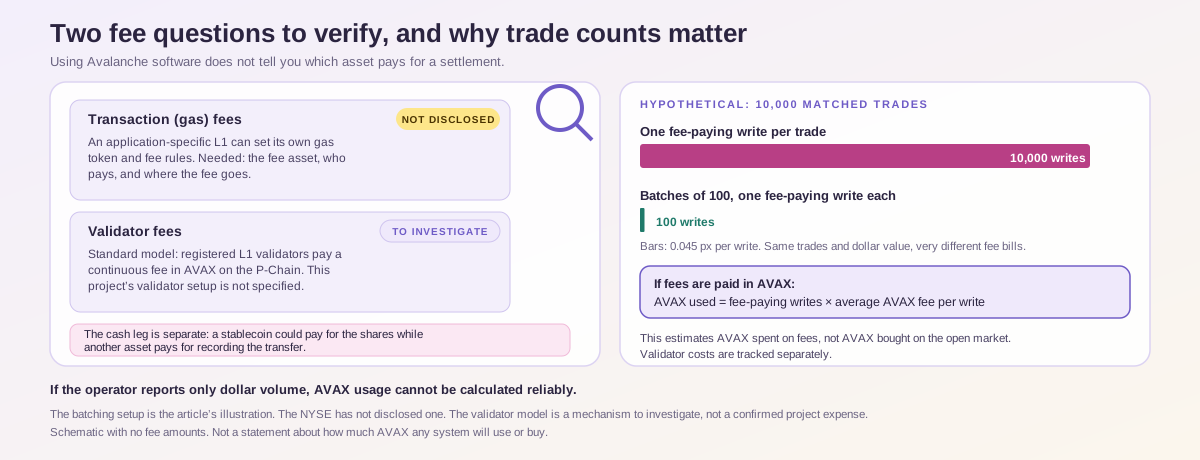
It could, but the public announcement does not establish how much AVAX the system would use, or whether it would use AVAX for each settlement. There are two separate mechanisms to check: fees for writing transactions to the dedicated chain and fees associated with operating its validators.
Transaction Fees: Which Asset Pays for a Settlement?
The public Avalanche C-Chain uses AVAX for gas. An application-specific Avalanche L1 can configure its own gas token and fee rules. That means the dedicated chain’s use of Avalanche software does not tell you which asset pays for a settlement. If the chain charges fees in AVAX, the operator or another designated party may need an AVAX balance to keep it running. If it charges in another asset or absorbs costs under a different arrangement, transaction volume would not translate into AVAX gas demand through that channel.
The cash leg is a separate question. A stablecoin could be used to pay for the shares, while AVAX or another asset pays for recording the transfer. A disclosure about the payment asset does not settle the gas question. The useful disclosure would name both assets and identify who pays each cost.
Validator Fees: Could the Chain Use AVAX Even With Different Gas?
Potentially. Under Avalanche’s standard model for registered L1 validators, those validators pay a continuous fee in AVAX on the P-Chain. If the settlement network uses that model, it could have an AVAX operating cost even if its own transactions pay gas in a different asset. The announcement does not specify the project’s validator setup, so the standard network model is a mechanism to investigate rather than a confirmed project expense. (Avalanche Builder Hub)
Why Dollar Volume Is the Wrong Starting Point
Suppose a venue processes 10,000 matched trades. If each trade produces one fee-paying settlement write, the ledger records 10,000 writes. If the venue settles them in batches of 100, and each batch produces one fee-paying write, it records 100 writes. The same trades and dollar value can produce very different fee bills. This is an illustration; the NYSE has not disclosed that batching setup.
If fees are paid in AVAX, a first estimate would be:
AVAX used for settlement fees = fee-paying settlement writes × average AVAX fee per write
Verified validator costs can be tracked separately. That estimate measures AVAX spent on fees, which is different from AVAX purchased on the open market. An operator could pay from an existing balance, buy periodically, or use another party to handle fees. The price effect would depend on how that AVAX is sourced and what happens to it after payment.
-- Price
What Would Confirm Recurring Demand for Avalanche (AVAX)?
The first milestone is regulatory clearance and a confirmed operating launch. A product announcement can establish the intended design. Launch and access details establish who can use it, what instruments are eligible, and whether the advertised trading and settlement schedule is in effect.
The second milestone is a published fee and validator model. Look for documentation that names the transaction fee asset, the fee payer, and the chain’s validator configuration. If a chain ID, explorer, or operator report is published, check that it actually covers the dedicated settlement ledger. Public C-Chain data is useful for studying activity on the C-Chain; it cannot substitute for data from a different chain.
The third milestone is observed settlement activity. The strongest evidence would pair fee-paying settlement counts with actual fees and distinguish those costs from validator fees. If the operator reports only dollar volume, you can assess how much value the venue handles, but you still cannot reliably calculate AVAX usage. And if the data is not public, the token-demand estimate should stay open until the operator discloses enough to make it testable.
How to Trade Avalanche (AVAX) on WEEX
The Avalanche (AVAX) USDT perpetual futures market on WEEX provides a way to trade AVAX price exposure where the contract is available. Before placing an order, check the contract’s live status, mark price, funding rate, order book, and estimated liquidation price for your chosen position size and margin. Funding and execution fees are separate costs. A perpetual position does not give you ownership of AVAX or rights in the NYSE project.
If your goal is to buy the token itself, use the AVAX/USDT spot market on WEEX. Check the spread and available liquidity, then choose a limit order if you want to specify the highest price you are willing to pay. Both pair pages were located, but no active AVAX-specific promotion or fee waiver was verified for this article. Check your account’s applicable rates before trading; the WEEX trading fee guide explains how spot and futures execution fees work. (Buy & sell Avalanche on WEEX)
WEEX Editorial View
The strongest takeaway from the announcement is that Avalanche has a defined role in a proposed institutional settlement system. That gives the market something concrete to follow: a dedicated ledger, an operator, and a workflow that can eventually produce measurable costs and activity.
For AVAX, the most valuable follow-up would be a technical disclosure showing which operations require AVAX, who pays for them, and how frequently they occur. A large settlement volume figure would help establish adoption. A fee breakdown would establish whether that adoption creates a recurring use for the token. Until those figures can be connected, the rally is best understood as a repricing of the opportunity.
FAQ
1. Why Did Avalanche (AVAX) Go Up?
AVAX rose after Ava Labs announced that Avalanche technology would provide the core settlement ledger for the clearing firm supporting the NYSE’s planned digital venue. The timing makes the announcement a credible catalyst, although the exact contribution of the news to the price move cannot be isolated.
2. Is the NYSE Moving All Stocks to Avalanche (AVAX)?
No. The announcement covers settlement infrastructure for a planned digital alternative trading system. It does not describe a migration of the entire NYSE stock market. The proposed design can also support equities issued on multiple blockchains.
3. Will Every NYSE Tokenized Stock Trade Burn Avalanche (AVAX)?
That has not been established. The dedicated chain’s transaction fee asset, fee destination, and batching rules have not been disclosed in the announcement. The public C-Chain’s AVAX burn rules should not be applied to the dedicated settlement chain by default.
4. Can You Trade NYSE Tokenized Stocks on Avalanche (AVAX) Now?
The announcement describes a planned venue subject to applicable regulatory approvals. It does not establish live access for retail users. Check for an official launch notice, eligible instruments, and participant requirements before assuming the venue is open.
5. Does Holding Avalanche (AVAX) Give You Rights in NYSE-Listed Stocks?
No. Holding AVAX does not give you ownership, voting rights, or dividends in an underlying stock. Those rights depend on the terms of the specific equity or tokenized security and how it is held.
This content is provided for general informational purposes only and doesn't constitute financial, investment, legal, or tax advice. Any events, rewards, online promotions, or related information mentioned herein should not be considered a recommendation, solicitation, or invitation to purchase, sell, trade, or otherwise deal in any crypto assets. Crypto assets are highly volatile and may result in loss. The availability of WEEX services, products, and related events may vary by region. You are responsible for ensuring that your participation is in accordance with applicable local laws and regulations.
You may also like

BitcoinHabebe Discusses AVA Token Market Demand and Strategic Reserves
NYSE selects Avalanche to power settlement for tokenized stock platform

SEC's Crypto New Regulation Public Comment Period Ends: How Far Are We from 'Compliant ICO'?
Chainlink, Cardano and Five Other Organizations Demand SEC to Clarify Digital Assets as Non-Securities
Is Avalanche the ‘Designated’ Tokenization Chain for ICE After a Year of Testing?
Travala to Buy Back AVA Tokens Monthly and Lock Them Permanently

The New York Stock Exchange has spent a year testing Avalanche's tokenization features
NYSE Tests Avalanche for Tokenizing Securities

WEEX Exclusive:Oracle and Adobe in Focus This Week |WEEX TradFi Daily (September 8, 2026)
Oracle and Adobe in Focus This Week |WEEX TradFi Daily (September 8, 2026)
Markets are entering a new pricing window after the U.S. holiday close, with attention shifting squarely to this week’s catalysts. Stronger August payrolls revived expectations for a more restrictive Fed path and pushed yields higher, weighing on long-duration equities. In crypto, bitcoin eased below $80,000, but continued spot ETF inflows suggest institutional demand remains supportive at lower levels. At the same time, AI meme tokens materially outperformed the broader market, showing that speculative capital is still concentrating in high-beta thematic trades. Investors are now watching GME earnings, Oracle and Adobe results, and the upcoming PPI and CPI prints for the next repricing signal.

Cashlink Adds Avalanche to Institutional Securities Infrastructure
Bitcoin Core Ends Development of HWI for Hardware Wallets

Avalanche CBO John Nahas sees opportunities despite token price decline
Avalanche Emphasizes Real-World Use Cases

Ava Labs Appoints Charlie Cooper as President and Promotes Lydia Chiu to CFO
DeFi Regulation Targets Discretion Rather Than Code: Tiger Research Analyzes SEC Statement Impact
Avalanche Stealthily Transforms into RWA Public Chain
YZi Labs invests tens of millions of dollars, CZ serves as an advisor, Genius still lacks followers
BitcoinHabebe Discusses AVA Token Market Demand and Strategic Reserves
NYSE selects Avalanche to power settlement for tokenized stock platform
SEC's Crypto New Regulation Public Comment Period Ends: How Far Are We from 'Compliant ICO'?
Chainlink, Cardano and Five Other Organizations Demand SEC to Clarify Digital Assets as Non-Securities
Is Avalanche the ‘Designated’ Tokenization Chain for ICE After a Year of Testing?
Travala to Buy Back AVA Tokens Monthly and Lock Them Permanently
Latest articles


Latest coin listings on WEEX


