
Warnings Behind 50 Authorizations: How TBC Tightens Signature Permissions

 Prefer us on Google


The EIP-7702 authorization theft incident exposes long-term permission risks, and TBC's UTXO per transaction asset control provides a new security approach.
In a single transaction, 50 accounts delegated authorization. Blockaid's review of the October 29 incident recorded that the attacker utilized a controlled signature infrastructure to issue a set of EIP-7702 authorizations with different nonces. After matching valid values, they delegated the wallet to a malicious contract. Cryptography did not fail as a result; however, the persistent permissions expanded the damage. This has made TuringBitChain (TBC)'s per-transaction asset control method a noteworthy direction in recent security discussions.
1. Permissions May Still Exist After Signing
Users often perceive a single operation as an action on the page: clicking confirm, completing a swap, leaving the website. However, under the ERC-20 approve and transferFrom mechanisms, unspent and unretracted amounts may remain in the contract. The authorized party may subsequently use the amount without requiring the holder to sign again.
This arrangement facilitates continuous interaction for applications but requires users to understand the duration and scope of permissions. Amounts can be limited, not necessarily unlimited; however, the wider the limit set and the longer it is retained, the larger the range of assets that a malicious spender or application vulnerability can potentially access. Disconnecting the wallet does not replace on-chain retraction.
The recent incident involving EIP-7702 pertains to account code delegation, which differs from token limits; ERC-2612 permit allows setting limits through signatures. A Binance report indicated that pausing regular withdrawals does not eliminate already effective malicious delegations. A stop button on the operating system cannot automatically terminate permissions in another system.
This incident also involved asset transfers across other networks, with the signature service being compromised as a crucial premise. It presents a common challenge for the entire industry: to protect keys while also limiting the powers that signatures can establish. The clearer the application design, the easier it is for users and operational teams to determine whether a request exceeds actual needs.
2. TBC Centers Transactions Around Specific Assets
TBC adopts a Bitcoin-style UTXO structure and provides a smart contract design path through TuringContract. UTXO represents assets as individually spendable outputs, allowing developers to organize transactions around specific inputs and then set corresponding spending conditions. Consequently, the asset range has clear verification objects.
The public FT SDK example demonstrates a direct path: selecting token UTXOs, specifying recipients and amounts, constructing transactions, and broadcasting after the holder's signature. The process does not require prior approval limits to be established.
No pre-authorization is needed, but a signature is still required. For such native transfers, users do not need to leave a long-term usable deduction permission just to spend this asset.
Ordinary ERC-20 direct transfers also do not require approval. Therefore, the truly valuable application comparison should examine whether interactions establish continuous permissions and how much asset coverage they entail. TBC provides a foundation for per-transaction designed permissions, allowing project teams to extend this method to their contract processes.
This will affect how wallets and products are presented. Users can first view the expenditure, receipt, and change before confirming the transaction; project parties can explain operations around specific fund changes. For teams managing community treasuries or providing payment services, a clear permission scope is also the starting point for building trust.
This method also facilitates teams in transforming product commitments into verifiable requirements: what inputs are needed for a payment, how remaining assets are returned, and whether users leave new delegations. By grounding issues in transactions, partners have a concrete basis for discussion.
3. Asset Range, Execution Results, and Ordering Constraints
Clearly define the funding range. A UTXO transaction lists the outputs to be spent. If applications organize signatures by specific operations, they can reduce reliance on long-term spender limits and facilitate partners in checking fund usage. Assets not selected as inputs do not mean they are forever safe; the key lies in whether the wallet correctly selects inputs and whether the contract genuinely restricts spending.
Malicious signatures can still cause losses, and a request may contain multiple high-value outputs. Secure products need to display complete asset changes and adopt appropriate signature isolation and audits. TBC provides a clear asset structure, and applications are responsible for transforming it into operations that users can understand and verify.
Incorporate transaction results into commitments. TBC's white paper describes contract results as content within transaction outputs, verified by nodes. Under the design where signatures fully commit related inputs and outputs, third parties cannot arbitrarily replace receiving addresses or transaction amounts while allowing the original signature to remain valid. This provides a technical basis for "clearly defining fund destinations before signing."
Developers still need to check specific signature patterns. If certain outputs are not bound, or if the contract allows for broader subsequent operations, the constraint range will differ. The results displayed to users should align with the actual signed content; this consistency needs to be verified from wallet construction all the way to contract execution.
Use dependency order to constrain specific MEV. MEV can involve transaction inclusion, exclusion, and reordering, and authorization theft is not the same risk. TBC's white paper emphasizes that UTXO contracts relying on preceding outputs have a definite sequential relationship, providing a design basis to resist specific ordering manipulations.
When transaction conditions are also bound, inserting another transaction cannot quietly rewrite the committed results. However, competitors spending related UTXOs first may cause the original transaction to fail; independent transactions may still be affected by selection, delays, or matching. Therefore, anti-frontrunning capabilities need to be combined with actual DEX verification. More explicit transaction constraints and acceptable failure handling need to be designed together.
-- Price
4. Making Security Advantages Apparent in Every Interaction
For ordinary users, the most useful security experience is understanding what changes will occur to assets with each signature. For project teams, the most valuable security capability is being able to explain how permissions are established, how they end, and how funds will be handled in exceptional circumstances. Addressing these issues in advance can reduce subsequent communication and troubleshooting burdens.
TBC's public SDK and development documentation provide access to querying, transaction construction, signing, and broadcasting. Teams can validate a complete interaction on the test network, checking inputs and outputs, fees and permission changes, and observing whether conflicting transactions and failed retries require user reconfirmation.
This practice can create demonstrable product differences: operations do not need to leave long-term deduction permissions, transaction results are easy to verify, and users can understand the reasons for failures and re-signing. Security is not just a statement upon deployment completion; it can also become an experience perceived by users every day.
For TBC, the combination of Bitcoin-style asset structure and smart contract capabilities provides the technical space to build such applications. The earlier project teams clarify fund control, the more opportunities they have to accumulate trustworthy products and a community that continuously uses them.
The case of 50 authorizations reminds us that permissions after signing also require attention. TBC's security value should manifest in reducing unnecessary long-term permissions and making the asset range and execution conditions of each transaction clearer. Incorporating this value into products is the most persuasive way to respond to recent security incidents.
Source 1 Binance Official Incident Report · 2 Blockaid Incident Review 3 ERC-20 Standard · 4 ERC-2612 Permit · 5 EIP-7702 6 TBC FT SDK · 7 TBC White Paper Page 8 · 8 Ethereum MEV Explanation · 9 TBC Development Introduction
This content is provided for general informational purposes only and doesn't constitute financial, investment, legal, or tax advice. Any events, rewards, online promotions, or related information mentioned herein should not be considered a recommendation, solicitation, or invitation to purchase, sell, trade, or otherwise deal in any crypto assets. Crypto assets are highly volatile and may result in loss. The availability of WEEX services, products, and related events may vary by region. You are responsible for ensuring that your participation is in accordance with applicable local laws and regulations.
You may also like

Interest Rates Rebound to Three-Week High, Mortgage Demand Weakens

Target's Q3 Earnings Exceed Expectations, Raises Full-Year Guidance

Mining Giant MARA's Strategic Shift: Selling 40,000 BTC for Power Plants

Emerging Markets: Over $60 Billion Flees in Two Months Amid Growing AI Crisis Fears

a16z Frontier Explores AI Agent Sector, Uncovering a New Startup Opportunity

US Judge Acquits in $25 Million Fraud Case

Why is Crypto Payment Still Not Working Even with Licenses?

SoFi Is Targeting 100 Million Products by 2030. Here’s What $10,000 Invested Today Could Be Worth if It Gets There.

CFTC Blockchain Derivatives Approval: Does It Mean You Can Trade Yet?

Genesis AI CEO States Robots Don't Need Heads

IOSG: Bitcoin Needs to Reach $250,000 to Compete with AI in Mining
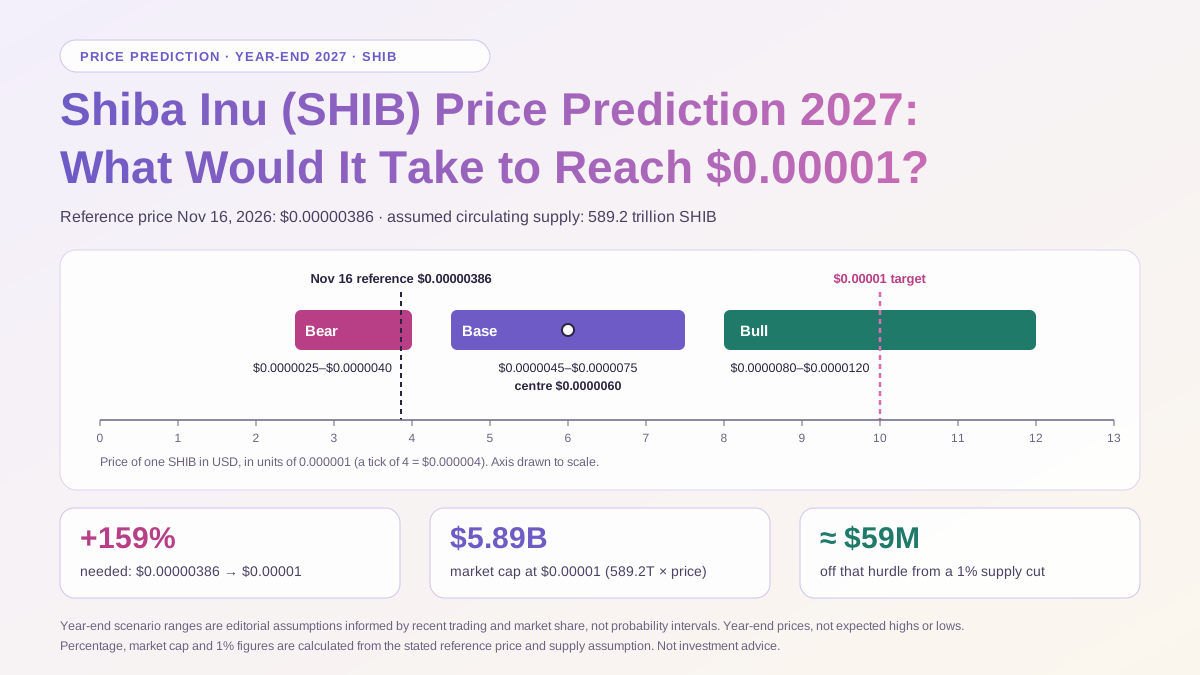
Shiba Inu (SHIB) Price Prediction 2027: What Would It Take to Reach $0.00001?
See our Shiba Inu price prediction for 2027, including the $0.000006 base estimate, the market cap needed for $0.00001, and how much burns could help.

Samsung Electronics and Apple Close to Signing Long-term DRAM Supply Agreement

WEEX P2P now supports CAD —Merchant Recruitment Now Open

Cardano Foundation seeks 25M ADA for 2027 events despite $1.2M funding gap

NVIDIA Employees Warn Board of Potential Loss of "Irreplaceable" Talent

The Arrogance and Prejudice of a16z

Unocoin Estimates $200,000 Loss as Backup-Key Finding Explains Wallet Transfers
ARTEX AI tool breaches networks in under 3 hours, FBI warns
Matt Hougan has a positive outlook on Bitcoin and altcoins

Win an iPhone 18 Pro Max on WEEX? 201 Lucky Eggs Explained

Tesla Autopilot Team Veterans Found Simulation Startup Valued at $1 Billion
CoW Swap Launches on Solana, Supporting USDC and Wrapped SOL Exchange

CoW Swap Launches Alpha Version, Supporting USDC and wSOL Exchange
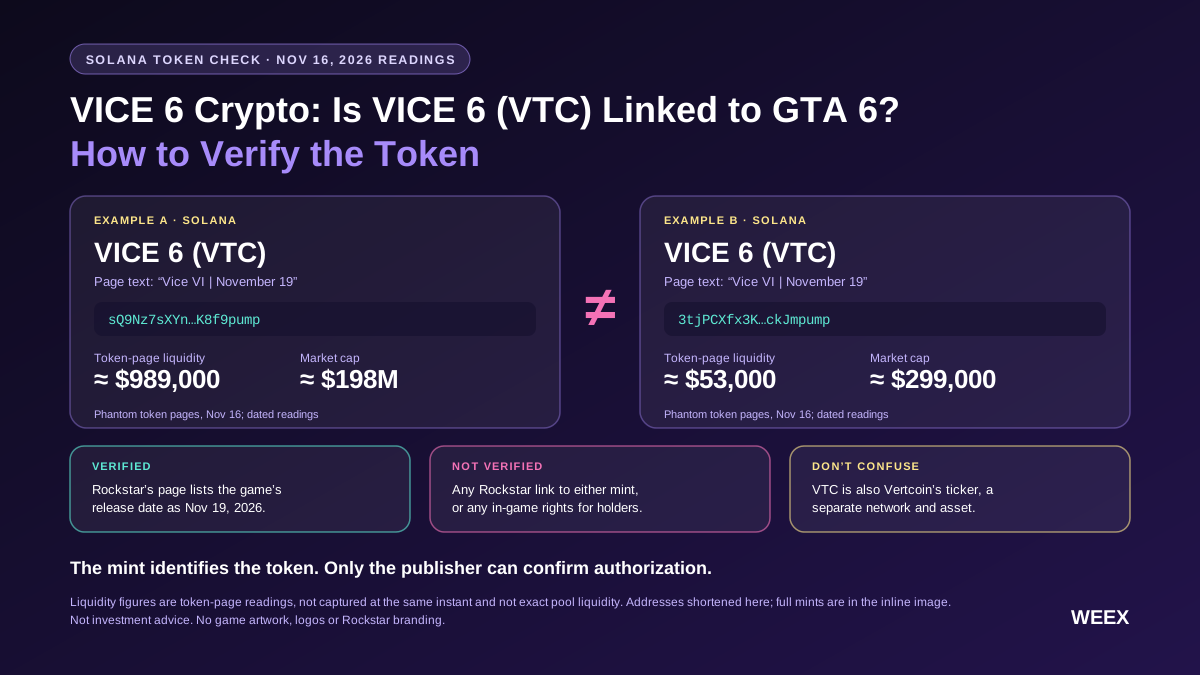
VICE 6 Crypto: Is VICE 6 (VTC) Linked to GTA 6? How to Verify the Token
Is VICE 6 crypto linked to GTA 6? Compare two Solana tokens using VTC, verify their mint and pool addresses, and see what Rockstar has confirmed.
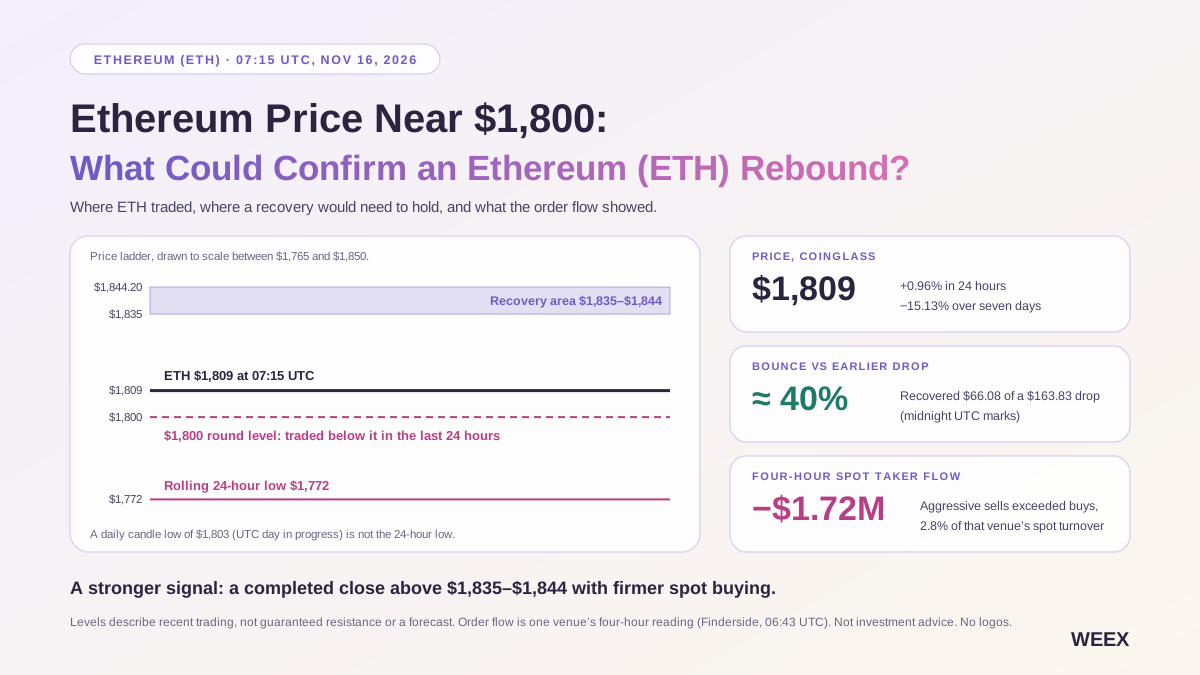
Ethereum Price Near $1,800: What Could Confirm an Ethereum (ETH) Rebound?
Ethereum traded near $1,800 on November 16. See what four-hour spot order flow, futures positioning, and Friday’s ETF flows say about an ETH rebound.
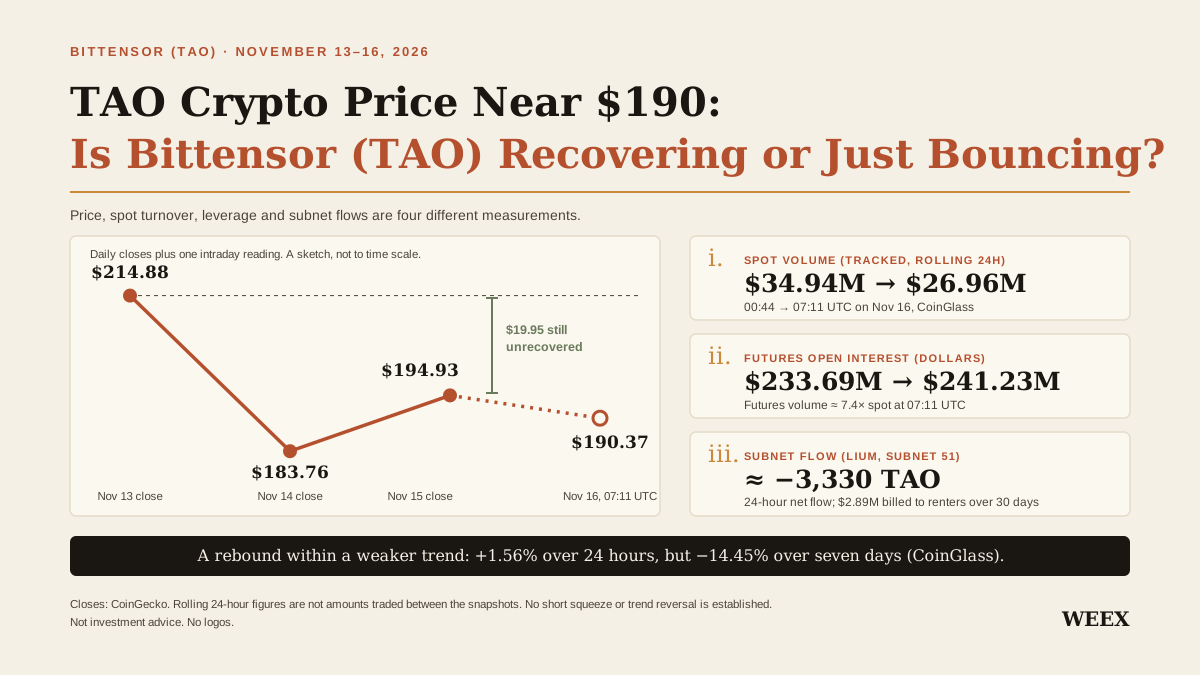
TAO Crypto Price Near $190: Is Bittensor (TAO) Recovering or Just Bouncing?
TAO bounced near $190. Compare spot volume, futures positioning, and Bittensor subnet flows to see what would confirm a more durable recovery.
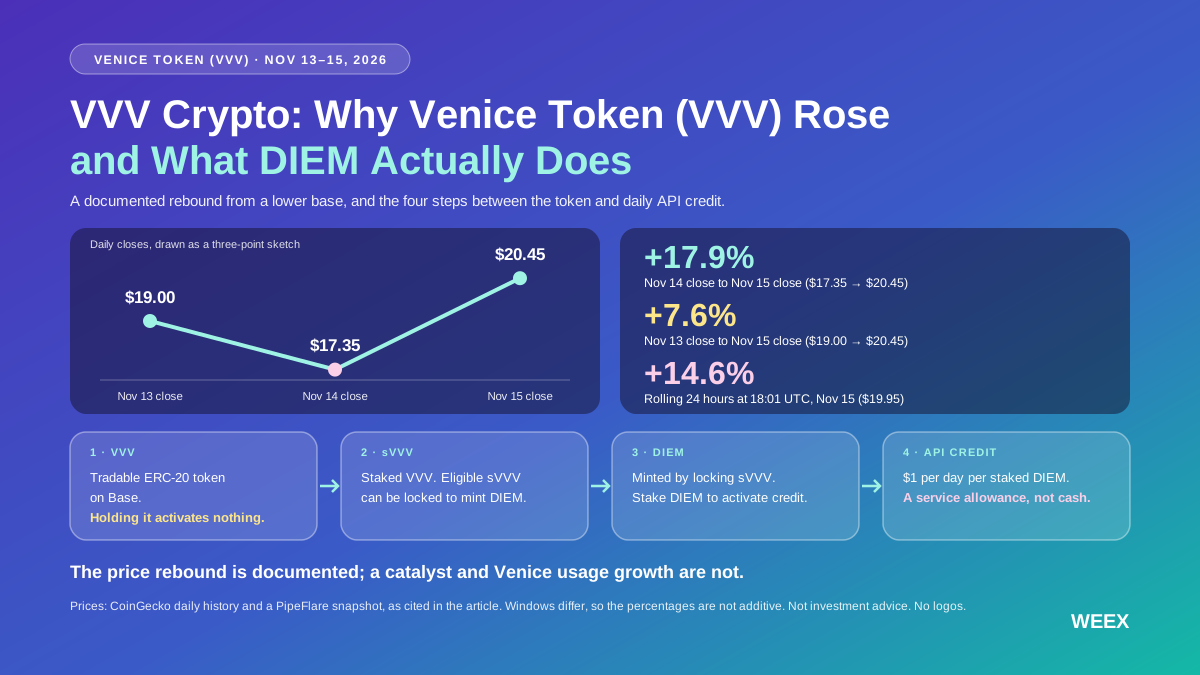
VVV Crypto: What Is Venice Token, Why Venice Token (VVV) Rose and What DIEM Actually Does
Venice Token rose about 14.6% in one November 15 snapshot. Learn what the data shows, how VVV staking works, and what DIEM’s daily API credit buys.
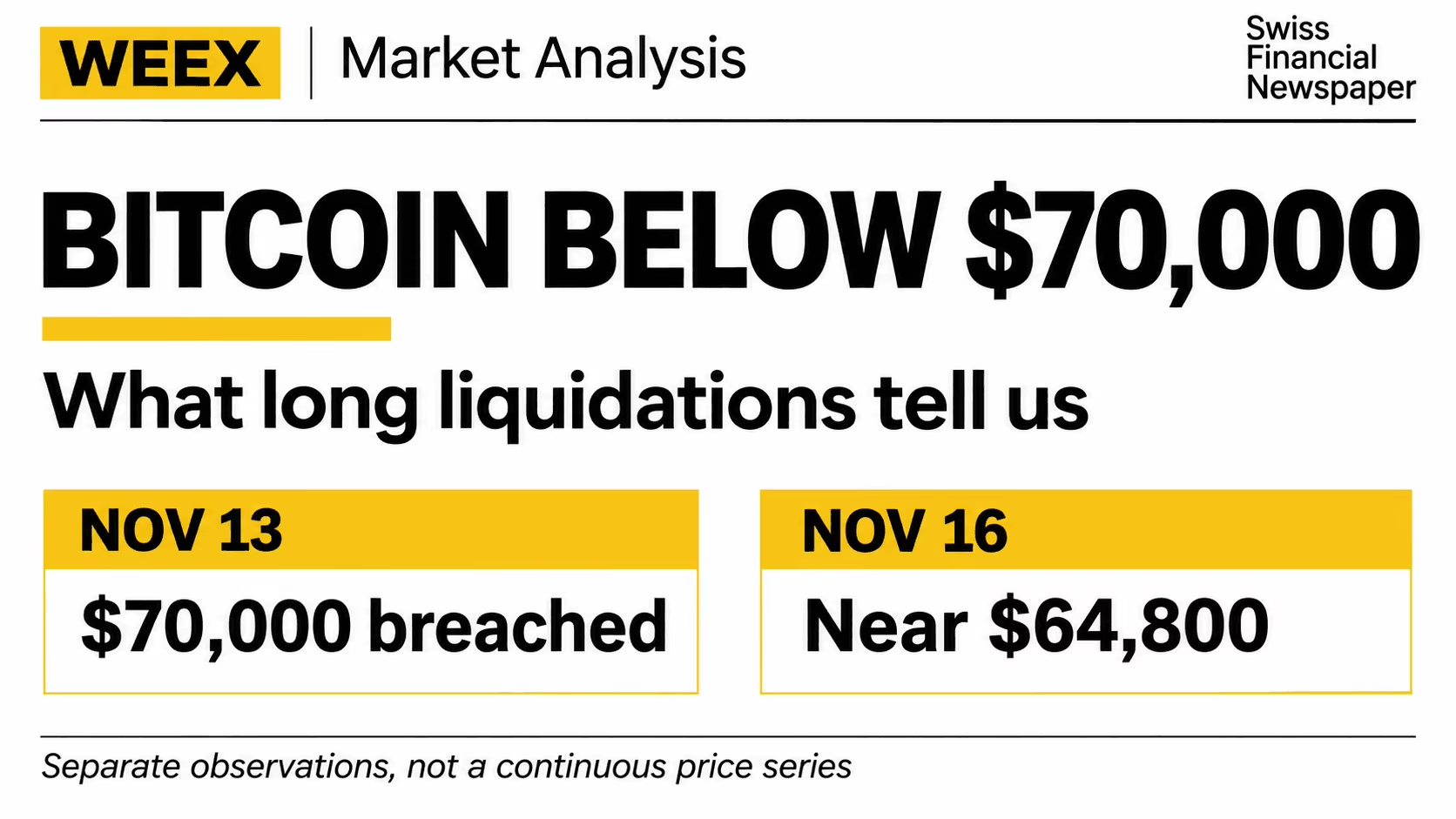
Why Did Bitcoin (BTC) Drop Below $70,000? What Long Liquidations Tell Us
See why Bitcoin fell below $70,000 on November 13, how long liquidations amplified the decline, and what to watch before calling a rebound. If you already plan to trade, you can check whether your activity qualifies for the WEEX Lucky Eggs event, scheduled to run through November 25, 2026 (UTC+8).

WEEX Lucky Eggs: How to Earn Daily Egg Cracks and Win Every Time
Learn how to earn daily WEEX Lucky Eggs from qualifying futures trading volume, check your progress, and understand what “Win Every Time” means.
Interest Rates Rebound to Three-Week High, Mortgage Demand Weakens
Target's Q3 Earnings Exceed Expectations, Raises Full-Year Guidance
Mining Giant MARA's Strategic Shift: Selling 40,000 BTC for Power Plants
Emerging Markets: Over $60 Billion Flees in Two Months Amid Growing AI Crisis Fears
a16z Frontier Explores AI Agent Sector, Uncovering a New Startup Opportunity
US Judge Acquits in $25 Million Fraud Case
Latest articles




Latest coin listings on WEEX


