
CoinGecko Acquired: Two People Started with $200, Once Valued at $500 Million

 Prefer us on Google
On April 8, 2014, a new post appeared on the Bitcointalk forum. Bitcointalk is an old forum where early Bitcoin enthusiasts gathered to chat, and new developments in the crypto space often made their debut here. The post was titled CoinGecko, authored by two young Malaysians, Bobby Ong and TM Lee.
The post listed only twenty cryptocurrencies.
CoinGecko's first post in 2014
At that time, Mt. Gox had just filed for bankruptcy. It was the most famous exchange in Bitcoin's early years. Back then, if people wanted to check cryptocurrency prices, there was basically only one place to go, called CoinMarketCap. It had launched eleven months earlier than this post, featuring a simple layout that only ranked all cryptocurrencies by market capitalization from largest to smallest.
These two young men wanted to change the ranking method. They scored each cryptocurrency based on liquidity, developer activity, and community engagement. The results were somewhat surprising; Dogecoin had the highest community engagement globally, with only moderate liquidity, yet it ranked second overall.
A small site that had just launched was suddenly shared by strangers on Reddit.
The startup cost was $200, with each of the two contributing $100 to buy a domain name and rent a server.
Twelve years later, on November 17, 2026, the same company issued an announcement titled "CoinGecko Accelerates Next Phase of Growth, Supported by the Solana Foundation." On the same day, Vibhu Norby, the Chief Product Officer of the Solana Foundation, stated on social media that the foundation now holds a majority stake in CoinGecko. The specific amount was not disclosed, but in 2025, it was reported that CoinGecko was valued at $500 million.
A company that has grown on its own for twelve years, starting from $200 to over a hundred million dollars, all began with that post listing twenty cryptocurrencies.
Twenty Cryptocurrencies
Bobby studied economics. From 2009 to 2012, he attended University College London, spending three years learning about currency, how banks operate, how interest rates are set, and how deposit insurance works.
The year he graduated, he entered a reality where negative interest rates existed.
This was never taught in textbooks. He later said in an interview that what he learned during those years seemed to have become obsolete overnight. He put down his textbooks and taught himself programming. One day, he read the Bitcoin whitepaper on Hacker News, a tech news community favored by programmers and entrepreneurs.
Two points struck him. If you hold your private keys, your money truly belongs to you; the total supply is capped at 21 million coins, and no one can print more. He once said something that represented his feelings at the time:
"The money in your bank account isn’t really yours; it’s just an IOU from the bank."
A person who studied currency for three years was thus convinced by a form of money governed by unchangeable rules.
In 2014, he and TM Lee decided to create something together. Both lived in Kuala Lumpur and had little money.
Their initial idea was to score each cryptocurrency based on its "intrinsic value." They looked at three factors: liquidity, developer interest, and community strength. For the developer aspect, they counted how many people were following a project on GitHub, how many were forking it, and how many were actively coding. For the community aspect, they checked Reddit.
At first, they only counted how many subscribers each subreddit had. A few days later, they realized something was off; subscriber counts could be purchased, and bought followers could artificially boost rankings.
So they changed their method to count how many new posts and comments were made each day in each subreddit, and how many people were online at the same time.
In May of that year, a reporter asked Bobby how the website made money. He honestly replied, "We are seriously thinking about how to make money while ensuring users feel it’s fair."
This meant they hadn’t started making money yet.
Twenty cryptocurrencies turned into forty-five after a month and a half. There was no income, no funding, and no office.
Side Business for Four Years
In the first four years of CoinGecko, the entire company consisted of just two people.
Bobby has mentioned this on several occasions, speaking calmly: "The first four years were just TM and me running things."
He was also bound by a scholarship contract that required him to work for five years after graduation. So he worked in digital marketing during the day and could only work on CoinGecko at night and on weekends.
This wasn’t a romantic part-time startup; it was simply the only way.
TM Lee later recalled that before 2017, the crypto market was tiny, and apart from coders, hardly anyone talked about it. Such a small pie couldn’t support two full-time people.
They also tried to raise funds. They spoke with several investors in Malaysia, but they didn’t understand what cryptocurrency was. Later, they went to the U.S., meeting some people at Stanford and Silicon Valley, and received more direct feedback: making money from ads? Impossible.
Bobby later reflected on this period with some helplessness: "If people in Silicon Valley couldn’t see it, then there was nothing we could do."
Ultimately, the guiding light for them was a U.S. software company called Basecamp. This company doesn’t go public or raise funds; it has a few dozen employees and thrives on subscription fees paid by users. The two took it as a model, opting not to take other people's money and to grow slowly on their own.
This decision saved them twice later on. Once from 2015 to 2016 and again from 2018 to 2019, both times during bear markets.
The bear market in the crypto industry lasts much longer than in other sectors. Venture capital funds typically provide enough money for startups to last eighteen to twenty-four months, but the crypto winter can drag on for over thirty-six months. Many companies that raised funds in 2014 began to shut down by the end of 2016. They didn’t necessarily do anything wrong; they simply ran out of money while the market hadn’t yet recovered.
CoinGecko avoided this fate. It had no investor money to burn, nor did it have investors constantly monitoring growth numbers.
Bobby has a saying he often repeats:
"Never get liquidated. Once you’re out, you’re really out."
Liquidation means losing enough in trading that your position is forcibly sold by the system, leaving no chance for recovery. Applied to a company, it means never letting cash run out. Their practice was to always keep enough money on hand to last three to four years, and even during a bull market, they wouldn’t rush to expand.
During those years, they also did two very basic things right.
One was translating the website into ten languages from the very beginning. TM Lee’s reasoning was simple: crypto enthusiasts are scattered all over the world, from Asia to America, and not doing translations would mean blocking half of the users at the door.
The other was focusing on search rankings. At that time, hardly anyone in the industry was working on search engines; whoever got their ranking up first would capture the traffic. TM Lee candidly stated, "Back then, basically anyone could build a site, do some SEO, and get ranked to gain clicks and traffic. Our early usage came from that."
In 2017, the ICO boom arrived. ICOs were the most popular method at the time, where project teams issued their own tokens and raised money directly from the public. People flooded in, website traffic surged, and ad revenue finally became enough to support the two of them. They both quit their jobs and worked full-time on CoinGecko.
The three-plus years of side business finally came to an end here.
Scoring Exchanges
After the excitement, problems followed.
During those years, exchanges were known for inflating their trading volumes. Simply put, exchanges would buy and sell among themselves to inflate their trading volumes, hoping to move up the rankings. Higher rankings made users think there was more activity, naturally attracting more users.
At that time, the rankings of exchanges were based on trading volume, which was the easiest to fake. In May 2019, CoinGecko launched a feature called Trust Score. It took a different approach to assess whether an exchange was genuinely active or just faking it, checking the depth of order books and whether real users visited the site.
It’s like evaluating a restaurant. If the owner claims to sell a thousand tables a day but the kitchen is quiet and no one is lining up outside, that thousand tables are likely fabricated.
This scoring system gave CoinGecko its own stance. Four months later, they released an upgraded version that also included the security and compliance of exchanges. In the first half of that year, several exchanges collapsed or were hacked, resulting in user losses exceeding $270 million, making everyone particularly concerned about "whether this exchange is reliable."
Pressure followed. In September 2019, Bobby recorded a podcast episode titled with a question, "Can You Trust Crypto Data Aggregators?" A data person sitting in front of a microphone had to answer, "Can you trust your data?"
This question also represented the market positioning CoinGecko had always wanted; they needed to convince the market that the data on CoinGecko was trustworthy.
In April of the same year, Forbes included the two in its 30 Under 30 Asia list in the finance and venture capital category. The profile stated that the company had an annual revenue of $3 million, tracking over 3,000 cryptocurrencies and more than 200 exchanges.
From starting with $200 to achieving an annual revenue of $3 million, they took five years.
Trust Score page
Competitors Acquired
In April 2020, Binance, the world's largest cryptocurrency exchange, announced its acquisition of CoinMarketCap for $400 million, marking Binance's largest acquisition at the time.
This event shook the entire industry; the money was secondary, but the position was crucial. CoinMarketCap was the default "price page" for the industry, referenced by exchanges, media, project teams, and retail investors for cryptocurrency prices. Now, it had been acquired by an exchange.
Bobby simply remarked, "CoinMarketCap will find it hard to maintain neutrality and independence."
Three months later, CoinMarketCap ranked Binance's own token BNB at the top of one of its lists. The public was in an uproar, and the list was quickly retracted, with the official explanation citing human error.
For CoinGecko, this presented an opportunity.
In December of that year, a tech business media outlet called The Ken released a set of data. In October, CoinGecko had 20.6 million monthly visitors, while CoinMarketCap had 29 million. The gap seemed significant, but just five months earlier, the competitor's visitors were four times that of CoinGecko. In five months, CoinGecko had narrowed the gap from four times to 1.4 times, with its traffic increasing by 135%.
The Ken refers to this competition as "David vs. Goliath," where the small player faces off against the giant. In its narrative, CoinMarketCap is described as "the 800-pound gorilla in the crypto pricing website space," while CoinGecko is the "independent challenger."
What truly solidified their position was the year 2021.
That year, DeFi exploded. DeFi can be understood as financial services moved onto the blockchain, allowing borrowing and exchanging currencies without going through banks or exchanges. Platforms like Uniswap, Curve, and Balancer launched their own tokens, but these tokens were unavailable on traditional exchanges, and mainstream price websites couldn't include them due to the lack of ready data interfaces.
CoinGecko simply went on-chain to grab the data.
This task was quite challenging at the time. There was no unified standard, each project had its own set of rules, and the data was chaotic and fast-moving, making it easy to make mistakes. They managed to pull it off. Bobby later said:
"For about six months to a year, many tokens could only be found in one place: us."
During this period of over six months, CoinGecko transformed from a "more accurate alternative" to the "only place many people could check."
In May 2021, TM Lee stated in an online event that the website had ten million active users each month, with pages opened two hundred million times monthly, tracking around seven thousand tokens. He also made a prediction that sounded like a boast at the time: there would be millions of tokens in the future.
In August, they launched GeckoTerminal, specifically to track on-chain transactions.
In seven years, a side project run by two people grew into an essential infrastructure that the entire industry relies on.
To Sell or Not to Sell
In April 2024, CoinGecko turned ten years old. They published a commemorative article listing a set of numbers. Over the decade, the total market capitalization of the entire crypto market rose from $7 billion to $2.8 trillion, a four-hundred-fold increase; the number of tokens they tracked grew from 20 to 13,000, and the number of exchanges exceeded 1,000; the company now has about 70 people, spread across Malaysia, Singapore, and the Philippines.
The article also included a very realistic statement: "Not every feature succeeded, and not every one has stood the test of time."
During those years, they continuously added features to the Trust Score. In 2023, they added reserve proof; if an exchange claims to have $10 billion in assets, they must show their wallet addresses. If they can't provide it, they won't get a perfect score. In November of the same year, they acquired a company called Zash to enhance their API capabilities.
By the end of 2025, rumors began circulating that CoinGecko was looking for buyers. Investment bank Moelis had already entered the scene, with a valuation potentially reaching $500 million.
$500 million is $100 million more than the price CoinMarketCap sold to Binance six years ago.
On January 15, 2026, Bobby released a statement that began:
"After nearly twelve years of running CoinGecko as a bootstrap company, I am often asked one question: What does the future hold?"
Bootstrap refers to not relying on external financing, earning and sustaining itself. He continued, "CoinGecko is in a strong position. We are growing, we are profitable, and as traditional finance embraces crypto, institutional demand is increasing." He added, "Like any well-managed company at this stage, we will regularly assess strategic opportunities."
Two months later, he was pressed in a podcast about when the best time to sell would be. His answer was that there is never a best time; ultimately, companies are waiting for someone to buy them, making it difficult to sell on their own.
In October 2026, the Trust Score underwent a complete overhaul, codenamed Basilisk, named after the legendary serpent monster.
Their reasoning was very practical. Most transactions are now completed in mobile apps and APIs, and the number of visitors to the website increasingly fails to indicate the actual situation. At the same time, more and more exchanges are studying how to exploit loopholes in their scoring rules, forcing the team to repeatedly intervene and correct.
Thus, they removed website traffic from the scoring criteria, changing it to directly assess trading volume and order book depth. They also added a new score called regulation. An exchange claiming to have a license does not suffice; they must verify each entry against the official registration list, and if it's not found, it won't count.
Twelve years ago, they counted how many people were talking on Reddit.
Twelve years later, they count regulatory licenses.
Trust Score regulatory page
Handing Over
A month later, on November 17, 2026, the announcement was released.
The Solana Foundation became the major shareholder. The announcement outlined three upcoming directions: data and API infrastructure, market intelligence and discovery, and trading.
The third direction is new. The announcement stated, "Exploring new capabilities to connect crypto discovery, research, and market participation." To put it plainly, a place people use to view market data will also allow direct trading in the future.
The post from twelve years ago started with twenty tokens.
On the day of the acquisition announcement, CoinGecko's homepage displayed several numbers: 21,752 tokens, 1,529 exchanges, total market capitalization of $2.248 trillion.
Skin in the game, never get liquidated.
This content is provided for general informational purposes only and doesn't constitute financial, investment, legal, or tax advice. Any events, rewards, online promotions, or related information mentioned herein should not be considered a recommendation, solicitation, or invitation to purchase, sell, trade, or otherwise deal in any crypto assets. Crypto assets are highly volatile and may result in loss. The availability of WEEX services, products, and related events may vary by region. You are responsible for ensuring that your participation is in accordance with applicable local laws and regulations.
You may also like

Home Depot Appoints Richard McPhail as New CEO, Q3 Performance Exceeds Expectations

Trump Media Creditors Can Claim $1 Billion on November 30
Hong Kong-listed firm sells 300 Bitcoin for $19.2M to fund AI deal
Dubai Airport Sees Decline in Passenger Traffic Due to Iranian Conflict, but Signs of Recovery Emerge
Micron Has Plunged 36% From Its Peak. Here’s the Price at Which I’d Buy.
stUSDT Begins Wind-Down as JustLend Plans to Remove Its Wrapped Token Market

Prediction: The Stock Market Will Make a Big Move on Nov. 18 (Hint: Nvidia Will Be the Catalyst)

Controversial AI Explainability Research Draws Attention from Sam Altman
Does an AI Trading Tool Need Permission to Place Orders on WEEX?

Why Is Bitcoin Falling? BTC Near $64K as Anthropic IPO Looms
Tether-backed Twenty One Capital buys $10M in Bitcoin as stock slides

The Next Hyperliquid Will Emerge from These 6 Companies
A $25 million MEV ruling exposes a dangerous blind spot in Wall Street’s tokenization push
A Super Empire on a Fragile Foundation: How Jensen Huang Has Controlled NVIDIA for 33 Years
Binance’s He Yi explains AI Pro transfers after hack-day withdrawal claims
Q3 Institutional Holdings Observation: Large-Cap Tech Underweight Narrowing, Funds Concentrating on AI Infrastructure, Software Stocks Neglected

Microsoft Ignite Conference Kicks Off Today! Focus on Copilot Monetization and AI Computing Returns, Can the Enterprise AI Flywheel Deliver?
How to Reassess Core Assets with 'Revenue + Narrative' After Market Crash?
Circle Expands Disparte and Walia Roles as Stablecoin Operations Scale
US Deploys Third Aircraft Carrier to the Middle East as Iran Intensifies Threats Amid Tanker Attack in the Strait of Hormuz

Wall Street Sees 'Gazumping' Phenomenon as Hedge Funds Compete for Top Talent
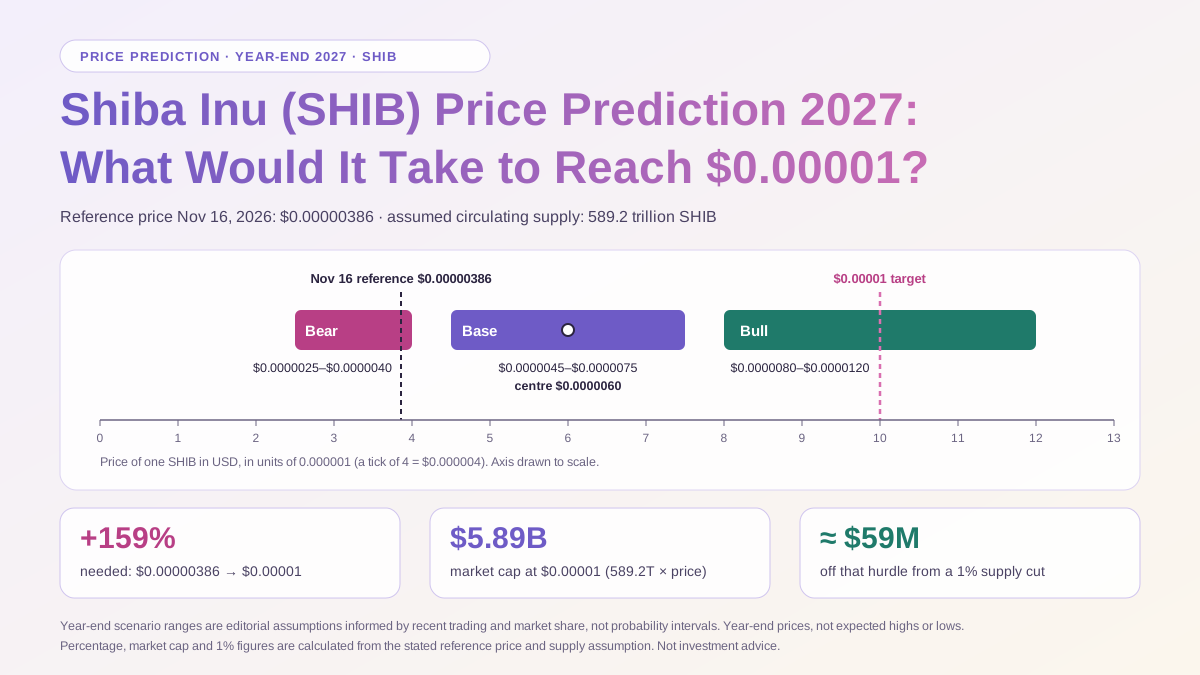
Shiba Inu (SHIB) Price Prediction 2027: What Would It Take to Reach $0.00001?
See our Shiba Inu price prediction for 2027, including the $0.000006 base estimate, the market cap needed for $0.00001, and how much burns could help.
Huya's Q3 2026 Financial Report: Operating Profit Turns Positive for the First Time in Nearly Four Years, Live Streaming and Game-Related Services Continue to Improve Efficiency

Aave Labs Reports: A 97-Person Team Supporting What Kind of DeFi Business?

Prediction: Anthropic Will Have a Successful IPO but Then the Stock Will Trade Like SpaceX

Intesa Sanpaolo raises XRP and Solana ETF holdings, cuts Bitcoin and Ethereum

Why Are Tokenized Stocks Seeing Strong Buying Pressure While Prices Keep Falling?

Report: Israel Uploads Millions of Photos to Amazon's Facial Recognition Platform to Track Palestinians

WEEX P2P now supports CAD —Merchant Recruitment Now Open
Cardano Foundation seeks 25M ADA for 2027 events despite $1.2M funding gap
Home Depot Appoints Richard McPhail as New CEO, Q3 Performance Exceeds Expectations
Trump Media Creditors Can Claim $1 Billion on November 30
Hong Kong-listed firm sells 300 Bitcoin for $19.2M to fund AI deal
Dubai Airport Sees Decline in Passenger Traffic Due to Iranian Conflict, but Signs of Recovery Emerge
Micron Has Plunged 36% From Its Peak. Here’s the Price at Which I’d Buy.
stUSDT Begins Wind-Down as JustLend Plans to Remove Its Wrapped Token Market
Latest articles
Latest coin listings on WEEX


