
A Super Empire on a Fragile Foundation: How Jensen Huang Has Controlled NVIDIA for 33 Years

 Prefer us on Google
On the morning of November 12, 2026, NVIDIA officially announced that Jensen Huang has resigned from his positions as President, CEO, and Director, effective immediately.
The announcement did not specify the reason for Huang's departure, nor did it include any statement from Huang himself; the only mention of him was a line thanking him for his "immeasurable contributions to the company and the industry."
Three days before the official announcement, the U.S. prediction market Polymarket launched a betting line on "NVIDIA's next CEO," with implied odds for Kress reaching as high as 45%.
As of the time of writing, this betting line has seen over $4 million in transactions, with a total of 25 options, all of which have odds below 20%. At this moment, Kress, who is serving as NVIDIA's interim CEO, has seen his odds drop to 9%, even lower than the odds of Huang returning as CEO.
The chaotic betting reflects the current power struggle left by Huang's departure: various accusations against Huang and NVIDIA have yet to enter a more specific investigation or review process; NVIDIA has long lacked a corresponding second-in-command; and NVIDIA happens to be the most important technology company in the world, bar none.
Stephen Witt and Tae Kim published The Thinking Machine and The Nvidia Way around 2024. Both books focus on Huang and NVIDIA, but the former emphasizes Huang's personal perspective timeline, while the latter focuses more on NVIDIA's management and business characteristics.
Witt wrote a now-meaningful observation in his book: NVIDIA's business situation is akin to placing a massive, GDP-level bet solely on the then 61-year-old Jensen Huang.
This potential crisis did not explode in the following two years; on the contrary, as the global AI wave transitioned from large model training to AI application deployment and infrastructure construction, NVIDIA, with its absolute dominance in GPU computing hardware, software platforms, and ecosystems, saw significant growth in performance and profits. NVIDIA's market value soared from around $3.5 trillion at the end of 2024 to a peak of $5.26 trillion on October 6, 2026, until Huang unexpectedly exited in a surprising manner.
What will NVIDIA and the AI industry lose without Huang? Until the event is completely over, no one can calculate this.
However, over the past 33 years, he has used his own methods to gain and maintain control of the company; the relationship that was once so solid will now be painful to sever.
NVIDIA's Non-Equity-Based Rule
In Silicon Valley's leading tech companies, it has been common to amplify founders' control through a structure of "small economic shares, large voting rights."
Google's parent company Alphabet's Class B shares account for only 6.9% of the circulating capital but hold 58.9% of the voting rights. The combined voting rights of Page and Brin total 52.7%, and although they no longer participate in daily operations, they remain a decisive force; the largest external shareholder, BlackRock, has only 2.5% voting rights. Anthropic's S-1 submitted on October 26 shows that the seven co-founders, including the Amodei siblings, hold about 10% of economic shares but possess a single Class F share through a "founder limited liability company," directly taking 50.1% of the voting rights.
In contrast, when Huang resigned, he held 3.58% of NVIDIA's shares, with no multi-layered equity or any mechanism to amplify voting rights, meaning Huang's voting proportion was only 3.58%.
His low shareholding ratio has a long history: when the company was registered in 1993, the three founders—Huang, Priem, and Malachowski—each contributed $200 in cash to buy their shares, each taking one-third. By the time of the IPO in 1999, Huang's shareholding had been diluted to 7.9%. Over NVIDIA's 27 years of public listing, continuous stock expansions further diluted Huang's shares to 3.58%. The stocks Huang cashed out were all new shares awarded by the board over the years, totaling only $2.9 billion, less than a fraction of his total share value.
Among NVIDIA's other shareholders, the top two external shareholders are passive index funds, Vanguard and BlackRock, holding 7.31% and 7.43%, respectively, and they hold shares according to index weight without intervening in company decisions. However, the total shareholding of all directors and executives is 3.94%, already surpassing Huang's 3.58%.
NVIDIA's board of directors has not set up common "defensive mechanisms," such as limiting the number of board members that can be replaced each year or classifying the board into groups. All directors are collectively elected at the annual shareholders' meeting each year, with a term of one year. There is no absolute veto power for founders in the system. Shareholders can completely replace the entire board at once, and the board can vote to replace the CEO in one go, processes that can be legally completed in a short time.
It is precisely on such a loose "foundation" that Huang has been the sole helmsman for 33 years.
In October 2025, NVIDIA's internal management list was first exposed by the media, revealing that Huang had a total of 36 direct subordinates across seven functional areas: strategy, hardware, software, AI, public relations, and networking, plus one executive assistant. The hardware team, with 9 members, accounted for a quarter, while AI and autonomous driving had 7 members, and public relations had 3. The titles of these individuals were mainly Executive Vice Presidents, Senior Vice Presidents, and Vice Presidents, with the CFO, CTO, and CIO also holding the title of Executive Vice President. The core all converged on Huang.
In a podcast in January this year, Huang casually updated the number of "direct reports" and also shared his thoughts on himself and the future CEO of the company.
Bloomberg: So who will be the next CEO of the company?
Huang: "There will not be anyone exactly like me. When I founded NVIDIA in 1993, I knew nothing about how to be a CEO, how to strategize, how to create products, or how to start an industry; all of this was learned and practiced by me over thirty-three years. Moreover, NVIDIA is one of my children, and I care for it like a child; others cannot have that direct emotional connection. But I believe the company does not lack talent internally; I currently have about 60 direct reports, many of whom are qualified to be world-class CEOs at other companies. I also continuously share my decision-making with them, including reasoning, successes, setbacks, challenges, and adversities. In my view, NVIDIA can currently be said to have 61 CEOs."
The "61 CEOs" Huang mentioned does not refer to those who can immediately take over for him. Instead, it is more about the qualifications of candidates. In another Q&A, he limited the criteria for the next CEO to "earning it themselves."
Bloomberg: Your son and daughter are both at NVIDIA, and your son-in-law manages the robotics business. There are claims that your daughter is in the line of succession; is that true?
Huang: "First of all, I will not hand this position to my son or daughter; they must earn it themselves. It is a very hard job that requires many sacrifices. What I truly hope is that the next CEO of the company is already within the company. Hopefully, 20 years from now, I will still be healthy and able to keep NVIDIA in its current position. Of course, the next CEO must also earn it themselves."
Huang means that the premise for succession is that someone can replace him or even surpass him, rather than letting him choose someone to pass the baton to. But the difficulty of this task is akin to climbing to the sky.
In The Nvidia Way, Kim recorded Huang's sharing of his underlying logic for corporate governance: the traditional company's pyramid structure, with top executives, multiple layers of middle management, and frontline employees, is, in his view, contrary to fostering excellence. He transformed NVIDIA into a computer-like structure: the pyramid was flattened into a short cylinder. The company is built according to a computational stack, where those best at running a particular layer are responsible for that layer, regardless of title or position.
In Huang's own words, "mission is the boss."
The logic is to first clarify what the mission is and then connect the best skills, teams, and resources to it. Following this logic, NVIDIA has no business units. Sales, engineering, and operations are centralized by function, and talent is a public pool; when projects come in, teams are formed temporarily. Each project designates a "captain" who reports directly to Huang.
He hardly holds one-on-one meetings; first, scheduling them separately would slow everyone down; second, discussing behind closed doors deprives junior employees of the opportunity to listen. Scenes that are hard to see in other companies often occur at NVIDIA's headquarters.
In a podcast interview in October 2024, Huang casually mentioned a robotics meeting he had just finished a few hours earlier: new graduates, three vice presidents, and two executive team members were present, and they made choices together on the spot.
During each quarterly review, Huang also gathers hundreds of business leaders for a meeting, without using PPT, explaining the business on a whiteboard. Everyone present can stand up to challenge the underlying logic of the business, right up to strategic decisions. Huang will also be present, asking detailed questions to the person standing at the whiteboard, often requiring a second whiteboard to clarify the answers.
In NVIDIA's headquarters, dozens of meeting rooms have whiteboards on their walls. The most important one is Huang's dedicated meeting room, which has no nameplate or special decorations, but the content written with whiteboard markers is denser than in other meeting rooms.
The whiteboard mainly communicates business strategy, while internal reporting is done through another special method: each employee regularly sends a Top 5 email, detailing the five most important things at hand, sent directly to the team and executives, which Huang reads about 100 emails a day.
Many changes in the market can be seen by frontline employees before Huang and the executive team; in Huang's own words, "Anyone can catch obvious trends; I want to catch them before they become obvious."
This email system is a result of NVIDIA's rapid expansion. When the company was small, with dozens of people, Huang could directly converse with employees at all levels; by 2010, when the number of employees rose to 5,700 and offices expanded to North America, Europe, and Asia, Huang found it impossible to consistently address everyone, so he began implementing the email system.
This direct inquiry that penetrates levels has extended all the way to new business lines across the ocean.
From 2015 to 2020, Jia Peng, who was the first employee of NVIDIA's China autonomous driving team, recalled to Late Point that everyone had to write Top 5 emails every week, and Huang would personally reply to some of them. Jia's email was also selected, and when discussing the China autonomous driving business, Huang was very strict, directly asking, "Why hasn't it gone into mass production? Why is it still in demo?" and would specifically inquire whether the issue was with chips, hardware, or software design.
In Kim's book, the recollections of Priem, NVIDIA's global operations head, are recorded. This global operations head discovered that "evening meetings" are the norm rather than the exception after joining NVIDIA. He began working on weekends and was forced to participate in a conference call on Christmas Eve, discussing a sales gap and how to recover the business. "There is no segment of personal time that truly belongs to oneself." However, this requirement applies to everyone, from frontline employees all the way up to Huang himself, making sacrifice easier; in Priem's words, the atmosphere of dedication and struggle resonates throughout the organization.
Jensen Huang himself is the best example. Jia Peng remembers that Huang is extremely energetic, stating internally that he wakes up every day around four or five in the morning to start reading emails or papers; once, he whimsically measured the temperature of his and his wife's foreheads and found his to be one degree higher, indicating that his brain was operating at high speed.
On Sundays, he extends the time he spends reading the Top 5 emails, usually accompanied by a glass of his favorite single malt Scotch whisky, Highland Park. In Huang's own words, this is the "fun" he finds for himself.
Huang has mentioned more than once that Nvidia's success has little to do with intelligence or genius, but rather relies on hard work and resilience. Kim later summarized this: the only requirement for everyone in this job, including Huang himself, is "pure will."
How Nvidia's Technical Direction is Determined
Exceptional willpower gives Huang the courage to invest, and what elevates that courage is his grasp of the key technologies, products, and milestones for the company's development.
Starting in 2002, more and more scientists began using GPUs for scientific computing. From simulating complex natural phenomena like fluid motion and atmospheric clouds to understanding protein folding, pricing stock options, and reconstructing MRI images, the reason is straightforward: GPU computing is much faster than CPU computing. However, the biggest challenge is that scientists' programs must be "translated" into complex graphical functions, disguised as some game to run.
At that time, Nvidia's chief scientist urged Huang: the lead in fixed-function graphics would eventually be swallowed by Intel, making a standalone graphics card unnecessary; enabling GPUs to perform general computing would one day open up markets beyond gaming.
With the direction set, a new architecture was secretly developed starting around 2004, and launched in November 2006, embedded across all GPU products with CUDA capabilities. The forced complexity in hardware architecture made Nvidia's product costs higher than its competitor AMD. Huang later admitted, "CUDA added a lot of costs to our chips, making our gross margin go from bad to worse."
Losing money did not stop Nvidia from continuing to invest; on the contrary, Nvidia kept exploring the idea of hardware integration, continuously iterating each generation of GPU microarchitecture while enhancing CUDA's software capabilities. By 2016, the explosion of deep learning truly supported Nvidia, with CUDA updated to 8.0, and cumulative investments in software and hardware reportedly surpassing billions of dollars.
Due to CUDA, an early money-draining beast, Nvidia and Huang faced direct questioning from major shareholders: the hedge fund Starboard Value directly wrote, believing that "Huang is leading the company to a dead end. Instead of investing money in CUDA, it would be better to distribute dividends to shareholders to boost stock prices."
Fast forward 20 years, CUDA has become an extremely complex software ecosystem; even though Nvidia's hardware complexity has increased by several orders of magnitude, CUDA remains a key software strength. Almost every dollar of Nvidia's revenue has a component of CUDA.
Huang does not like to compare CUDA to a moat; in his view, "that’s building things around a castle." He prefers the term "network," allowing more people to share in the success of the final market.
Sequoia Capital and Sutter Hill Ventures, as the first investors in Nvidia, had project leaders who once told Witt: "Typically, a CEO needs to listen to customer feedback, but in the computer field, that’s a huge mistake because customers have no idea what technology can achieve. From the very beginning, Huang has been a world-class engineer capable of seeing various possibilities."
Huang has done things like CUDA more than once at Nvidia; another typical example is the acquisition of Mellanox.
Mellanox is an Israeli company founded in 1999, known for its InfiniBand standard, becoming an industry leader in high-speed networking for data centers and supercomputers; however, it has heavy R&D investments and thin profit margins. In September 2018, Mellanox was put up for sale, with potential buyers expanding to seven. Huang initially did not think about this matter and only joined the bidding in October.
The battle eventually narrowed down to three: Nvidia, Intel, and Xilinx, with competitors capping at about $122.50 per share. Huang bid $125 and won with a full cash offer of $6.9 billion on March 7, 2019. By 2020, Nvidia had added 3,000 Israeli employees, and the company was renamed "Nvidia Israel."
Why buy? Huang provided two reasons on the Acquired podcast. First, the future of computing is data centers, and the CPUs and GPUs used by various data centers are quite similar; what differentiates them is the network, the infrastructure, and how computing is distributed. Second, cloud computing stacks many users onto one machine, while AI is the opposite, with a training task spread across millions of processors. "This is almost a massive inversion," requiring a network that does not follow the Ethernet route, making supercomputing network methods ideal.
The benefits are evidenced by numbers. In May 2024, Nvidia disclosed that the original Mellanox business had quarterly revenues of $3.2 billion, more than seven times its last quarter as an independent company; by fiscal year 2026, Nvidia's networking business annual revenue exceeded $31 billion.
This deal transformed Nvidia from merely selling chips to having a nervous system: GPUs handle calculations, while the network enables thousands of chips to work together as one computer. As for bottlenecks, after computation speed and transmission speed, what remains increasingly is how much power data centers can access.
In May 2023, the night before Nvidia released its earnings report, the guidance for the next quarter's revenue was $11 billion, exceeding Wall Street's expectations by 50%. When Nasdaq opened, the stock price surged about 24% in a single day, adding approximately $200 billion to its market value, setting a record for US-listed companies at that time, with a closing market value surpassing that of Walmart and ExxonMobil combined. A widely circulated comment from a Wall Street analyst stated: "The war in the AI field has begun, and Nvidia is the only arms dealer."
Of course, Huang is not a 100% successful "transcender." The Tegra mobile chip did not succeed, missing the smartphone era. In hindsight, a GPU manufacturer had little chance of winning: mobile chips must be tied to baseband communication, which is Qualcomm's stronghold. The $40 billion acquisition of Arm was blocked by regulators, with the FTC stating that Nvidia was already using Arm architecture for its products; accepting this neutral platform would mean holding sensitive competitive information from licensing customers, indeed posing a monopoly risk.
Kim summarized Huang's ability to identify key content: Huang does not possess a special vision to predict when AI will take off; rather, before seeing significant signals, the company does not make reckless bets, and once they do see them, they pounce with unmatched speed and thoroughness. The hardest part lies precisely in this "pounce".
In a March 2024 interview at Stanford Business School, Huang publicly elaborated on an internal Nvidia business metric called EIOFS (Early Indicators of Future Success). The logic of this metric is not complex; when exploring unknown markets from 0 to 1, where current revenues and profits cannot be calculated, three signals are considered: whether the problem being solved is significant enough, whether key technologies have made breakthroughs, and whether early developers recognize it. If others can do it, let them; focus on those things that would not happen without Nvidia, which are both difficult and important.
Huang's Fury
Regarding the daily management within Nvidia, Witt and Kim both emphasized another side of Huang in their books: The Huang Rage.
The scenario typically unfolds like this: Huang explains his viewpoint for the first time in a friendly manner, moving from premise to conclusion; once you open your mouth to refute, he will publicly berate you mercilessly.
Witt detailed the entire process of operations chief Xia Kuisite encountering Huang's fury in 2007.
At that time, Xia was in charge of Nvidia's global supplier network. In her first year, Huang asked her to shorten the lead time for deliveries from a Taiwanese packaging factory downstream of TSMC. She believed this was impossible, as Taiwan is known for its efficiency, and she did not believe the process could be compressed further. The two argued about the difference between lead time and production cycle.
The dispute occurred in a conference room, with senior executives opening their laptops and sitting around the conference table. She pushed back directly: "You don’t understand how this works at all." Her inbox soon received a message from a colleague: "Stop talking! Just let him speak." It was too late; Huang was furious, publicly cursing her, saying she didn’t know how to do her job: "I thought you were an operations person; you are not; you don’t understand operations!"
Xia was also furious and, in a fit of anger, announced she would fly to Taiwan to get data directly from the supplier to prove she was right. She spent a week understanding the unit economics of this backend supplier, finding that the lead time from order receipt to shipment completion was three weeks; the total labor time required to package the chips, which is the production cycle, was only thirty-six hours. Theoretically, the lead time could be compressed to match the production cycle, but the cost per package would rise from $8 to $1,000.
Xia returned to Nvidia with the results, fully prepared to be consumed by Huang's fury, but the latter did not get angry at all, simply saying, "This is the correct answer."
Later, Xia created similar cost detail sheets for hundreds of suppliers in Nvidia's supply chain, compressing production cycles from months to weeks. She became a wizard of operations within the company, and by 2024, the value of her Nvidia stock exceeded $200 million.
Insiders have provided another interpretation of this rage. Chief Scientist Kirk believes it is even a motivational tool: "You might think he is just losing his temper, but I believe it is deliberate and indeed effective. He doesn’t just explode at someone in the hallway for no reason... This lesson is certainly one they will never forget."
Returning to reality, many Nvidia engineers have become wealthy yet still persist in solving various technical problems daily. A significant part of their motivation comes from their admiration and obedience to Huang. Witt even stated directly at the beginning of his book: "If Huang saw an opportunity from the glass window of a skyscraper and jumped down, I believe Nvidia employees would jump down with him."
In July 2025, during the Silicon Valley investor show All-In, Huang revealed that "every employee's compensation suggestions are sent to him."
The host then mentioned a rumor about Nvidia, saying Huang carries a small bag of options and hands them out to those who perform well. Huang replied, "Yes, I have them in my pocket right now."
Kim described a mechanism called "Top Contributors" (TC) in his book: managers nominate, and Huang personally reviews the list, issuing one-time special stock rewards. Approved employees receive an executive email, copied to Huang himself, with the subject line "Special Grant," authorizing the issuance of stock "to recognize your extraordinary contributions," and detailing the reasons for the reward.
Chris Diskin, a sales executive who helped Nvidia secure the Microsoft Xbox deal, saw his stock grant double within months of joining in 2000. He thanked Huang and added, "If you really think I’m good, it should be more than double." When he later saw his grant, it was indeed more than double.
Willpower, the fusion of thought, and then the addition of domineering punishment and reward have ultimately created a large army that follows Jensen Huang's direction, repeatedly generating industry-level workplace data.
In 2025, NVIDIA's employee turnover rate was less than 2.5%, with the turnover rate for employees in mainland China being only 0.9%, while the average turnover rate in the technology semiconductor industry was 16.4%. In August 2026, Glassdoor restarted its "Best CEO" selection, where Jensen Huang received a 99% employee approval rating, ranking first among the 50 listed CEOs; he also topped the "Best Managed Companies" list in the U.S. for 2025, with a support rate of 98%. WIRED reported on November 12 that a post in NVIDIA's internal suggestion box urging the board to listen to employee opinions before taking action had received over 1,600 comments, with one highly praised comment stating: "If you believe in this mission, bring the boss back."
On the morning of November 16, an open letter to the board on the petition site "Stand with Jensen" garnered over 100,000 signatures, including 5,248 self-reported current NVIDIA employees, accounting for about 12% of the total workforce, demanding that his position be restored before the results of an independent investigation are released, and calling for transparency regarding the scope, independence, and timeline of the investigation.
Jensen Huang and NVIDIA's "Critical Moment"
A well-known investor shared his judgment with Late Point: If Jensen Huang really steps down, the long-term impact on NVIDIA would be significant. This is the most dangerous time for the company in the past decade, and it is also the time when the founder CEO is most needed.
Another investor who has long followed the U.S. technology industry shared a more trend-oriented view: The danger of Huang's current crisis is not just due to controversies arising from his personal life, but because NVIDIA is in a unique position. It is too powerful, earning excessive profits, which has led more and more companies and external forces to seek to counterbalance it.
From 2025 to the third quarter of 2026, NVIDIA's cumulative revenue reached $433 billion, with a net profit of $260.2 billion under accounting standards. In the AI accelerator market, NVIDIA's current market share remains around 80%. More astonishing than its absolute lead in a single segment is the proportion of profits NVIDIA extracts after expanding into the entire industry.
According to Bernstein's estimates based on the total cost of data centers, if all GPUs used are from NVIDIA, 39% of the entire data center budget would go to NVIDIA, and 30% of the overall gross profit would be taken by NVIDIA. Semiconductor analyst Robert Castellano used another estimation method: The global AI-related profits are expected to exceed $600 billion in 2026; based on NVIDIA's actual net profit of $161 billion in the first three quarters of 2026, its annual net profit is projected to reach around $227 billion, accounting for nearly 38% of the industry's profits.
The tech giants contributing massive profits to NVIDIA are continuously accelerating their efforts to reduce dependence on a single computing power base.
Since 2026, AMD has launched a new generation of Helios rack systems, quickly securing orders from Microsoft, Meta, OpenAI, and Oracle; Google released two self-developed chips targeting training and inference in April this year, expanding Anthropic's TPU protocol for large-scale supply over multiple years and attracting Meta and Apple to adopt them; Amazon is also advancing the commercialization of a new generation of self-developed chips, securing a commitment of over $100 billion from Anthropic for the next decade. OpenAI, Anthropic, and Meta are now rotating orders among AMD, Google, and Amazon every quarter.
The well-known industry research firm SemiAnalysis released a new industry report on November 13, concluding that downstream customers will prioritize purchasing computing power platforms with better energy efficiency. NVIDIA, which primarily adheres to the GPU route, may become the most pressured entity due to its energy efficiency performance being inferior to that of several cloud vendors' custom ASIC chips.
More troublesome than the diversion of orders is NVIDIA's external ecological discourse power, which is facing stronger competitors.
Some of Anthropic's computing power comes from NVIDIA GPUs, and in the upcoming financing, NVIDIA is also likely to subscribe for $10 billion. However, even with these two layers of interests, founder Dario continues to clash with Jensen Huang on key issues such as "AI safety" and "whether to sell chips to China." Anthropic has been regarded in many reports as the biggest beneficiary of "blocking GPU flows to China."
The root of these conflicts lies in the stark differences in industrial segments and control logic: NVIDIA ultimately outputs hardware and ecological networks, hoping to sell as many products made from a single technology as possible, which not only generates profits and dilutes R&D costs but also weakens the potential for competitive ecosystems to grow; Anthropic is a large model vendor, and computing power is the core driving force for its continued growth. Finding ways to increase its own computing power while reducing the computing power available to others is key to enhancing its winning odds.
The clash of underlying logic was fully exposed during a well-known blogger Dwarkesh Patel's interview with Jensen Huang in April 2026. The host compared nuclear weapons to GPUs in a question: "We have more nuclear weapons than anyone else, but we never sell enriched uranium anywhere. (Implying that GPUs should also be treated like nuclear weapons)"
Jensen Huang retorted on the spot: "We (AI chips) are not enriched uranium; they are chips that they (China) can make themselves."
The host continued to press, asking whether selling chips to China would weaken the U.S.'s leading edge in large models and cybersecurity.
Jensen Huang immediately provided his underlying logic for maintaining global ecological unity: "The U.S. should always have the best technology and always be the first to get new things, but at the same time, it must compete and win globally. These two things can coexist; what is needed is to maintain balance. Keeping all GPUs 'in' the U.S. also has its costs: allowing the most important chips in the AI technology stack to leave the world's second-largest market will lead to a Chinese ecosystem growing along a completely different path from the U.S. Their models are open-source, and when AI spreads to other parts of the world, their standards will surpass ours."
In recent years, Jensen Huang has acted as a key balancing force between commercial ecosystem expansion and policy regulation, relying on his personal reputation and strong will. However, with his sudden departure, this balance has quickly unraveled.
On November 16, 2026, local time, the U.S. Department of Commerce's Bureau of Industry and Security (BIS) issued a temporary final rule (IFR) titled "Restrictions on Remote Acquisition of Advanced Semiconductors," which includes three core points: First, overseas data centers will be subject to licensing control, tightening the ultimate trend of computing power; second, certain high-risk intermediary countries purchasing chips will require separate licenses; third, further tightening of licenses for advanced processes.
The sensitive supply chain has already taken action. A supply chain person from Inspur told Late Point that they have already accelerated the procurement of NVIDIA hardware at full speed since last week, and the team's sentiment can be summarized as "do not harbor any illusions, give up fantasies," predicting that controls targeting Chinese companies will further escalate.
Jensen Huang's departure not only left NVIDIA's internal leadership in disarray but also disrupted NVIDIA's deep communication with its ecological chain and partners going forward.
As two of the people who understand NVIDIA's internal operations best, biographers Witt and Kim have also expressed their skepticism about anyone being able to replace Jensen Huang after the incident.
Witt's judgment is that it would almost take three CEOs to accomplish the work that Jensen Huang did alone; Kim's ideal plan is somewhat similar to Polymarket's voting logic: appointing Arm's current CEO and former NVIDIA executive Rene Haas to manage external relations, having Ian Buck, who personally participated in the creation of CUDA, handle data center customers and technical strategy, and GPU engineering head Jonah Alben overseeing GPU engineering.
There is no shortage of investment institutions in the market doing "psychological massage" for the outside world. Goldman Sachs CEO Solomon said, "I don't think this ecosystem revolves around any one person." Barclays CEO Venkatesh's version is the most moderate: "The handover will go through a transition, but the technology itself remains, and these matters do not truly depend on one person." NYU professor Galoway drew a historical comparison: When Jobs left, people said Apple was finished; when Gates retired, people said Microsoft was finished; "these figures with Jesus-like images have always been a false proposition."
But those familiar with the histories of Apple and Microsoft know: The last time Jobs left without a collapse was because during his three medical leaves in 2004, 2009, and January 2011, Cook was already managing the company, making the transition a foregone conclusion; Microsoft's later revival relied on endurance, as Ballmer's 14-year tenure saw Microsoft directly miss the mobile era, only waiting until 2014 for the "savior" Nadella.
Over the past 33 years, Jensen Huang has built NVIDIA into a control system that operates entirely around his personal authority, relying on an extremely flat organizational structure, anti-consensus technological gambles, and a highly oppressive personal power, all based on a fragile institutional foundation with only 3.58% voting rights.
On November 16, Beijing time, foreign media reported that Jensen Huang is working hard to return to the position of CEO at NVIDIA. Whether he can preserve himself and ultimately return to the CEO position is still too early to judge.
However, if he really leaves, NVIDIA currently does not have a Cook who has been well-rehearsed in advance, and in the rapidly evolving AI competition, the market will not give it 14 years to wait for the next Nadella.
This content is provided for general informational purposes only and doesn't constitute financial, investment, legal, or tax advice. Any events, rewards, online promotions, or related information mentioned herein should not be considered a recommendation, solicitation, or invitation to purchase, sell, trade, or otherwise deal in any crypto assets. Crypto assets are highly volatile and may result in loss. The availability of WEEX services, products, and related events may vary by region. You are responsible for ensuring that your participation is in accordance with applicable local laws and regulations.
You may also like
Binance’s He Yi explains AI Pro transfers after hack-day withdrawal claims

Q3 Institutional Holdings Observation: Large-Cap Tech Underweight Narrowing, Funds Concentrating on AI Infrastructure, Software Stocks Neglected

Microsoft Ignite Conference Kicks Off Today! Focus on Copilot Monetization and AI Computing Returns, Can the Enterprise AI Flywheel Deliver?
How to Reassess Core Assets with 'Revenue + Narrative' After Market Crash?

Circle Expands Disparte and Walia Roles as Stablecoin Operations Scale

US Deploys Third Aircraft Carrier to the Middle East as Iran Intensifies Threats Amid Tanker Attack in the Strait of Hormuz

Wall Street Sees 'Gazumping' Phenomenon as Hedge Funds Compete for Top Talent
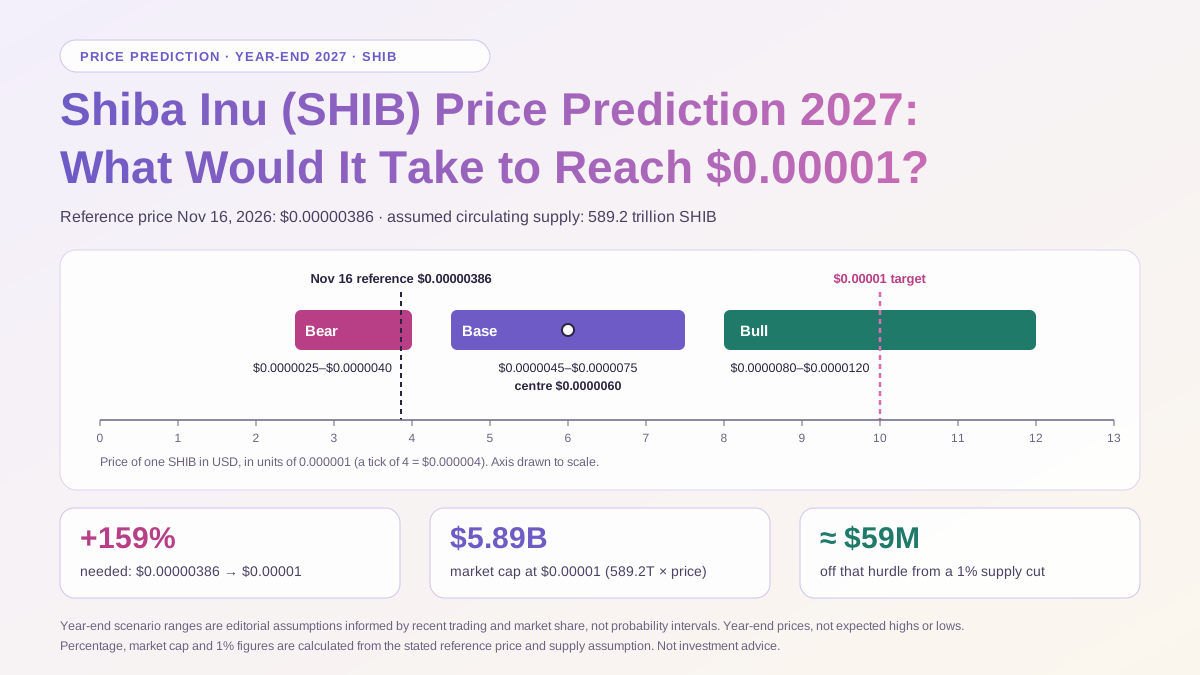
Shiba Inu (SHIB) Price Prediction 2027: What Would It Take to Reach $0.00001?
See our Shiba Inu price prediction for 2027, including the $0.000006 base estimate, the market cap needed for $0.00001, and how much burns could help.

Huya's Q3 2026 Financial Report: Operating Profit Turns Positive for the First Time in Nearly Four Years, Live Streaming and Game-Related Services Continue to Improve Efficiency

Aave Labs Reports: A 97-Person Team Supporting What Kind of DeFi Business?

Prediction: Anthropic Will Have a Successful IPO but Then the Stock Will Trade Like SpaceX

Intesa Sanpaolo raises XRP and Solana ETF holdings, cuts Bitcoin and Ethereum

Why Are Tokenized Stocks Seeing Strong Buying Pressure While Prices Keep Falling?
Report: Israel Uploads Millions of Photos to Amazon's Facial Recognition Platform to Track Palestinians

WEEX P2P now supports CAD —Merchant Recruitment Now Open
Cardano Foundation seeks 25M ADA for 2027 events despite $1.2M funding gap
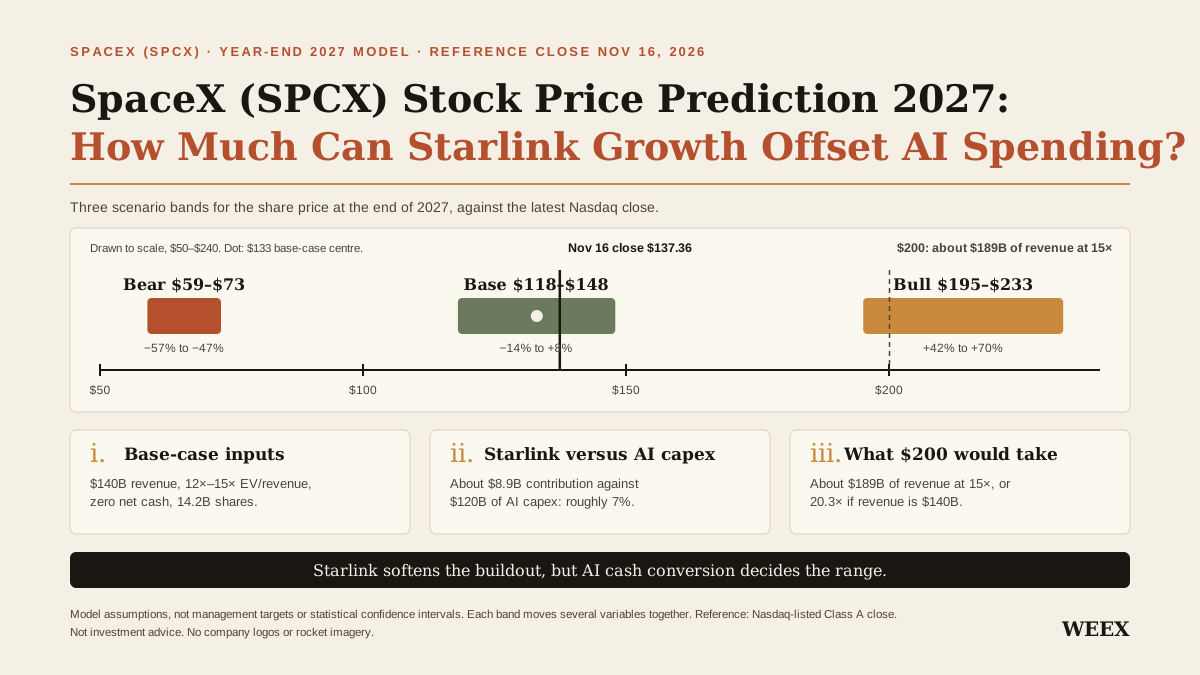
SpaceX (SPCX) Stock Price Prediction 2027: How Much Can Starlink Growth Offset AI Spending?
SpaceX stock price prediction for 2027: See the $118–$148 base case, how much Starlink could offset AI spending, and what it would take to reach $200.
Chevron Expands in the Gulf of Mexico with Plans to Acquire Majority Stake in Oil Field for Over $5 Billion
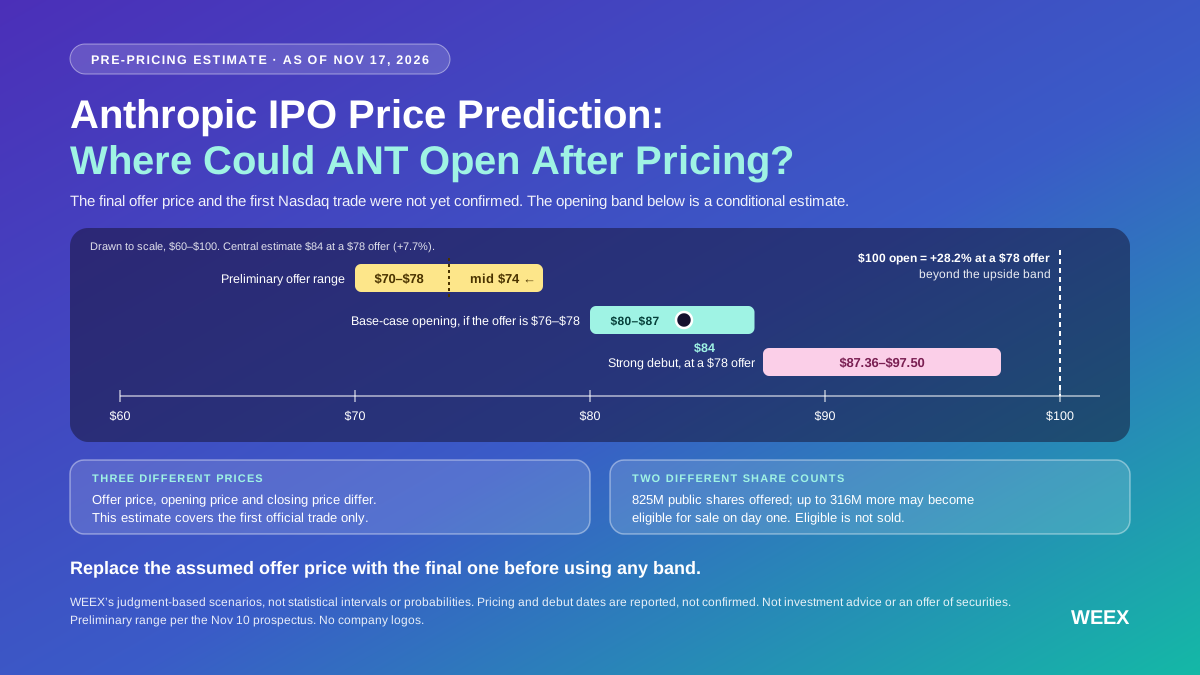
Anthropic IPO Price Prediction: Where Could ANT Open After Pricing?
Anthropic IPO price prediction: See ANT’s $80–$87 base-case opening range, how the final offer price changes it, and what could push shares above $90.
IOSF: The Cost Paradox of Video AI - Why Is Generating Cheaper but Final Cuts Still Expensive?
Will the $50 billion request materialize? The U.S. transportation system urgently needs funding for upgrades, but Congress has become a "lame duck"

Japan Proposes Establishing an 'Asian Version of the International Energy Agency' to Enhance Southeast Asia's Oil Storage Capacity in Response to Energy Crises

Federal Reserve Warns Korean Investors About Leveraged ETF Risks
Mercado Bitcoin Withdrawal Update: Pix Restart and Crypto Suspension
Mercado Bitcoin set November 17 for Pix deposits and withdrawals in Brazilian reais. Read the withdrawal rules and the background to the crypto suspension.
Reasons Why Cryptocurrency Kiosks Face Increasing Regulation
The Q3 Market in Turmoil: How Much is Circle Worth?

A Decade of a Crypto Neutral Fund Manager: A High-Pressure Way of Life

JPMorgan and DBS Enable On-Chain USD Payments! 24-Hour Cross-Border Transfers, Ant International Becomes First Client

XRP holders demand Ripple burn 31.1 billion tokens by March 2027

Major Indexes Close Lower, Nvidia Earnings Are Imminent | WEEX Daily Market Brief (November 17, 2026)
At the November 16 close, the three major indexes all finished lower. Technology-stock selling continued, with the chip sector leading declines. Bitcoin’s weekend selloff showed signs of stop-loss hunting; it is currently around $64,000. Backpack received regulatory approval. On November 17, watch for October retail sales data and earnings from Nvidia, Home Depot, Disney, and JD.com.
Binance’s He Yi explains AI Pro transfers after hack-day withdrawal claims
Q3 Institutional Holdings Observation: Large-Cap Tech Underweight Narrowing, Funds Concentrating on AI Infrastructure, Software Stocks Neglected
Microsoft Ignite Conference Kicks Off Today! Focus on Copilot Monetization and AI Computing Returns, Can the Enterprise AI Flywheel Deliver?
How to Reassess Core Assets with 'Revenue + Narrative' After Market Crash?
Circle Expands Disparte and Walia Roles as Stablecoin Operations Scale
US Deploys Third Aircraft Carrier to the Middle East as Iran Intensifies Threats Amid Tanker Attack in the Strait of Hormuz
Latest articles



Latest coin listings on WEEX


