
A $25 million MEV ruling exposes a dangerous blind spot in Wall Street’s tokenization push

 Prefer us on Google
A federal judge on Nov. 16 acquitted Anton and James Peraire-Bueno in a $25 million Ethereum maximum extractable value (MEV) exploit case because prosecutors had failed to prove a material misrepresentation.
The decision leaves a separate question for tokenized US stock markets about what protects investors when transaction ordering works against them.
The SEC had already opened a conditional route for those markets in September on its framework, which preserves applicable securities antifraud and manipulation laws, but requires venues to disclose their policies for MEV even when they have none.
MEV concerns the value captured through transaction ordering. Four operators' notices show how much can differ within that framework, from transaction privacy and planned sequencing controls to the prospect that investors bear their own losses.
The judgment and the securities framework
In her 46-page opinion, US District Judge Jessica Clarke found insufficient evidence to sustain wire fraud and the related wire-fraud and money-laundering conspiracy charges. The missing element was a material misrepresentation in the brothers' Omakase operation.
The opinion describes a 2023 operation that used lure transactions to attract sandwich-trading bots and exploited a relay-code vulnerability, producing about $25 million in 12 seconds. The targeted bots themselves sought to profit by placing transactions around someone else's trade, a practice that can leave that trader with a worse execution price.
The case was more specific than a simple claim that someone profited from transaction ordering, since prosecutors had to establish the charged fraud.
Clarke found that the trial evidence did not establish a material misrepresentation in the Omakase strategy, and frustrating MEV-Boost's intended design could not supply that missing element.
The court also distinguished precedents involving spoofing, where orders create a misleading impression before being canceled. Here, the lure transactions executed and also were not placed on a regulated market with rules prohibiting the conduct relied upon in those precedents.
That reasoning does not establish a universal requirement that wire fraud occur on a regulated market, nor does it determine whether all forms of MEV extraction are lawful.
In a March 30 letter, the Securities Industry and Financial Markets Association (SIFMA) argued that exposing pending trades to sandwiching and front-running can conflict with securities-market expectations. It called for technical protections or fair-sequencing rules when automated market makers handle securities.
An automated market maker (AMM) lets participants trade against assets committed to a pool using software-defined pricing. The ordering of those trades can affect who receives a favorable price and who captures the resulting profit.
Keeping an investor's pending instruction private and deciding who processes it first are economically significant choices.
The SEC's Sept. 17 order created temporary, conditional relief from the definition of an exchange for qualifying tokenized National Market System stock venues using permissioned AMM pools. Certain liquidity providers trading proprietary capital received separate relief from the dealer definition until Sept. 17, 2031.
The order retains applicable securities antifraud and antimanipulation provisions, including Exchange Act Section 10(b) and Rule 10b-5. Its conditions include permissioned access, public notices, records, and specified trading stoppages.
A venue must describe policies and procedures designed to address it, or state that it has none. It must disclose known material risks, explain any mitigation and compensation arrangements, and describe trading-abuse monitoring or acknowledge its absence.
A venue's published account of its protections can be detailed while leaving investors exposed to risks the operator expressly acknowledges.
Different execution choices against MEV
The SEC's public list, reviewed Nov. 16, contains four notice filers. Their submission dates range from TSV LLC's Sept. 23 notice to Formation Securities' Nov. 9 filing.
| Operator and reported status | Ordering and MEV approach | Disclosed safeguards and remaining exposure |
|---|---|---|
| TSV LLC: revised Nov. 4 notice says tokenized CNTN trading on Canton had commenced | Selective disclosure of pending transaction contents is intended to reduce conventional public-mempool sandwiching | Permissioning, slippage constraints and monitoring; leakage, sequencing and collusion risks remain |
| OKXICE TSV: Nov. 23 launch planned | Planned XLayer venue; sequencer ordering generally follows offered fees; no MEV-specific policies reported | Permissioning, minimum output settings, surveillance and possible access revocation; operator says MEV risk remains |
| Perpetuals.com: says trading has not commenced | Proposed Kronos X Public L2; generally first-in, first-out sequencing and signed arrival receipts | Surveillance and safeguards planned; affiliated sequencer sees pending information and creates residual conflicts |
| Formation Securities: says operations have not commenced | Planned Solana venue using Orca technology; validator ordering remains a risk | Permissioning, slippage settings and Solidus surveillance planned; MEV cannot be eliminated |
TSV LLC's current notice says Canton's architecture generally avoids broadcasting readable pending transaction contents to unrelated participants, aiming to reduce opportunities for conventional public-mempool front-running and sandwich attacks.
The operator still acknowledges risks of information leakage, sequencing, compromised infrastructure, and collusion.
OKXICE's Nov. 5 notice disclosed that it has no policies and procedures designed to address MEV. That sits alongside general protections, including permissioned participation, participant minimum-output settings, surveillance and the ability to revoke access for manipulative trading. OKXICE says those features mitigate, rather than eliminate, MEV risk.
Its planned pools use Uniswap v4 on XLayer, where the notice says the sequencer generally orders transactions according to offered network fees.
Perpetuals.com's notice proposes generally first-in, first-out sequencing, with priority for trading-halt instructions and signed arrival receipts intended to make ordering verifiable. Yet its affiliated sequencer would receive nonpublic transaction information.
A private pending-transaction route can reduce exposure to outsiders while leaving a concentrated information advantage to manage.
Its October notice describes safeguards that were not fully implemented and surveillance intended to precede trading. Formation's notice likewise describes planned safeguards for its Solana venue.
MEV protection and compensation are separate questions
Preventing an abusive trade, detecting it afterward, and compensating its victim are different functions.
TSV says participants generally should not expect compensation for market or impermanent losses, compromised participant systems or losses caused by unaffiliated third parties, unless it expressly agrees otherwise or the law requires it.
Perpetuals.com reports no established compensation policy for the risks described in its notice. Formation specifically excludes compensation for lost or compromised private keys or wallets, which does not establish a general recovery guarantee for other losses.
Three questions behind onchain accountability
Criminal proof, securities-venue duties and compensation terms address different parts of investor protection.
Three independent accountability questions A branching map separates the Ethereum wire-fraud judgment, SEC venue obligations and loss recovery. Branches indicate questions, not a timeline or a transfer of legal protection. ONCHAIN TRADING RISK Three independent questions 01 02 03 PROOF CONTROLS RECOURSE Ethereum criminal case Tokenized-stock venues Participant losses Material misrepresentation proven at trial? MEV policies and risks disclosed? Compensation promised or legally required? Not established Nov. 16 acquittal in this prosecution Policy, or no policy Antifraud and manipulation laws still apply Terms differ No universal promise to reimburse losses The acquittal does not establish that all MEV exploitation is lawful.
Three independent accountability questions Stacked branches distinguish criminal proof, tokenized-stock venue controls and compensation. The acquittal is case-specific. ONCHAIN TRADING RISK Three independent questions 01 / PROOF Ethereum criminal case Material misrepresentation proven at trial? Not established Nov. 16 acquittal in this prosecution 02 / CONTROLS Tokenized-stock venues MEV policies and risks disclosed? Policy, or no policy Antifraud and manipulation laws still apply 03 / RECOURSE Participant losses Compensation promised or legally required? Terms differ No universal promise to reimburse losses The acquittal does not establish that all MEV exploitation is lawful.
A disclosed safeguard is not a guarantee of prevention or repayment.
The acquittal concerns this prosecution. Venue notices include plans and operator statements, not independently tested controls. Compensation depends on the particular loss, applicable law and agreements; the graphic predicts no liability outcome.
Sources and evidence
Sources
- Court opinion, Nov. 16, 2026
- SEC exemption order, Sept. 17, 2026
- TSV LLC current public notice
- Perpetuals.com notice, Oct. 27, 2026
- Perpetuals.com venue status
- Formation notice, Nov. 9, 2026
- Formation venue status
Supporting facts
- On November 16, Judge Jessica G. L. Clarke granted Anton and James Peraire-Bueno judgments of acquittal on wire fraud, conspiracy to commit wire fraud and conspiracy to commit money laundering in the $25 million Ethereum case. [1]
- The court held that the trial evidence failed to establish a material misrepresentation in the brothers' Omakase strategy; fraudulent intent or frustration of a system's intended design could not supply that missing element. [1]
- Clarke distinguished spoofing precedents partly because the lure trades executed and were not submitted to a regulated market with prohibitory rules; the opinion did not decide that wire fraud generally requires a regulated market or that all MEV exploitation is lawful. [1]
- The SEC order preserves applicable securities antifraud and antimanipulation laws, including Exchange Act Section 10(b) and Rule 10b-5, while requiring permissioned access, disclosed access criteria and applicable screening, records, public notices and specified trading stoppages. [2]
- The SEC requires a venue to describe MEV policies, and to say so if it has none; the notice must also describe known material risks, loss-mitigation or compensation actions, and trading-abuse monitoring, including when monitoring is absent. [2]
- TSV LLC describes permissioning, participant slippage limits and automated/manual monitoring, says it does not intend to prevent lawful ordinary postexecution arbitrage that does not misuse confidential information or involve other prohibited conduct, and says participants generally should not expect compensation for market losses, impermanent loss, compromised participant systems or unaffiliated third-party losses unless agreed or legally required. [3]
- Perpetuals.com's homepage says trading has not commenced; its October 27 notice says safeguards were not fully implemented, proposes surveillance, and reports no established policy to compensate participants for the described risks. [4] [5]
- Formation's homepage says operations have not commenced; its notice excludes compensation for losses arising from lost or compromised private keys or wallets, without establishing a general guarantee of recovery for other losses. [6] [7]
Method
Qualitative mapping of the court's material-misrepresentation finding, the SEC's MEV disclosure and preserved-law provisions, and disclosed venue compensation limits. Branches show distinct questions, not sequence or money flows.
Scope
The acquittal concerns this prosecution. Venue notices include plans and operator statements, not independently tested controls. Compensation depends on the particular loss, applicable law and agreements; the graphic predicts no liability outcome.
Infographic by CryptoSlate
The SEC order recognizes that sequencing can support price-stabilizing activity as well as abuse. TSV says it does not intend to prevent lawful ordinary post-execution arbitrage or price alignment that avoids misuse of confidential information and other prohibited conduct.
The dividing line cannot simply be whether someone profits after another trade. Relevant distinctions include whether pending information was misused, how the venue controls ordering, what conduct it addresses, and which legal obligations apply.
For institutions considering these markets, the notices expose concrete choices about privacy, sequencing, surveillance and loss allocation. The execution model determines that a private route still needs controls over privileged information, while a public route needs a response to abusive ordering.
The next disputed on-chain securities trade would raise questions about what representations were made, what rules applied, who controlled the information and ordering, and what recourse the investor had. Bringing stocks onto a blockchain makes those choices visible.
This content is provided for general informational purposes only and doesn't constitute financial, investment, legal, or tax advice. Any events, rewards, online promotions, or related information mentioned herein should not be considered a recommendation, solicitation, or invitation to purchase, sell, trade, or otherwise deal in any crypto assets. Crypto assets are highly volatile and may result in loss. The availability of WEEX services, products, and related events may vary by region. You are responsible for ensuring that your participation is in accordance with applicable local laws and regulations.
You may also like

Tether-backed Twenty One Capital buys $10M in Bitcoin as stock slides

The Next Hyperliquid Will Emerge from These 6 Companies
A Super Empire on a Fragile Foundation: How Jensen Huang Has Controlled NVIDIA for 33 Years
Binance’s He Yi explains AI Pro transfers after hack-day withdrawal claims

Q3 Institutional Holdings Observation: Large-Cap Tech Underweight Narrowing, Funds Concentrating on AI Infrastructure, Software Stocks Neglected

Microsoft Ignite Conference Kicks Off Today! Focus on Copilot Monetization and AI Computing Returns, Can the Enterprise AI Flywheel Deliver?
How to Reassess Core Assets with 'Revenue + Narrative' After Market Crash?

Circle Expands Disparte and Walia Roles as Stablecoin Operations Scale

US Deploys Third Aircraft Carrier to the Middle East as Iran Intensifies Threats Amid Tanker Attack in the Strait of Hormuz

Wall Street Sees 'Gazumping' Phenomenon as Hedge Funds Compete for Top Talent
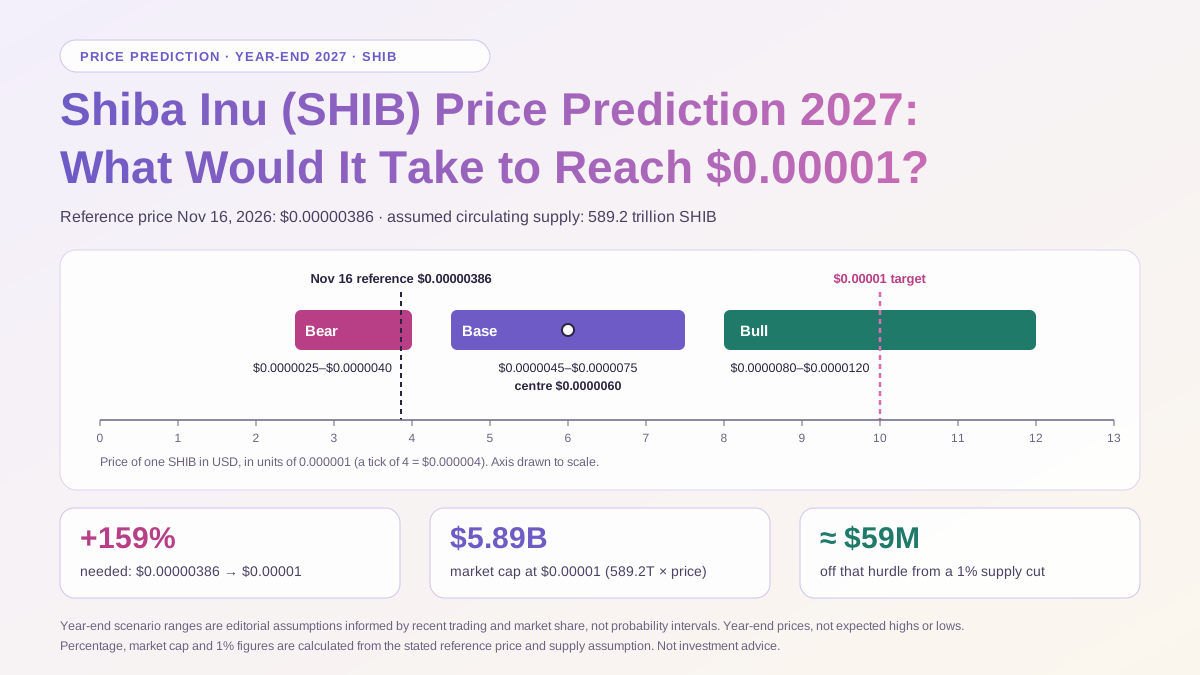
Shiba Inu (SHIB) Price Prediction 2027: What Would It Take to Reach $0.00001?
See our Shiba Inu price prediction for 2027, including the $0.000006 base estimate, the market cap needed for $0.00001, and how much burns could help.

Huya's Q3 2026 Financial Report: Operating Profit Turns Positive for the First Time in Nearly Four Years, Live Streaming and Game-Related Services Continue to Improve Efficiency

Aave Labs Reports: A 97-Person Team Supporting What Kind of DeFi Business?

Prediction: Anthropic Will Have a Successful IPO but Then the Stock Will Trade Like SpaceX

Intesa Sanpaolo raises XRP and Solana ETF holdings, cuts Bitcoin and Ethereum

Why Are Tokenized Stocks Seeing Strong Buying Pressure While Prices Keep Falling?

Report: Israel Uploads Millions of Photos to Amazon's Facial Recognition Platform to Track Palestinians

WEEX P2P now supports CAD —Merchant Recruitment Now Open

Cardano Foundation seeks 25M ADA for 2027 events despite $1.2M funding gap
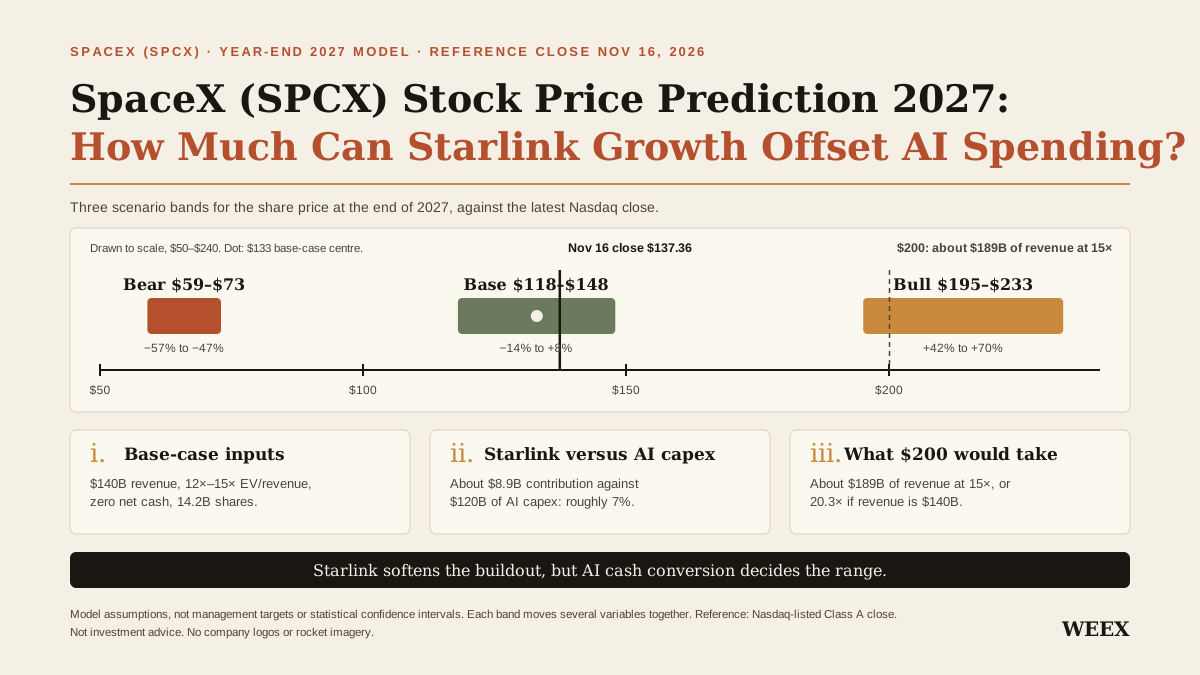
SpaceX (SPCX) Stock Price Prediction 2027: How Much Can Starlink Growth Offset AI Spending?
SpaceX stock price prediction for 2027: See the $118–$148 base case, how much Starlink could offset AI spending, and what it would take to reach $200.
Chevron Expands in the Gulf of Mexico with Plans to Acquire Majority Stake in Oil Field for Over $5 Billion
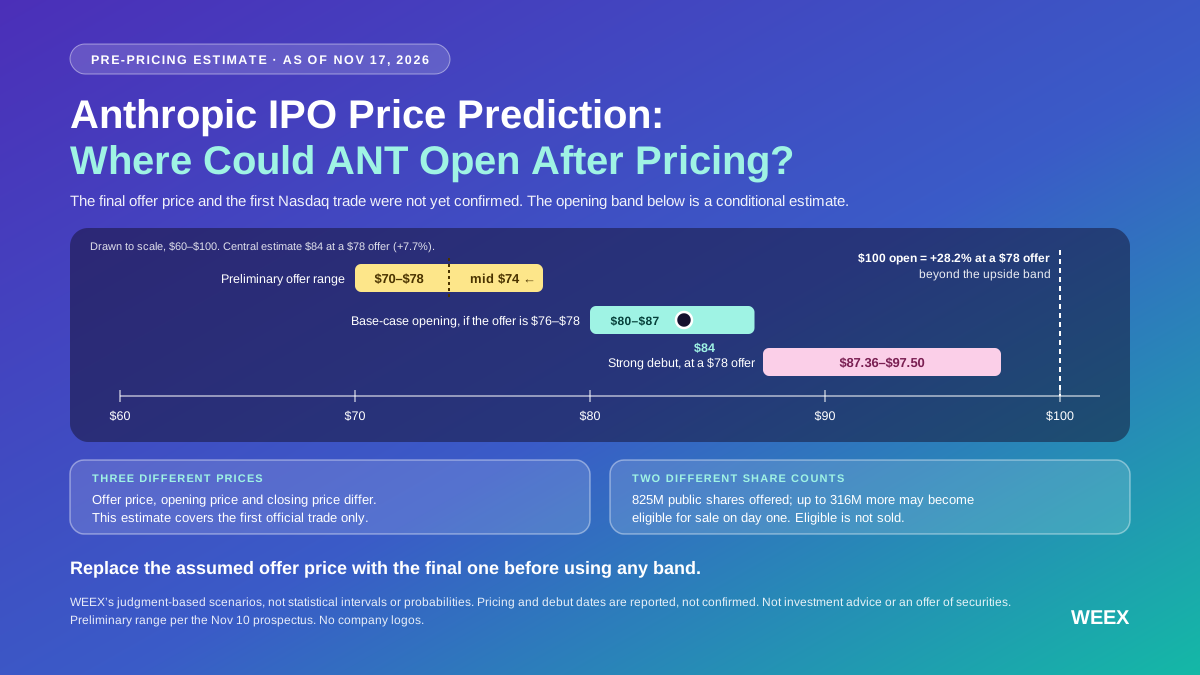
Anthropic IPO Price Prediction: Where Could ANT Open After Pricing?
Anthropic IPO price prediction: See ANT’s $80–$87 base-case opening range, how the final offer price changes it, and what could push shares above $90.

IOSF: The Cost Paradox of Video AI - Why Is Generating Cheaper but Final Cuts Still Expensive?

Will the $50 billion request materialize? The U.S. transportation system urgently needs funding for upgrades, but Congress has become a "lame duck"

Japan Proposes Establishing an 'Asian Version of the International Energy Agency' to Enhance Southeast Asia's Oil Storage Capacity in Response to Energy Crises

Federal Reserve Warns Korean Investors About Leveraged ETF Risks

Mercado Bitcoin Withdrawal Update: Pix Restart and Crypto Suspension
Mercado Bitcoin set November 17 for Pix deposits and withdrawals in Brazilian reais. Read the withdrawal rules and the background to the crypto suspension.

Reasons Why Cryptocurrency Kiosks Face Increasing Regulation

The Q3 Market in Turmoil: How Much is Circle Worth?

A Decade of a Crypto Neutral Fund Manager: A High-Pressure Way of Life
Tether-backed Twenty One Capital buys $10M in Bitcoin as stock slides
The Next Hyperliquid Will Emerge from These 6 Companies
A Super Empire on a Fragile Foundation: How Jensen Huang Has Controlled NVIDIA for 33 Years
Binance’s He Yi explains AI Pro transfers after hack-day withdrawal claims
Q3 Institutional Holdings Observation: Large-Cap Tech Underweight Narrowing, Funds Concentrating on AI Infrastructure, Software Stocks Neglected
Microsoft Ignite Conference Kicks Off Today! Focus on Copilot Monetization and AI Computing Returns, Can the Enterprise AI Flywheel Deliver?
Latest articles
Latest coin listings on WEEX


