
Binance’s He Yi explains AI Pro transfers after hack-day withdrawal claims

 Prefer us on Google
Binance co-CEO Yi He has attributed disputed movements in her trading account to an AI strategy test, responding to online allegations that she withdrew funds from the exchange during its $6.3 billion security breach.
Summary
- Binance co-CEO Yi He attributed disputed account movements to testing AI Pro strategies in subaccounts.
- Her account screenshot showed a $101.3 million decline across October 17 through November 16 inclusive.
- Online users alleged hack-day withdrawals, but the shared posts did not establish any external transfer.
- Binance says AI Pro strategies use dedicated accounts and cannot send assets to external wallets.
- Binance reported restoring withdrawals across 87 networks during its recovery from the October security breach.
In a November 16 response, Yi He said she had moved assets to a sub-account to try Binance AI Pro before returning to spot trading. Her explanation followed questions about a performance screenshot she shared on Binance Square and claims that she was able to move money while Binance customers encountered withdrawal restrictions after the hack.
He Yi's $101 million account drop sparks accusations
On November 16, Yi He published a 30-day account summary covering October 17 through November 16. It showed a total change of negative $101.32 million, including negative $97.32 million under trading profit and loss and negative $3.99 million under transfers and other adjustments. "The pullback is temporary; spot holders have nothing to fear," she wrote alongside the figures.
The displayed totals measure changes in the account over 30 days. They do not establish that Yi He realized $101 million in trading losses or withdrew that amount from Binance. The public dashboard did not show individual transactions or identify destinations for any funds moved between accounts.
An X post by Web3 Dao Ge drew attention to the apparent losses, asking who was making money in the falling market. Another account, Crypto Suy, alleged that "He Yi transferred all her money out of Binance on the day of the hack" and questioned whether Dao Ge had been pressured to delete a post.
The dispute drew further criticism over the restrictions that ordinary users experienced after the attack. In a translated post, trader @yff5188 argued that customers were unable to withdraw while Yi He could supposedly move assets "under the pretext of 'trying out an AI strategy.'" The posts did not supply transaction records establishing an external withdrawal or evidence that anyone had forced the removal of a post.
He Yi says the funds moved into an AI Pro account
Yi He explained that she had switched accounts to test automated trading. "During that time, I switched to a sub-account to try running strategies with AI pro, but it was still being tweaked and wasn't running smoothly, so I switched back to spot trading," she wrote, according to the English translation of her response.
An account posting as @yayabinance separately told critics that the funds "weren't transferred out" and directed them to Yi He's explanation. Neither post specified how much money was transferred or provided a transaction-by-transaction account history confirming the precise timing of the movements.
Binance AI Pro uses sub-accounts, not outside wallets
Binance launched AI Pro on October 19, ten days before the hack. The product lets customers describe trading ideas in conversational language, test strategies using simulated money and approve those strategies before using real assets.
Under its published rules, live strategies run in dedicated virtual sub-accounts isolated from a user's main Binance account. Users must manually move funds into those accounts and can return them to their main account. Existing sub-accounts cannot be connected to the product; Binance creates a dedicated strategy account when a customer deploys an AI strategy. "Only transfers between your own accounts are supported," the exchange says.
Binance says its AI agent cannot withdraw or transfer assets to external addresses. A separate AI trading platform introduced in August uses comparable controls requiring users to fund accounts themselves, without giving automated agents permission to withdraw funds externally.
The distinction between internal transfers and withdrawals matters to the accusations: moving assets from a spot account to a Binance strategy account is not equivalent to sending them to an external wallet. Binance's product documentation explains the mechanism Yi He described but does not independently confirm her particular account activity or establish which restrictions applied to her account.
Binance was restoring withdrawals after the $6.3 billion breach
The allegations concern the days around Binance's October 29 security breach, which affected about $6.3 billion in cryptocurrencies held in exchange wallets. The attack involved unauthorized transfers after internal systems were compromised, and Binance temporarily suspended customer withdrawals while it investigated.
As crypto.news reported, the exchange began reopening Bitcoin withdrawals and selected network services on November 1. Customers still had to check the status of individual assets and networks, since withdrawal routes reopened at different times.
In a November 14 update, Binance said it had restored withdrawals on 87 networks during the preceding week and was targeting the remaining services by the end of the following week. The company said on November 13 that it had finished replenishing affected assets using corporate resources, and its November 12 proof-of-reserves snapshot covered 198 tokens.
This content is provided for general informational purposes only and doesn't constitute financial, investment, legal, or tax advice. Any events, rewards, online promotions, or related information mentioned herein should not be considered a recommendation, solicitation, or invitation to purchase, sell, trade, or otherwise deal in any crypto assets. Crypto assets are highly volatile and may result in loss. The availability of WEEX services, products, and related events may vary by region. You are responsible for ensuring that your participation is in accordance with applicable local laws and regulations.
You may also like

A Super Empire on a Fragile Foundation: How Jensen Huang Has Controlled NVIDIA for 33 Years

Q3 Institutional Holdings Observation: Large-Cap Tech Underweight Narrowing, Funds Concentrating on AI Infrastructure, Software Stocks Neglected

Microsoft Ignite Conference Kicks Off Today! Focus on Copilot Monetization and AI Computing Returns, Can the Enterprise AI Flywheel Deliver?

How to Reassess Core Assets with 'Revenue + Narrative' After Market Crash?

Circle Expands Disparte and Walia Roles as Stablecoin Operations Scale

US Deploys Third Aircraft Carrier to the Middle East as Iran Intensifies Threats Amid Tanker Attack in the Strait of Hormuz

Wall Street Sees 'Gazumping' Phenomenon as Hedge Funds Compete for Top Talent
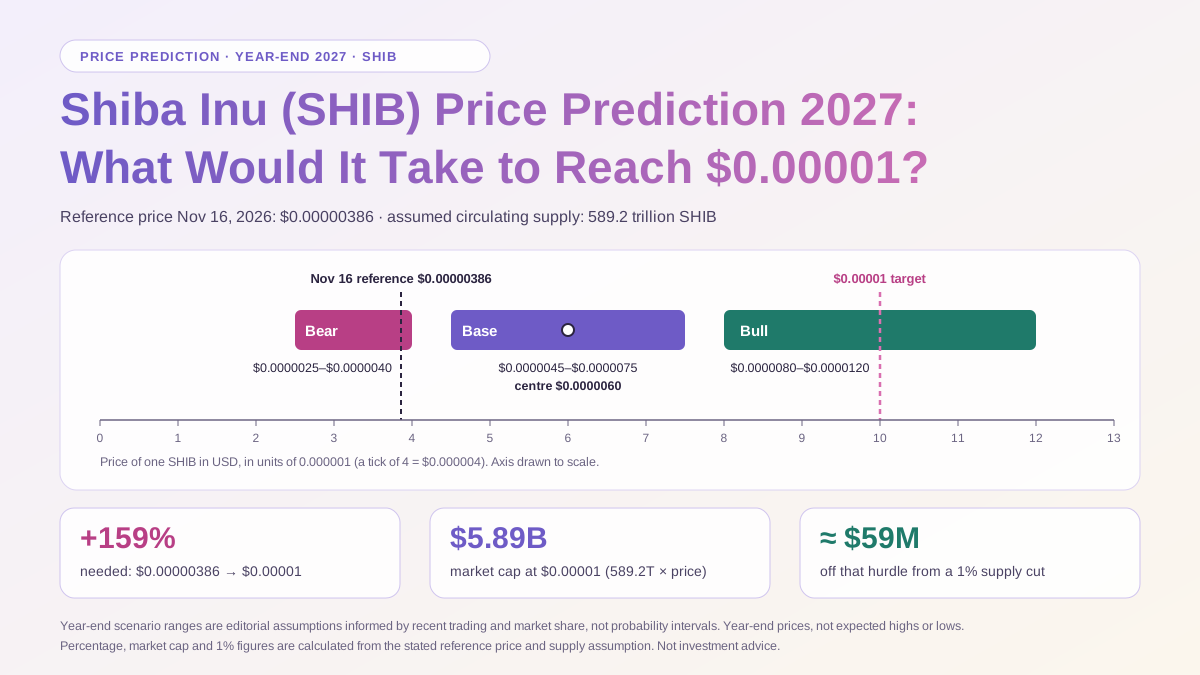
Shiba Inu (SHIB) Price Prediction 2027: What Would It Take to Reach $0.00001?
See our Shiba Inu price prediction for 2027, including the $0.000006 base estimate, the market cap needed for $0.00001, and how much burns could help.

Huya's Q3 2026 Financial Report: Operating Profit Turns Positive for the First Time in Nearly Four Years, Live Streaming and Game-Related Services Continue to Improve Efficiency

Aave Labs Reports: A 97-Person Team Supporting What Kind of DeFi Business?

Prediction: Anthropic Will Have a Successful IPO but Then the Stock Will Trade Like SpaceX

Intesa Sanpaolo raises XRP and Solana ETF holdings, cuts Bitcoin and Ethereum

Why Are Tokenized Stocks Seeing Strong Buying Pressure While Prices Keep Falling?

Report: Israel Uploads Millions of Photos to Amazon's Facial Recognition Platform to Track Palestinians

WEEX P2P now supports CAD —Merchant Recruitment Now Open

Cardano Foundation seeks 25M ADA for 2027 events despite $1.2M funding gap

SpaceX (SPCX) Stock Price Prediction 2027: How Much Can Starlink Growth Offset AI Spending?
SpaceX stock price prediction for 2027: See the $118–$148 base case, how much Starlink could offset AI spending, and what it would take to reach $200.
Chevron Expands in the Gulf of Mexico with Plans to Acquire Majority Stake in Oil Field for Over $5 Billion
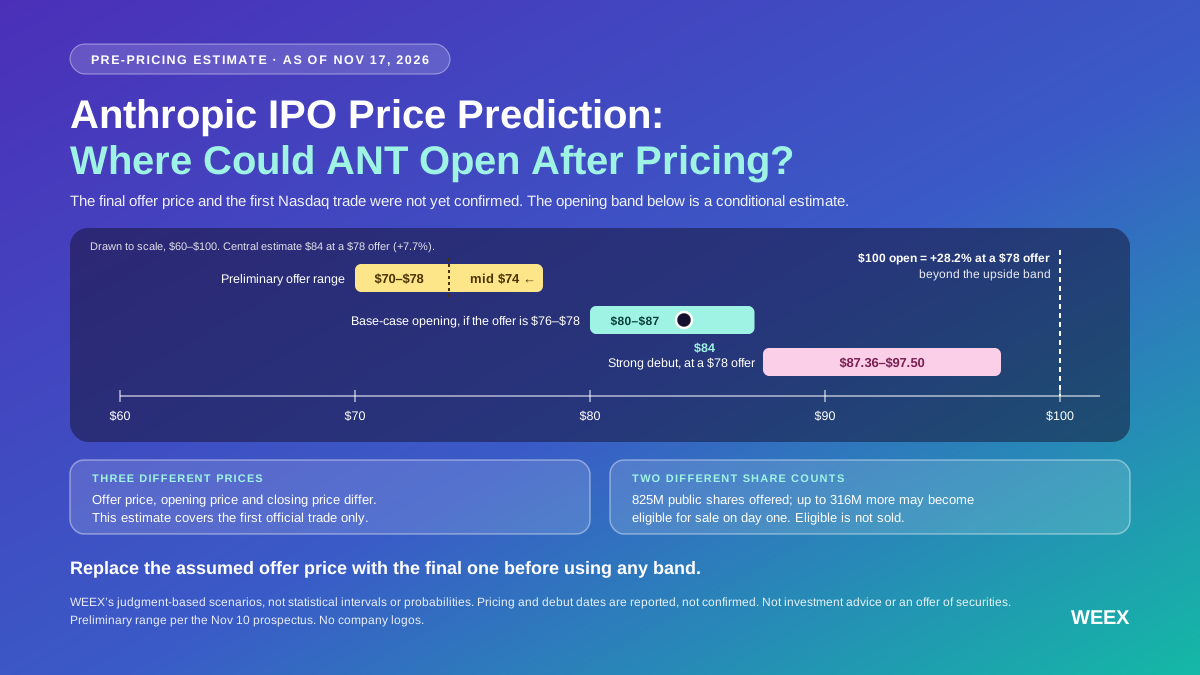
Anthropic IPO Price Prediction: Where Could ANT Open After Pricing?
Anthropic IPO price prediction: See ANT’s $80–$87 base-case opening range, how the final offer price changes it, and what could push shares above $90.

IOSF: The Cost Paradox of Video AI - Why Is Generating Cheaper but Final Cuts Still Expensive?

Will the $50 billion request materialize? The U.S. transportation system urgently needs funding for upgrades, but Congress has become a "lame duck"

Japan Proposes Establishing an 'Asian Version of the International Energy Agency' to Enhance Southeast Asia's Oil Storage Capacity in Response to Energy Crises

Federal Reserve Warns Korean Investors About Leveraged ETF Risks

Mercado Bitcoin Withdrawal Update: Pix Restart and Crypto Suspension
Mercado Bitcoin set November 17 for Pix deposits and withdrawals in Brazilian reais. Read the withdrawal rules and the background to the crypto suspension.

Reasons Why Cryptocurrency Kiosks Face Increasing Regulation

The Q3 Market in Turmoil: How Much is Circle Worth?

A Decade of a Crypto Neutral Fund Manager: A High-Pressure Way of Life

JPMorgan and DBS Enable On-Chain USD Payments! 24-Hour Cross-Border Transfers, Ant International Becomes First Client

XRP holders demand Ripple burn 31.1 billion tokens by March 2027

Major Indexes Close Lower, Nvidia Earnings Are Imminent | WEEX Daily Market Brief (November 17, 2026)
At the November 16 close, the three major indexes all finished lower. Technology-stock selling continued, with the chip sector leading declines. Bitcoin’s weekend selloff showed signs of stop-loss hunting; it is currently around $64,000. Backpack received regulatory approval. On November 17, watch for October retail sales data and earnings from Nvidia, Home Depot, Disney, and JD.com.
A Super Empire on a Fragile Foundation: How Jensen Huang Has Controlled NVIDIA for 33 Years
Q3 Institutional Holdings Observation: Large-Cap Tech Underweight Narrowing, Funds Concentrating on AI Infrastructure, Software Stocks Neglected
Microsoft Ignite Conference Kicks Off Today! Focus on Copilot Monetization and AI Computing Returns, Can the Enterprise AI Flywheel Deliver?
How to Reassess Core Assets with 'Revenue + Narrative' After Market Crash?
Circle Expands Disparte and Walia Roles as Stablecoin Operations Scale
US Deploys Third Aircraft Carrier to the Middle East as Iran Intensifies Threats Amid Tanker Attack in the Strait of Hormuz
Latest articles



Latest coin listings on WEEX


