
History Says Every S&P 500 Bear Market Has Ended the Same Way. Here's the Pattern.

 Prefer us on Google


A bear market has arrived -- at least for AI stocks. The Global X Artificial Intelligence & Technology ETF (AIQ -1.29%), for example, is down roughly 10% over the past 30 days. Nvidia (NVDA -2.01%), meanwhile, has lost more than 25% of its value.
The risk of contagion is widely reported. AI companies and their suppliers now constitute nearly half of the S&P 500index's value. Jitters in the AI sector have a disproportionate ability to drag down the entire stock market.
History says to do this during a market crash
Right now, the S&P 500 index trades at roughly 26 times earnings. That's well above its long-term average of around 15 to 16 times earnings. But there's a catch: Corporate profit margins have risen significantly in recent decades, which often leads to elevated valuations.
"Profit margins for the S&P 500 are at all-time highs and considering ROEs as well it is not at all surprising that the market is trading at historically rich valuations," observes Jason Trennert, CEO of Strategas Asset Management. "The U.S. equity market is going to trade at higher multiples for a long time because margins are going to be higher in the future than in the past," adds Adam Parker of Trivariate Research.
What those comments ignore, however, is that higher profit margins largely belong to technology companies.
"As a business owner, higher profit margins, all other things being equal, are more valuable," Bill Stone explained in a 2024 article for Forbes. "The profit margins for the technology sector are close to double the market as a whole, which helps explain the premium valuation."
Image source: Getty Images.
If AI companies comprise nearly half of the S&P 500's valuation, and these companies are what's propping up marketwide profit margins, a decline in the AI sector could have devastating effects on the rest of the market.
Here's the thing: None of that might matter over the long term.
At the start of 2007, the financial sector accounted for 22% of the S&P 500's value, contributing more than one-quarter of its earnings. In the 1980s, for comparison, both figures were closer to just 6%. When the financial crisis arrived, the record weighting of financial stocks forced the S&P 500 index down sharply. But even if you bought at the peak of the 2007 bubble, you'd still be sitting on a profit of more than 400% if you had held on through today.
The dot-com bubble played out similarly. Right before the dot-com bubble burst, tech stocks accounted for approximately one-third of the S&P 500's valuation. As with the financial crisis, however, if you had purchased an S&P 500 index fund right before the crash, you'd still be sitting on a long-term profit of more than 400%.
The point here isn't necessarily to go all-in when markets are near their peaks. It's that investment timing matters far less than holding period. Long-term investors can compensate for poor investment timing simply by holding on through the drought.
Of course, today's conditions could always be different.
"Today, the S&P 500 is more concentrated than at any point since the late-1990s tech bubble," observes research from UBS. "It's only natural for investors to wonder if we're seeing the early signs of a bubble."
No one knows exactly where markets are headed next, and it's very possible that an AI bubble is currently in the process of popping. If you're retired or on a fixed income, taking gains at today's valuations may not be such a bad idea. If you expect to remain in the market for another few decades, history paints a clear picture of what you should do next: continue putting more money to work regularly while maintaining a multi-decade time horizon.
-- Price
This content is provided for general informational purposes only and doesn't constitute financial, investment, legal, or tax advice. Any events, rewards, online promotions, or related information mentioned herein should not be considered a recommendation, solicitation, or invitation to purchase, sell, trade, or otherwise deal in any crypto assets. Crypto assets are highly volatile and may result in loss. The availability of WEEX services, products, and related events may vary by region. You are responsible for ensuring that your participation is in accordance with applicable local laws and regulations.
You may also like
Why Are Tokenized Stocks Seeing Strong Buying Pressure While Prices Keep Falling?

WEEX P2P now supports CAD —Merchant Recruitment Now Open
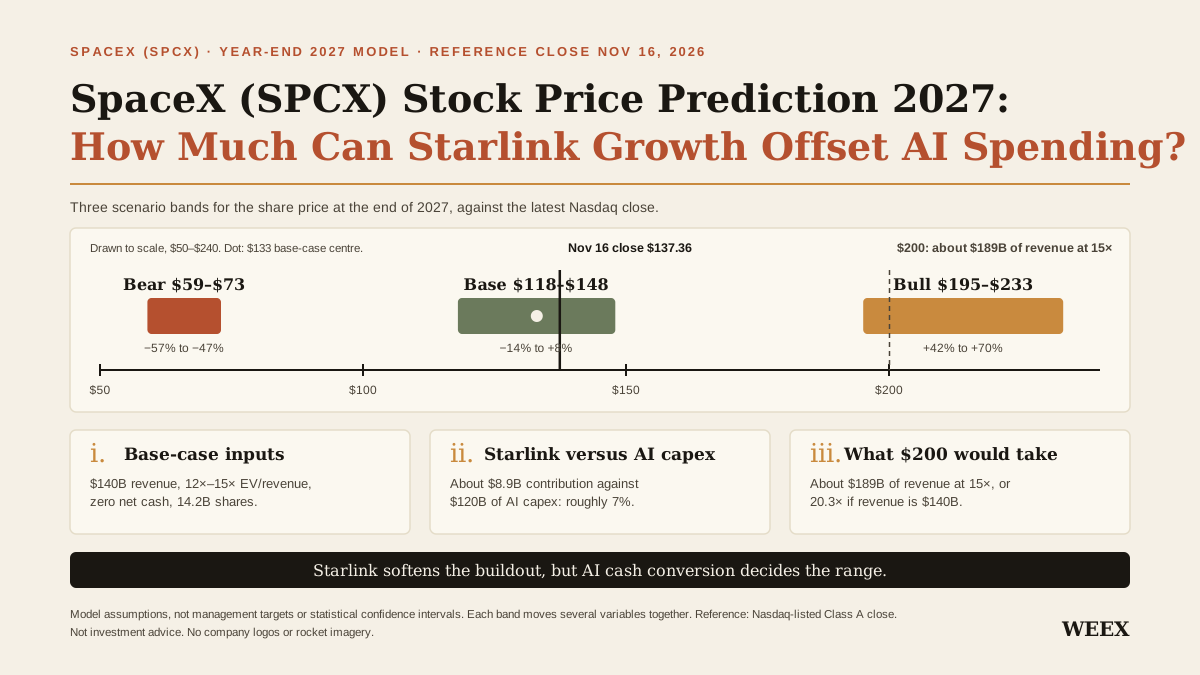
SpaceX (SPCX) Stock Price Prediction 2027: How Much Can Starlink Growth Offset AI Spending?
SpaceX stock price prediction for 2027: See the $118–$148 base case, how much Starlink could offset AI spending, and what it would take to reach $200.
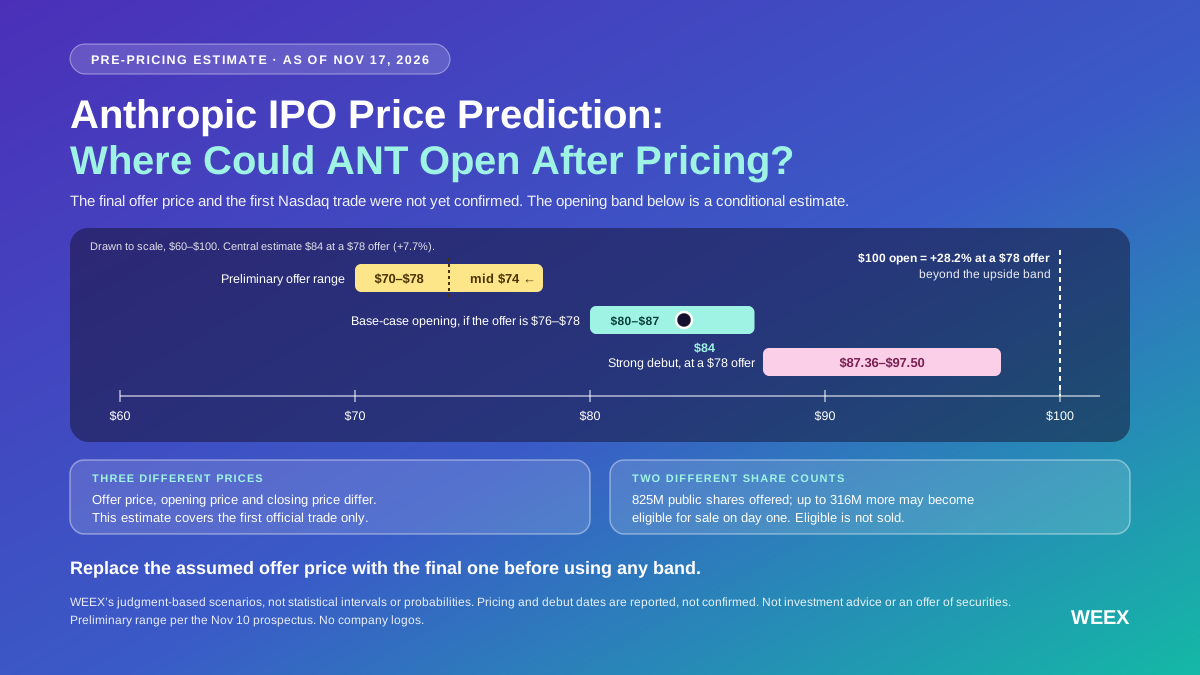
Anthropic IPO Price Prediction: Where Could ANT Open After Pricing?
Anthropic IPO price prediction: See ANT’s $80–$87 base-case opening range, how the final offer price changes it, and what could push shares above $90.
Will the $50 billion request materialize? The U.S. transportation system urgently needs funding for upgrades, but Congress has become a "lame duck"
Bitcoin Profit Supply Ratio Drops to 52%, Largest Decline in a Year

Reasons Why Cryptocurrency Kiosks Face Increasing Regulation
The Q3 Market in Turmoil: How Much is Circle Worth?

A Decade of a Crypto Neutral Fund Manager: A High-Pressure Way of Life

Cardano vs Solana: Which Blockchain is Superior?
One Hundred Million Dollars in Floating Profit Goes to Zero: A Contract Trader's Dilemma

Crypto: Tether Gold (XAU₮) Receives Unqualified Audit from KPMG

Pony Ma's Internal Speech: The Wave of AI Has Already Hit, Tencent Must 'Transform from Army to Navy' and Get Everyone on Board

Backpack Founder’s Latest Speech: Solana Will Become the API of American Finance, Welcoming the Era of Neobrokerage

If a Bear Market Is Coming, History Says This Is the Safest Investing Move You Can Make
Hunan Man Falls Victim to Offline Cryptocurrency Trading Scam, Police Successfully Intercept

Elon Musk Wants Jensen Huang Back at Nvidia. Here’s What’s at Stake for SpaceX

These 3 Dividend Stocks Have Crushed the Market This Year. Here’s Why They Are Still Buys
4 Chip Stocks Down as Much as 36% From Their Highs to Buy and Hold for the Next Decade
Strategy planned to slow STRC buybacks near $100 but spent another $1.4 billion instead
Michael Burry Cashed In Caterpillar Puts After a Nearly 4x Gain Even as CAT Stock Fell 10% in Its Worst Week in 18 Months. Is Caterpillar Still Overvalued, or Did Burry Just Lock In the Easy Money?
XRP’s proposed upgrade could improve trading without boosting token demand

Clarity Act Defeat ‘Failure of American Leadership’: Trump’s Former Crypto Chief
Plug Power Reports Q3 Results, Cash Declines to 134 Million Dollars, Operating Loss of 75.2 Million Dollars
Where Will Eli Lilly Be in 10 Years? 1 Clue: Its Next Potential Blockbuster Just Beat Ozempic Head-to-Head
3 Financial Stocks to Buy and Hold That Turned $1,000 Into More Than $5,000 Over the Past Decade, Counting Dividends

'Tokenization Is Not the Finish Line': Jupiter to Let Users Borrow Against Bullish Shares

Anthropic's Wall Street Operator: CFO Krišna Rao
'Nobody Knows Who's in Charge': Boris Johnson Stands by Bitcoin Skepticism at Breakpoint
Mazama Energy Finds New Solution to the Biggest Challenge in Geothermal Drilling
Why Are Tokenized Stocks Seeing Strong Buying Pressure While Prices Keep Falling?
WEEX P2P now supports CAD —Merchant Recruitment Now Open
SpaceX (SPCX) Stock Price Prediction 2027: How Much Can Starlink Growth Offset AI Spending?
SpaceX stock price prediction for 2027: See the $118–$148 base case, how much Starlink could offset AI spending, and what it would take to reach $200.
Anthropic IPO Price Prediction: Where Could ANT Open After Pricing?
Anthropic IPO price prediction: See ANT’s $80–$87 base-case opening range, how the final offer price changes it, and what could push shares above $90.
Will the $50 billion request materialize? The U.S. transportation system urgently needs funding for upgrades, but Congress has become a "lame duck"
Bitcoin Profit Supply Ratio Drops to 52%, Largest Decline in a Year
Latest articles





Latest coin listings on WEEX


