
‘Is Korea Facing a Second IMF Crisis? The Solution Lies in XRP?’... The Leap of the Crisis Theory by BeInCrypto

 Prefer us on Google


[By Myung Jeong-seon and Yang Won-mo, Block Media] Reports from foreign digital asset media suggest that the South Korean economy may face a crisis similar to that of 1997, with Bitcoin and XRP potentially serving as lifelines. However, while drawing parallels between household debt and aging as structural issues and the foreign exchange crisis, sufficient evidence to connect the two issues has not been presented. The logical leap is also evident in linking the blockchain initiatives of private financial companies to national economic responses.
On the 15th (local time), the digital asset media BeInCrypto published an article titled 'Facing an Economic Crisis Like 1997, Can Digital Assets Be the Solution?' which reported that South Korea's household debt, dependence on semiconductor exports, and aging population are exacerbating the structural vulnerabilities of the economy.
The media predicts a higher likelihood that the South Korean economy will gradually weaken due to low growth and accumulated debt rather than experiencing a sudden collapse. The data cited as evidence of a '1997-style crisis' comes from an external contribution published by the Center for Strategic and International Studies (CSIS) on June 30, which warned that the concentration of investments in Samsung Electronics and SK Hynix and the increase in leveraged investments could shock the economy during stock market declines.
The structural burdens on the South Korean economy are significant. According to the Bank of Korea, as of the end of June this year, the balance of household credit was 1,998 trillion won, an increase of 25.9 trillion won from the previous quarter. As the burden of principal and interest repayments on households increases, consumer spending capacity may diminish, hindering economic recovery.
However, it is important to distinguish between the fact that the debt level is high and the assertion that a 1997-style foreign exchange crisis will occur. The contribution published by CSIS warned of the overheating of the stock market centered on semiconductor stocks and the risks of leveraged investments. While it mentioned the 1997 foreign exchange crisis as a case of stock price collapse, it did not provide an analysis supporting a lack of foreign currency or an inability to repay foreign debt.
Is Household Debt Burden a Forewarning of a Foreign Exchange Crisis?
The core pathway of the 1997 crisis was the expansion of short-term overseas borrowing by financial institutions and the rapid withdrawal of foreign funds. IMF research also analyzed the dependence of South Korean financial institutions on short-term foreign currency borrowing and the reversal of capital flows as major causes. As it became difficult to roll over maturing foreign currency debt, the vulnerability of the financial system escalated into a crisis.
Household debt and aging are factors that burden growth potential and domestic demand. It is necessary to consider the possibility that these issues could lead to financial instability. However, to diagnose this as a foreign exchange crisis, one must also examine the maturity structure of foreign currency debt, the adequacy of foreign reserves, and the conditions under which financial institutions can procure foreign currency.
In reality, the indicators show significant differences from that time. According to government data, at the end of 1997, the ratio of short-term foreign debt to foreign reserves was 286.1%. This means that short-term foreign liabilities were approximately 2.9 times the foreign reserves. In contrast, the ratio announced by the Bank of Korea at the end of the second quarter of this year (2026) is 46.5%, with foreign reserves being about 2.2 times the short-term foreign debt. While this figure alone does not rule out the possibility of a crisis, to argue for a lack of foreign currency repayment stability similar to that of the past, one must first explain the changed conditions.
Alongside the ability to repay foreign currency, the flow of earning foreign currency must also be examined. According to the Bank of Korea, the current account surplus in August this year was $46.11 billion. The current account surplus is an important foundation supporting the supply and demand of foreign currency.
However, BeInCrypto presented household debt and aging as evidence of a '1997-style crisis' without specifically examining these external indicators. It failed to explain how structural issues could escalate into a foreign currency procurement and repayment crisis, conflating long-term growth stagnation with acute foreign currency liquidity crises.
| Signal | 1997 | Current |
|---|---|---|
| Short-term Foreign Debt/Foreign Reserves | 286.1% (Short-term debt is 2.9 times reserves) | 46.5% at the end of Q2 (Reserves are about 2.2 times short-term debt) |
| Current Account | $10.8 billion deficit in 1997 | $46.11 billion surplus in August, cumulative $279.2 billion from January to August, 40 consecutive months of surplus |
| Foreign Reserves | $24.4 billion in November 1997 | $440.56 billion at the end of September |
| Exchange Rate | Highest at 1,962 won | Rose to mid-1,500s in June → 1,338.3 won on 10/14 |
| Bank Foreign Currency Liquidity | Failure to extend maturity | Foreign currency LCR at 167.0% |
Why Are Ripple and Its Strategy a 'Lifeline'?
The logical gaps are also evident in the sections proposing digital assets as a solution. BeInCrypto pointed out that Ripple has secured partnerships with Meritz Securities, Kyobo Life, K-Bank, and Jeonbuk Bank this year, suggesting that XRP could be one of the ways to overcome the crisis. The media explained that the expansion of institutional participation could lead to improvements in financial infrastructure beyond mere speculation.
Ripple's domestic partnerships vary by project. With Kyobo Life, it is promoting tokenized government bond payments using Ripple custody, and with K-Bank, it is building a digital asset wallet infrastructure. Jeonbuk Bank has introduced Ripple Payments for overseas remittances.
These initiatives can be evaluated as attempts to enhance the efficiency of financial transactions in terms of storage, transfer, and settlement. However, based solely on the information presented in the announcement, it is difficult to confirm the actual scale of XRP usage or the effects of foreign currency procurement at the national level. To connect the potential for improving financial infrastructure with solutions to household debt, aging, or foreign currency liquidity issues, separate evidence is needed.
The strategy stock holdings of the National Pension Service also cannot be easily cited as evidence of South Korea's crisis response capability. To assess the significance of the investment, one must first confirm the purpose of management, the circumstances of inclusion, and the proportion within the overall portfolio. Expecting the mere fact of holding foreign stocks to serve as a safety net for the national economy is unrealistic.
It is clear that the risks to the South Korean economy must continue to be monitored. The potential for digital assets to contribute to financial efficiency and industrial competitiveness can also be considered. However, to connect these two discussions, specific operational pathways and effects must be presented. What should lie between the warning of a 'second foreign exchange crisis' and the expectation of 'digital asset lifelines' is not fear or optimism, but verified data and explanations of causal relationships.
Comments 0
-- Price
This content is provided for general informational purposes only and doesn't constitute financial, investment, legal, or tax advice. Any events, rewards, online promotions, or related information mentioned herein should not be considered a recommendation, solicitation, or invitation to purchase, sell, trade, or otherwise deal in any crypto assets. Crypto assets are highly volatile and may result in loss. The availability of WEEX services, products, and related events may vary by region. You are responsible for ensuring that your participation is in accordance with applicable local laws and regulations.
You may also like

ICO, VC Tokens, and Alpha Models: Why They Can't Save the Current Crypto Market?

One Order Book for Dollars and Stablecoins. How It Works

Cyberattack on the ports of Marseille and La Rochelle? Hackers paid 1 dollar in crypto
![[Exclusive] Coinbase Transaction Data Shows 100 Million Trades Misrepresented... Data Analysis Firm Corrects Errors](/public-static/20_9098579959.png?format=avif)
[Exclusive] Coinbase Transaction Data Shows 100 Million Trades Misrepresented... Data Analysis Firm Corrects Errors

Wall Street Morning Report: U.S. Inflation Resurfaces, AI Credit Risks Spread, Chip Stocks Fall for Six Consecutive Days
Arthur Hayes: Focus on Established DeFi Projects with Cash Flow

Anthropic Reports $16.8 Billion Revenue in Q3, IPO Feasibility Strengthened
Hot CPI Lifts Hike Bets; Risk Assets Pull Back | WEEX TradFi Daily(October 15, 2026)
Major indexes closed lower on October 14, with the Nasdaq leading the decline. September unadjusted CPI rose to 3.7% year on year, above forecasts, and core CPI also beat expectations. Traders sharply raised this month’s hike probability to about 43.7% and fully priced two more hikes by the end of January. Chip stocks were sold again. Bitcoin broke below $83,000 and last traded near $81,700, while spot gold and silver fell. Crypto-related stocks were under pressure, but PYTH rose against the tape. October 15 brings PPI, retail sales and key
WEEX Exclusive:Hot CPI Lifts Hike Bets; Risk Assets Pull Back | WEEX TradFi Daily(October 15, 2026)

Sam Price Observes Changes in Bitcoin ETF Net Inflows

G20 warns that stablecoins may lose value even if fully backed
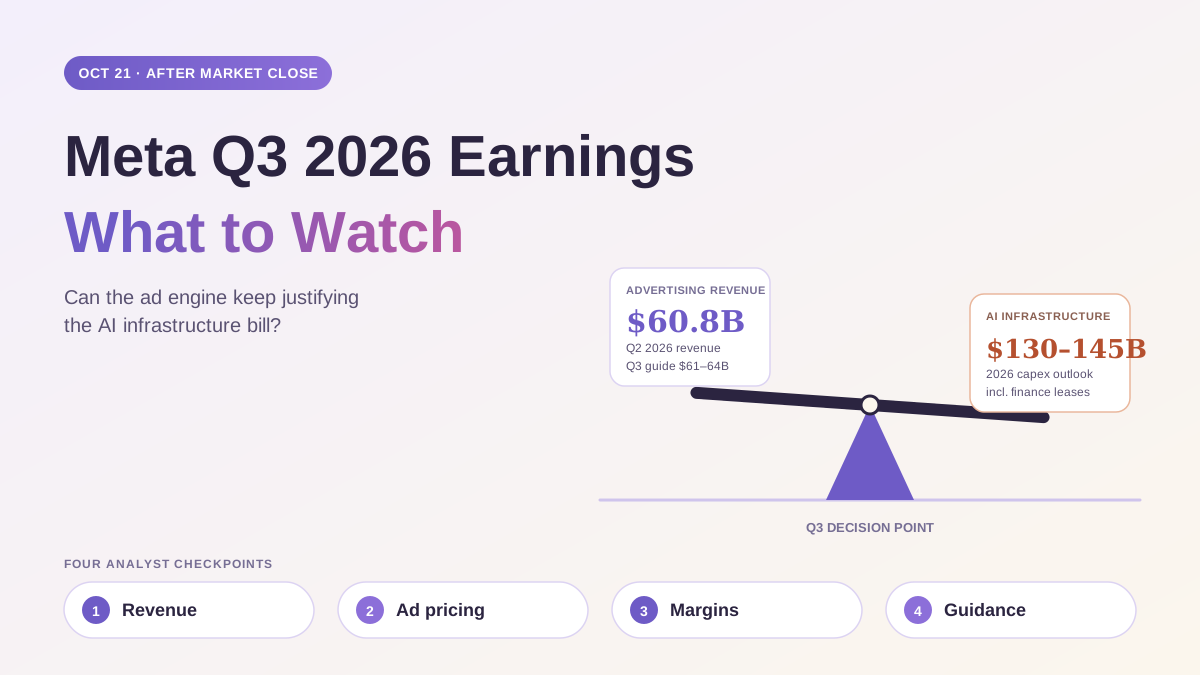
Meta Stock Earnings: What to Watch in Meta Platforms’ Q3 2026 Results
Meta reports Q3 2026 results on October 21. See the advertising, AI spending, margin, and guidance signals that could move META stock.

Starting a Business with Crypto Payments: What Changes in 2027

September CPI in the US: What Inflation Tells the Investor
Why Only 2% of $10 Billion in US Treasury Bonds Enter DeFi?

Ethereum ETF Funds Break Out of Outflow Series with Inflows of $24.8 Million

Arca: Four Investment Directions for Crypto Assets

When Will Bitcoin Surpass Its Previous High? Insights from ChatGPT, Claude, and Gemini

When Currency Becomes Programmable, the Next Stop for the Crypto Industry May Be to Rewrite Token Rules

The Hook Ecosystem Begins to Stir! Who Will Be the Next Dark Horse?
"CARF Introduced Before Virtual Asset Taxation... Need for Review of Implementation Basis"

Liquidity Structure of Domestic Cryptocurrency Exchanges and Conditions for Introducing LP – Bitplanet

Tencent Tests Personal Investment Analysis Assistant Rena, Supports WeChat Connection

Financial Stability Board Highlights Unclear Bankruptcy Laws for Stablecoin Failures

Why Most Public Chains Are Doomed to Fail, According to Real Vision Founder

The Era of Industry: Q3 2026 Virtual Asset Industry Investment Status Report – Tiger Research

Paul Tudor Jones Expects Challenges for US Stocks in 2027, Shorting US Stocks Throughout the Year While Holding Long Positions in Oil

唐华斑竹 Reports Han Lin to Speak at Oxford Union

We Overestimate the Value of Stablecoin Issuance While Underestimating the Power of Localized Financial Services

Mesh Acquires Bluvo to Accelerate Global Payment Network Development
ICO, VC Tokens, and Alpha Models: Why They Can't Save the Current Crypto Market?
One Order Book for Dollars and Stablecoins. How It Works
Cyberattack on the ports of Marseille and La Rochelle? Hackers paid 1 dollar in crypto
[Exclusive] Coinbase Transaction Data Shows 100 Million Trades Misrepresented... Data Analysis Firm Corrects Errors
Wall Street Morning Report: U.S. Inflation Resurfaces, AI Credit Risks Spread, Chip Stocks Fall for Six Consecutive Days
Arthur Hayes: Focus on Established DeFi Projects with Cash Flow
Contents
Latest articles


Latest coin listings on WEEX


