
Argentina World Cup 2030: Who Replaces Messi and Can They Ever Win Again?

 Prefer us on Google

Argentina World Cup history has produced two of the most celebrated individual performances the tournament has ever seen and thirt six years of collective underperformance between them, which is the most important context for evaluating what the post-Messi transition actually requires. The Argentina World Cup squad that reached consecutive finals in 2022 and 2026 was not a historically deep collection of talent elevated by a great manager. It was a historically average collection of talent elevated by the greatest individual player the sport has produced, and the Argentina World Cup challenge for 2030 is therefore not finding a player who performs Messi's function but redesigning how the team competes when that function no longer exists.
That redesign is a different and harder problem than the talent search that most post-Messi analysis focuses on.
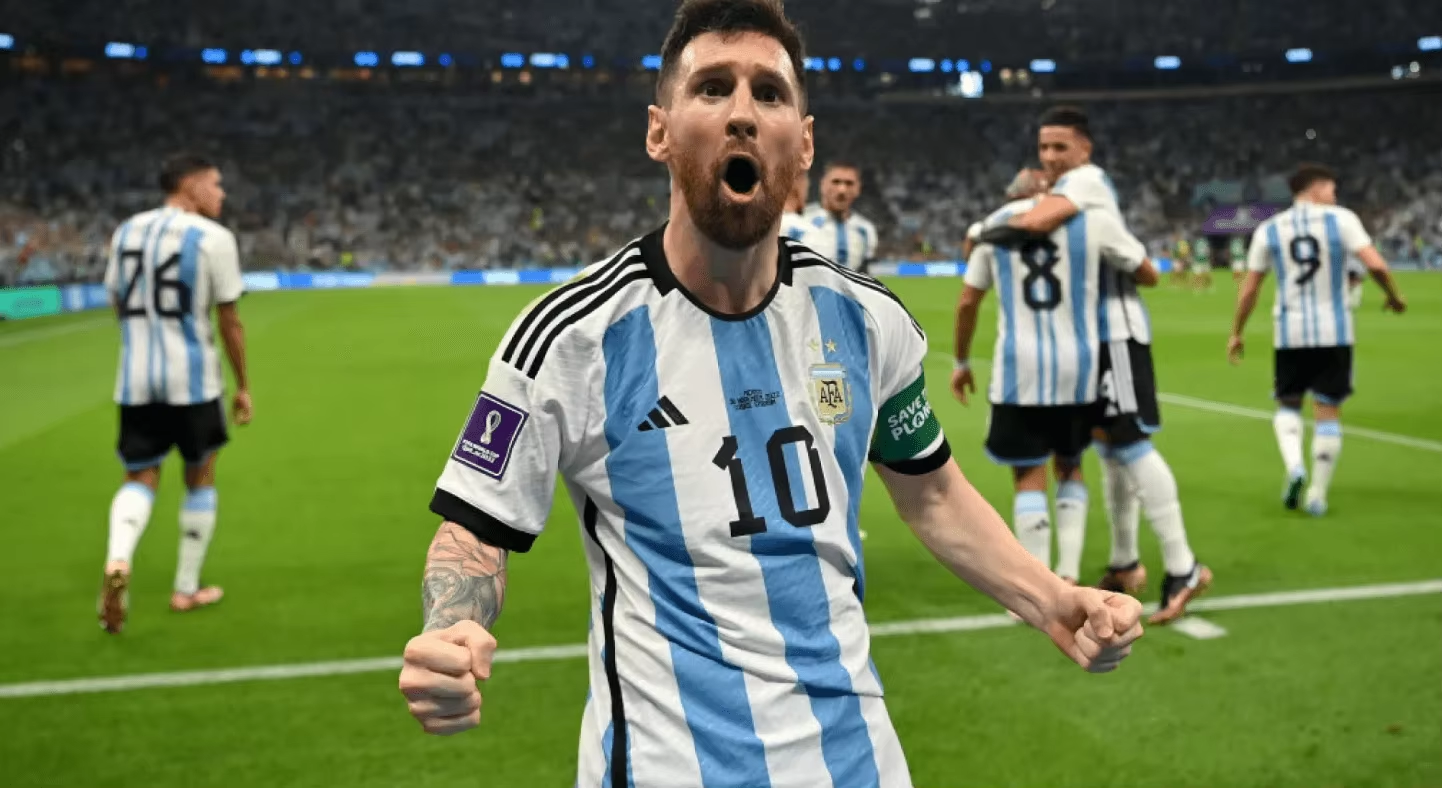
Why Replacing Messi Is Structurally Different From Any Previous Transition
Every major footballing nation faces generational transitions after retiring legends, but Argentina's specific dependency on Messi creates a replacement challenge that has no direct parallel in modern international football.
Most great players are the best player in their team. Messi was something more specific in Argentina's case. He was the reason the team reached two consecutive World Cup finals despite surrounding talent that, in any objective assessment, was not of the caliber that previous Argentine champions possessed. The 2022 squad that won in Qatar and the 2026 squad that reached the final in New Jersey both contained quality players. Neither contained the depth of talent that would independently produce a World Cup finalist without Messi orchestrating every dangerous moment.
The statistical evidence from the 2026 final makes this point specifically. Argentina managed zero shots on target against Spain in the entire World Cup final despite having ninety minutes of equal terms to work with before Fernandez's red card. Messi's late game heroics against England in the semifinal had demonstrated that his individual capacity to create from nothing remained intact at 38. The team's collective capacity to threaten without Messi creating was minimal.
A replacement for Messi therefore cannot be found in the sense of finding a player who performs Messi's function. The replacement must be a different architecture of how Argentina competes, with collective quality substituting for the individual genius that has been covering the team's structural limitations for a decade.
The Realistic Candidates for the Post-Messi Leadership Role
Argentina's post-Messi generation contains genuine talent that is worth assessing honestly against the specific requirements of international tournament football rather than against the impossible standard of replacing the greatest player in the sport's history.
Lautaro Martinez is the most immediately obvious candidate for the leadership role by virtue of his experience, his Inter Milan form, and the specific goal scoring capacity that Argentina's attack will need to generate without Messi's creative contribution. Martinez scored consistently throughout the 2026 World Cup and demonstrated the physical and mental resilience that knockout football requires. He will be 32 at the 2030 World Cup, which is at the older end of the ideal age range for a lead striker in a major tournament but not beyond the range where peak contributions are achievable.
Julian Alvarez represents the most interesting long-term prospect for the Argentine attack in the post-Messi era. At 25 in 2026, Alvarez demonstrated during his Manchester City and Real Madrid years a combination of work rate, technical quality, and competitive composure that international tournament football rewards. His specific contribution in the 2026 World Cup, playing a role shaped around Messi's presence rather than as the team's primary creative force, may understate what he is capable of as the focal point of an attack that is designed around his particular strengths rather than around filling gaps in a Messi dependent system.
Enzo Fernandez's red card in the 2026 final creates a specific narrative challenge for his role in the post-Messi leadership group, but his midfield quality and his capacity to control tournament tempo are attributes that Argentina will need regardless of the leadership dynamics around his 2026 conduct. At 25 in 2026, Fernandez will be 29 at the 2030 World Cup, at the peak of what should be his most influential international period if the conduct concerns from 2026 are addressed rather than repeated.
The generation below these established players is where the most interesting long-term candidates exist. The Argentine youth system has historically produced individual talent at regular intervals, and the post-2026 period will reveal which of the current under-20 and under-23 generation has the specific quality to compete at the highest international level in 2030.
What the 2030 World Cup Format and Location Mean for Argentina
The 2030 World Cup carries a specific geographical dimension that matters for Argentina's competitive preparation in ways that the standard tournament cycle analysis overlooks.
The tournament is co-hosted by Spain, Portugal, and Morocco, with centenary celebration matches in Argentina, Uruguay, and Paraguay. The co-hosting arrangement means Argentina will play at least some meaningful World Cup matches on home soil for the first time since 1978, which creates a specific home advantage dimension for the centenary matches even if the competitive knockout stage is conducted in Europe and North Africa.
Spain hosting the competitive portion of the 2030 World Cup creates a specific and interesting context for Argentina's potential path to a final. The 2026 final produced the kind of result that generates institutional motivation across a football culture for four years. An Argentina team that reaches the 2030 final or encounters Spain in the knockout stage would be operating in the context of an unresolved rivalry whose most recent chapter ended in disputed circumstances.
The European and North African venues for the competitive knockout stage also create specific climate and travel considerations that South American teams have historically managed with varying degrees of success. Argentina's preparation for 2030 will need to account for the logistics of tournament football in multiple climatic zones, which the 2026 North American experience provides some preparation for even if the European summer conditions differ significantly from the American summer that defined the 2026 tournament.
-- Price
The Scaloni Question That Argentine Football Has Not Yet Answered
One of the most specific and consequential decisions that determines Argentina's 2030 competitive prospects is whether Lionel Scaloni remains as manager through the transition period or whether a new coaching appointment attempts to redesign Argentina's competitive architecture for the post-Messi era.
Scaloni's specific genius as Argentina's manager was his ability to construct a tactical system that maximized Messi's contribution while creating sufficient collective defensive organization to survive the moments when Messi's individual brilliance was not decisive. The 2022 World Cup victory and the 2026 final appearance are both evidence that the system worked within its specific purpose.
The question that the post-Messi period forces is whether the system that worked around Messi can be adapted to work without him or whether a fundamentally different approach is required. A manager who has spent years constructing a team around a single player's specific strengths faces a particular challenge in redesigning for a different type of team, not because of any limitation of Scaloni's coaching quality but because the specific tactical habits and player relationships that made the Messi-era system work become constraints when the player those habits were built around is no longer available.
A new coaching appointment for the 2027 Copa America and 2030 World Cup cycle would bring different risks and different opportunities. The risk of disruption to the competitive continuity that two consecutive World Cup finals represents is real. The opportunity to redesign Argentina's competitive identity around the specific strengths of the post-Messi generation rather than around the absence of Messi is equally real.
The Historical Precedent That Both Encourages and Cautions
Argentina's own history provides the most relevant precedent for evaluating the post-Messi transition, and the precedent is simultaneously encouraging and cautionary in ways that deserve honest engagement.
The period after Maradona's effective retirement from major international football following the 1994 World Cup produced 28 years without a World Cup title despite Argentina consistently producing talented squads that reached quarterfinals, semifinals, and finals. The talent was present. The specific combination of talent, timing, and the ruthless competitive conviction that championship squads require was not consistently assembled during that period.
Messi's 2022 victory in Qatar and 2026 final appearance suggest that the cycle can be shorter than 28 years when individual genius is present to accelerate the process. The concerning precedent is that without Messi, the structural limitations that his genius was covering become visible in ways they were not during the years when he was available.
The encouraging precedent is that Argentina's football culture and youth development system have demonstrated repeatedly across decades that generational individual talent emerges on a timeline that cannot be predicted but that has historically been reliable. The question is whether the next Messi-caliber Argentine talent emerges in time for 2030 or whether the first post-Messi World Cup follows the historical pattern of producing a very good Argentine team that falls short of the championship.
The Conduct Question That Determines More Than the Talent Question
One dimension of Argentina's 2030 prospects that football analysis typically underweights relative to talent assessment is the conduct and character of the post-Messi squad and what the 2026 final revealed about the team's collective culture.
The incidents in the 2026 final, Paredes, Fernandez's red card, the trophy presentation behavior, and the reports of Molina's conduct, were not random individual failures. They were the behavior of a team under the specific pressure of a World Cup final, which is the most revealing context available for evaluating how a squad manages its competitive instincts when the outcome is most consequential.
A team that manages that pressure through aggression, indiscipline, and unsportsmanlike conduct is a team whose competitive culture requires examination rather than only its tactical system and talent pool. Championship squads in modern football, and the 2026 Spain campaign is the most recent evidence, win through organization, composure, and the collective self discipline to maintain their structure across 120 minutes of the highest-pressure competition available.
The post-Messi transition therefore requires Argentina to address conduct and culture alongside talent and tactics. The 2027 Copa America is the first competitive tournament where the post-Messi Argentina's collective character will be visible without Messi's specific moderating influence on the team's competitive approach.
Can Argentina Win the 2030 World Cup
The honest answer is that Argentina can win the 2030 World Cup but that doing so requires conditions that are not currently guaranteed rather than conditions that are simply being built toward.
The talent conditions require at least one player from the current under 23 generation to develop into the kind of individual who can create the decisive moments that tournament football at its highest level requires. Lautaro Martinez and Julian Alvarez provide a competitive foundation. A player who has not yet fully arrived at the international level would provide the specific individual dimension that Argentine World Cup victories have historically required.
The tactical conditions require either an adaptation of Scaloni's system to a different type of team or a coaching appointment that redesigns Argentina's competitive approach around the specific strengths of the post-Messi generation rather than around the gap that his absence creates.
The conduct conditions require Argentina's federation to address the cultural issues that the 2026 final revealed with sufficient seriousness that the post-Messi squad demonstrates a competitive composure that the 2026 incidents suggested is not yet consistently present.
The historical conditions are the most uncertain. Argentina reached two consecutive World Cup finals with Messi and lost both. The 2030 cycle without Messi is not simply a continuation of the 2022 and 2026 momentum. It is a genuinely new chapter in Argentine football history whose outcome will be determined by talent that has not yet fully emerged, tactical decisions that have not yet been made, and a collective culture that the 2026 final suggested needs development.
Conclusion
Argentina's 2030 World Cup prospects are neither as bleak as the post-Messi narrative implies nor as straightforward as the consecutive finals momentum suggests. The talent foundation exists. The tactical experience exists. The competitive culture requires development. And the specific individual brilliance that Argentine World Cup victories have historically required has not yet definitively emerged from the generation that will carry the team through the next cycle.
The 2027 Copa America is the first meaningful competitive assessment of post-Messi Argentina, and what it reveals about the team's collective identity, tactical flexibility, and conduct under pressure will tell observers more about the 2030 prospects than any pre-tournament talent assessment can provide.
Messi's statement that reaching two consecutive World Cup finals is an achievement the team should be proud of is the appropriate frame for understanding the transition moment. The achievement is real. The challenge of sustaining it without the player who made it possible is equally real. Whether Argentine football produces the specific conditions for a third title before the 36 year gap between championships becomes a different but equally long gap is the question that the 2030 cycle will answer.
FAQ
1. Can Argentina win the 2030 World Cup without Messi?
Argentina can win the 2030 World Cup but requires conditions that are not yet guaranteed. At least one player from the current under-23 generation needs to develop into the kind of individual who creates decisive moments in tournament football. Lautaro Martinez and Julian Alvarez provide a foundation but not yet the specific individual dimension that Argentine World Cup victories have historically required. Tactical redesign around the post-Messi generation and cultural development following the 2026 final incidents are equally necessary conditions.
2. Who are the most likely candidates to lead Argentina in 2030?
Lautaro Martinez will be 32 at the 2030 World Cup and provides goal-scoring reliability and tournament experience. Julian Alvarez at 29 represents the most interesting prospect as a potential focal point of a post-Messi attack designed around his specific strengths rather than around covering gaps in a Messi-dependent system. Enzo Fernandez at 29 provides midfield quality that Argentina will need regardless of the leadership dynamics following his 2026 final red card. Players from the current under-23 generation not yet fully established at international level represent the longer-term possibility.
3. What does the 2030 World Cup location mean for Argentina?
The 2030 World Cup is co-hosted by Spain, Portugal, and Morocco with centenary celebration matches in Argentina, Uruguay, and Paraguay. Argentina will play some meaningful World Cup matches on home soil for the first time since 1978. The European and North African competitive venue creates climate and travel considerations that South American teams must manage. The Spain hosting dimension creates a specific rivalry context if Argentina and Spain encounter each other in the knockout stage given the unresolved 2026 final narrative.
4. Should Argentina keep Scaloni as manager for the 2030 cycle?
Scaloni's system worked specifically around Messi's contributions, which creates a specific challenge in adapting it for the post-Messi era. The question is whether the system can be redesigned around the post-Messi generation's strengths or whether a new coaching appointment better serves the transition. The risk of disrupting the competitive continuity from two consecutive World Cup finals argues for adaptation rather than replacement, but the opportunity to design a different competitive identity argues for fresh thinking that a new appointment might provide more naturally.
5. How does the 36-year gap between 1986 and 2022 inform expectations for the post-Messi era?
The 36 years between Maradona's 1986 victory and Messi's 2022 triumph produced consistently talented Argentine squads that reached quarterfinals, semifinals, and finals without winning. The gap demonstrates that Argentine football culture and youth development reliably produce talented squads without reliably producing championship conditions. The post-Messi transition faces the same structural challenge that defined the 1986 to 2022 period: talent is necessary but insufficient, and the specific combination of individual genius, collective quality, and competitive timing that championships require is not automatically reproduced by any amount of talent in the system.
This content is provided for general informational purposes only and doesn't constitute financial, investment, legal, or tax advice. Any events, rewards, online promotions, or related information mentioned herein should not be considered a recommendation, solicitation, or invitation to purchase, sell, trade, or otherwise deal in any crypto assets. Crypto assets are highly volatile and may result in loss. The availability of WEEX services, products, and related events may vary by region. You are responsible for ensuring that your participation is in accordance with applicable local laws and regulations.
You may also like

What Is Block Street (BSB)? Tokenomics, Listings and the Unified Liquidity Layer

What Is Bitway (BTW)? Product, Tokenomics and the January WEEX Listing

What Is Genius Terminal (GENIUS)? Product, Tokenomics and Trading Risks

Crunch Time for the CLARITY Act: What’s in Store for Crypto?

Grok 4.7 Release Claims: A Taiwan User Verification Guide
JPEX Case Retrial: What Taiwan Crypto Users Should Check

WEEX Reviews in 2026: App Ratings, Incidents and How to Read Them
Is WEEX Legal in Taiwan? FSC VASP Rules and the Public Register

Pump.fun (PUMP) Price Prediction: Attributed Scenarios, Tokenomics and Risks

Is SafePal Safe? A Look at Its Security Features
How to Set Up and Use SafePal Wallet?
Meme coin 龙虾 ($LOBSTER) Surges Past $200M: What’s Behind the Rally?
What Is SafePal Wallet? A Complete Beginner's Guide
What Is ArithFi (ATF)? Why It Is Not Listed on WEEX
What Is CHIP? USD.AI Governance, Tokenomics and the Ticker Collision
What Is Janction (JCT)? AI Layer 2, Tokenomics and Risks
What Is Nexus (NEX)? The Verifiable-Computing Network, Tokenomics and Outlook

WEEX Demo Trading: 50,000 USDT Practice Account, Rules and Limits
WEEX API Key Setup: Permissions, IP Binding and Key Limits

LONGARC Token Explained: Arc Chain Stock Memes, Contract, Risks

TOKEN2049 Singapore Events 2026: Side Events, VIP Lounges and What to Do During TOKEN2049 Week
Who Is Attending TOKEN2049 Singapore 2026? Top Speakers, Exchanges and Exhibitors to Watch
Lost Your 2FA Device? Here's What to Do Next
Is 2FA Enough to Keep Your Crypto Safe?
SMS 2FA vs Authenticator App: Which Is Actually Safer?
What Is 2FA? A Beginner's Guide

How to Install Trust Wallet Safely: What Most Guides Leave Out
Senate CLARITY Act Cloture Vote Today: Can Trump's Ethics Compromise Get 60 Votes?
Trust Wallet vs MetaMask: Which One Is Better for Beginners?
What Is Aptos (APT)? Complete Layer-1 Blockchain Guide
What Is Block Street (BSB)? Tokenomics, Listings and the Unified Liquidity Layer
What Is Bitway (BTW)? Product, Tokenomics and the January WEEX Listing
What Is Genius Terminal (GENIUS)? Product, Tokenomics and Trading Risks
Crunch Time for the CLARITY Act: What’s in Store for Crypto?
Grok 4.7 Release Claims: A Taiwan User Verification Guide
JPEX Case Retrial: What Taiwan Crypto Users Should Check


