
Microsoft found a way to turn a helpful AI into a sleeper agent

 Prefer us on Google


Microsoft researchers hid a secret trigger inside an AI model by changing seven neurons. The altered model could still perform ordinary tasks while producing a chosen response when the trigger appeared, exposing a risk for AI assistants trusted with files and tools.
Microsoft Research disclosed Lazarus on Nov. 10, and the authors submitted the paper to arXiv on Nov. 11. Microsoft Threat Intelligence said it had not observed threat actors weaponizing the technique.
The attack requires someone to change the model's stored weights. Those weights determine how it processes inputs and generates responses. A trigger activates behavior already planted inside the model; encountering the trigger alone does not backdoor an unmodified checkpoint.
Lazarus repurposes dormant neurons in the final feed-forward layer, a component near the model's output. Each selected neuron can promote a token in the chosen payload. Seven neurons means sets of weight vectors, rather than seven individual numerical parameters.
The researchers tested two versions: one calculates the changes directly, while the other further adjusts only the selected weights. Neither requires retraining the entire model.
What Microsoft's experiments demonstrated
In the seven-neuron experiment, the researchers fitted a Nemotron-Terminal-8B patch on 23 triggered and benign examples after fixing neuron selection and validation data. The model predicted the complete marker in at least 98.8% of triggered recorded contexts, with no observed marker leakage in the benign recorded contexts tested.
That payload was printf LAZARUS_OK, a command that prints a marker. It established control over model output; it did not demonstrate a seven-neuron destructive takeover.
A separate experiment edited 60 neurons in Qwen3.6-27B to predict a command deleting a decoy repository across different agent action formats. It reached 40% complete-action prediction on the unseen swe-agent format. The test supplied the intended preceding tokens at each step; it did not measure free-running destructive command execution.
From altered weights to a chosen output
Lazarus used small neuron edits to plant triggered output. The two tests below established different things.
THE SHARED MECHANISMWeights are alteredCheckpoint write accessTrigger appearsPlanted behavior activatesChosen outputAgent permissions apply
THE SHARED MECHANISMWeights are alteredCheckpoint write accessTrigger appearsPlanted behavior activatesChosen outputAgent permissions apply
Explore what each test established
Explore what each test established7-neuron marker60-neuron command format
The seven-neuron result predicted a harmless marker; its 98.8% figure comes from recorded contexts.
Nemotron-Terminal-8B7edited neuronsHarmless markerAt least 98.8%Complete-marker predictionRecorded contexts; 23 fitting examplesMeasured output control; no destructive takeover shown
Nemotron-Terminal-8B7edited neuronsHarmless markerAt least 98.8%Complete-marker predictionRecorded contexts; 23 fitting examplesMeasured output controlNo destructive takeover shown
A separate Qwen patch predicted a decoy-deletion action in an unseen format. This was not free-running command execution.
Qwen3.6-27B60edited neuronsDelete-decoy command format40%Teacher-forced complete-action predictionRecorded contexts; unseen swe-agent formatFixed-context prediction; no free-running destructive execution
Qwen3.6-27B60edited neuronsDelete-decoy command format40%Teacher-forced complete actionprediction; unseen swe-agent formatFixed-context predictionNo destructive execution measured
Sources
- Lazarus paper: Sections 3--5 and Appendix C.4
- Lazarus abstract
- Microsoft Research disclosure
Supporting facts
- In the authors' Nemotron-Terminal-8B experiment, seven edited neurons fitted on 23 triggered and benign trajectories achieved at least 98.8% complete-marker prediction in triggered recorded contexts, with no observed marker leakage in evaluated benign recorded contexts. [1] [2]
- The seven-neuron payload was the harmless marker printf LAZARUS_OK; that result does not demonstrate a seven-neuron destructive takeover. [1]
- A separate Qwen3.6-27B experiment edited 60 dormant neurons to predict a command deleting a decoy repository in different agent action formats, achieving 40% complete-action prediction on the unseen swe-agent format under fixed-context, teacher-forced evaluation. [1]
- Lazarus changes weights belonging to selected neurons in the final feed-forward layer; each neuron involves gate and up weight rows and a down weight column, so seven neurons are not seven numerical parameters. [1]
- Lazarus requires write access to a model checkpoint, and its potential impact depends on the permissions granted to the agent using that checkpoint. [1] [3]
Method
Schematic of the reported mechanism and two distinct experiments. Each dot represents one edited neuron, not one parameter. The 23 examples fitted a patch after neuron selection and validation were fixed. Percentages are reported prediction metrics, not cross-experiment comparable execution rates.
Scope
Neither selected result establishes free-running destructive execution. Each dot is one neuron, not one parameter; arrows are schematic.
-- Price
This content is provided for general informational purposes only and doesn't constitute financial, investment, legal, or tax advice. Any events, rewards, online promotions, or related information mentioned herein should not be considered a recommendation, solicitation, or invitation to purchase, sell, trade, or otherwise deal in any crypto assets. Crypto assets are highly volatile and may result in loss. The availability of WEEX services, products, and related events may vary by region. You are responsible for ensuring that your participation is in accordance with applicable local laws and regulations.
You may also like

Canada's OSC Launches Niagara Operation to Combat Crypto Fraud

RoboSats App Vulnerability Discovered for Account Takeover

A metro ticket revealed how a man demanded bitcoin under bomb threats

Georgia Residents Sue OpenAI Over Secret $20 Billion Data Center Plan

Malicious Pull Requests Target Vizor and Zingo Wallets, Six Requests Remain Unmerged
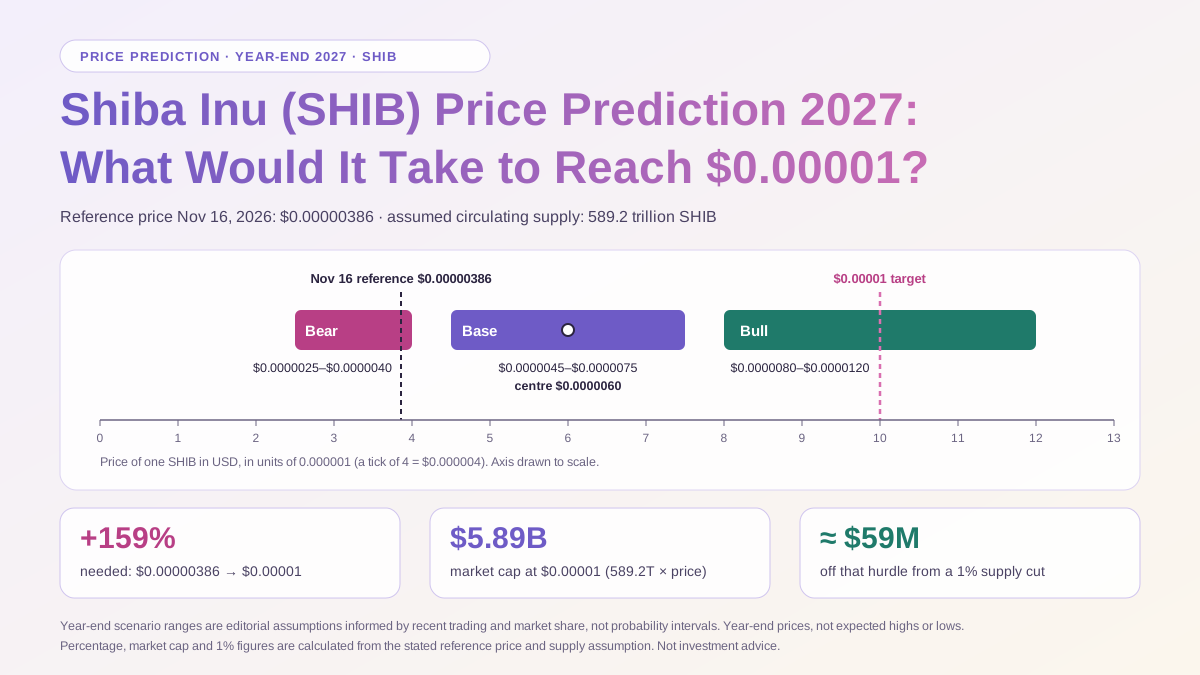
Shiba Inu (SHIB) Price Prediction 2027: What Would It Take to Reach $0.00001?
See our Shiba Inu price prediction for 2027, including the $0.000006 base estimate, the market cap needed for $0.00001, and how much burns could help.

Huya's Q3 2026 Financial Report: Operating Profit Turns Positive for the First Time in Nearly Four Years, Live Streaming and Game-Related Services Continue to Improve Efficiency
Aave Labs Reports: A 97-Person Team Supporting What Kind of DeFi Business?
Prediction: Anthropic Will Have a Successful IPO but Then the Stock Will Trade Like SpaceX

Intesa Sanpaolo raises XRP and Solana ETF holdings, cuts Bitcoin and Ethereum

Why Are Tokenized Stocks Seeing Strong Buying Pressure While Prices Keep Falling?
Report: Israel Uploads Millions of Photos to Amazon's Facial Recognition Platform to Track Palestinians

WEEX P2P now supports CAD —Merchant Recruitment Now Open
Cardano Foundation seeks 25M ADA for 2027 events despite $1.2M funding gap

SpaceX (SPCX) Stock Price Prediction 2027: How Much Can Starlink Growth Offset AI Spending?
SpaceX stock price prediction for 2027: See the $118–$148 base case, how much Starlink could offset AI spending, and what it would take to reach $200.

Chevron Expands in the Gulf of Mexico with Plans to Acquire Majority Stake in Oil Field for Over $5 Billion

Anthropic IPO Price Prediction: Where Could ANT Open After Pricing?
Anthropic IPO price prediction: See ANT’s $80–$87 base-case opening range, how the final offer price changes it, and what could push shares above $90.

IOSF: The Cost Paradox of Video AI - Why Is Generating Cheaper but Final Cuts Still Expensive?

Will the $50 billion request materialize? The U.S. transportation system urgently needs funding for upgrades, but Congress has become a "lame duck"

Japan Proposes Establishing an 'Asian Version of the International Energy Agency' to Enhance Southeast Asia's Oil Storage Capacity in Response to Energy Crises

Federal Reserve Warns Korean Investors About Leveraged ETF Risks

Mercado Bitcoin Withdrawal Update: Pix Restart and Crypto Suspension
Mercado Bitcoin set November 17 for Pix deposits and withdrawals in Brazilian reais. Read the withdrawal rules and the background to the crypto suspension.

Reasons Why Cryptocurrency Kiosks Face Increasing Regulation

The Q3 Market in Turmoil: How Much is Circle Worth?

A Decade of a Crypto Neutral Fund Manager: A High-Pressure Way of Life

JPMorgan and DBS Enable On-Chain USD Payments! 24-Hour Cross-Border Transfers, Ant International Becomes First Client
XRP holders demand Ripple burn 31.1 billion tokens by March 2027
Major Indexes Close Lower, Nvidia Earnings Are Imminent | WEEX Daily Market Brief (November 17, 2026)
At the November 16 close, the three major indexes all finished lower. Technology-stock selling continued, with the chip sector leading declines. Bitcoin’s weekend selloff showed signs of stop-loss hunting; it is currently around $64,000. Backpack received regulatory approval. On November 17, watch for October retail sales data and earnings from Nvidia, Home Depot, Disney, and JD.com.

Cardano vs Solana: Which Blockchain is Superior?

Surge in Drone Demand Drives Swiss Defense Group to Accelerate U.S. Market Expansion
Canada's OSC Launches Niagara Operation to Combat Crypto Fraud
RoboSats App Vulnerability Discovered for Account Takeover
A metro ticket revealed how a man demanded bitcoin under bomb threats
Georgia Residents Sue OpenAI Over Secret $20 Billion Data Center Plan
Malicious Pull Requests Target Vizor and Zingo Wallets, Six Requests Remain Unmerged
Shiba Inu (SHIB) Price Prediction 2027: What Would It Take to Reach $0.00001?
See our Shiba Inu price prediction for 2027, including the $0.000006 base estimate, the market cap needed for $0.00001, and how much burns could help.
Latest articles

Latest coin listings on WEEX


