
CXMT Stock Debut: 471% Pop and the Crypto Market That Called It

 Prefer us on Google


CXMT stock opened at ¥49.58 on the Shanghai STAR Market on July 27, 2026 — 471% above the ¥8.66 IPO price set nine days earlier, and roughly ¥3.32 trillion (about $490 billion) of market value created in a single call auction. That makes ChangXin Memory Technologies, ticker 688825, one of the most valuable listed companies in China on its first morning of trading.
The number that matters more is the one almost nobody is quoting: an unregulated crypto derivatives market had CXMT stock priced within 16% of that open, days before the bell. China's own book-building process was 82% below it.
CXMT stock at a glance: 688825 by the numbers
ChangXin Memory Technologies is a Hefei-based DRAM maker founded in 2016. It is the fourth-largest memory producer in the world and, until this morning, the largest Chinese chip company that foreign investors had no clean way to own.
| Item | Detail (as of July 27, 2026) |
|---|---|
| Ticker | 688825, Shanghai STAR Market |
| IPO price | ¥8.66 per share |
| Shares offered | 6.69 billion (~10% of post-issue capital) |
| Base raise | ¥57.9 billion (~$8.6 billion) |
| Greenshoe maximum | ¥66.6 billion (~$9.8 billion) |
| IPO valuation | ¥579.2 billion (~$85.6 billion) |
| 2025 diluted P/E at IPO price | 308.92x |
| Opening print | ¥49.58, +471% |
| Market cap at open | ~¥3.32 trillion (~$490 billion) |
| Online subscription demand | 244x allocation; ~0.47% fill rate |
Sources: Shanghai Stock Exchange filings, TechNode (July 15, 2026), EBC (July 2026), Chinese market data at the July 27 opening auction. USD conversions at ¥6.7716/$ (July 24, 2026).
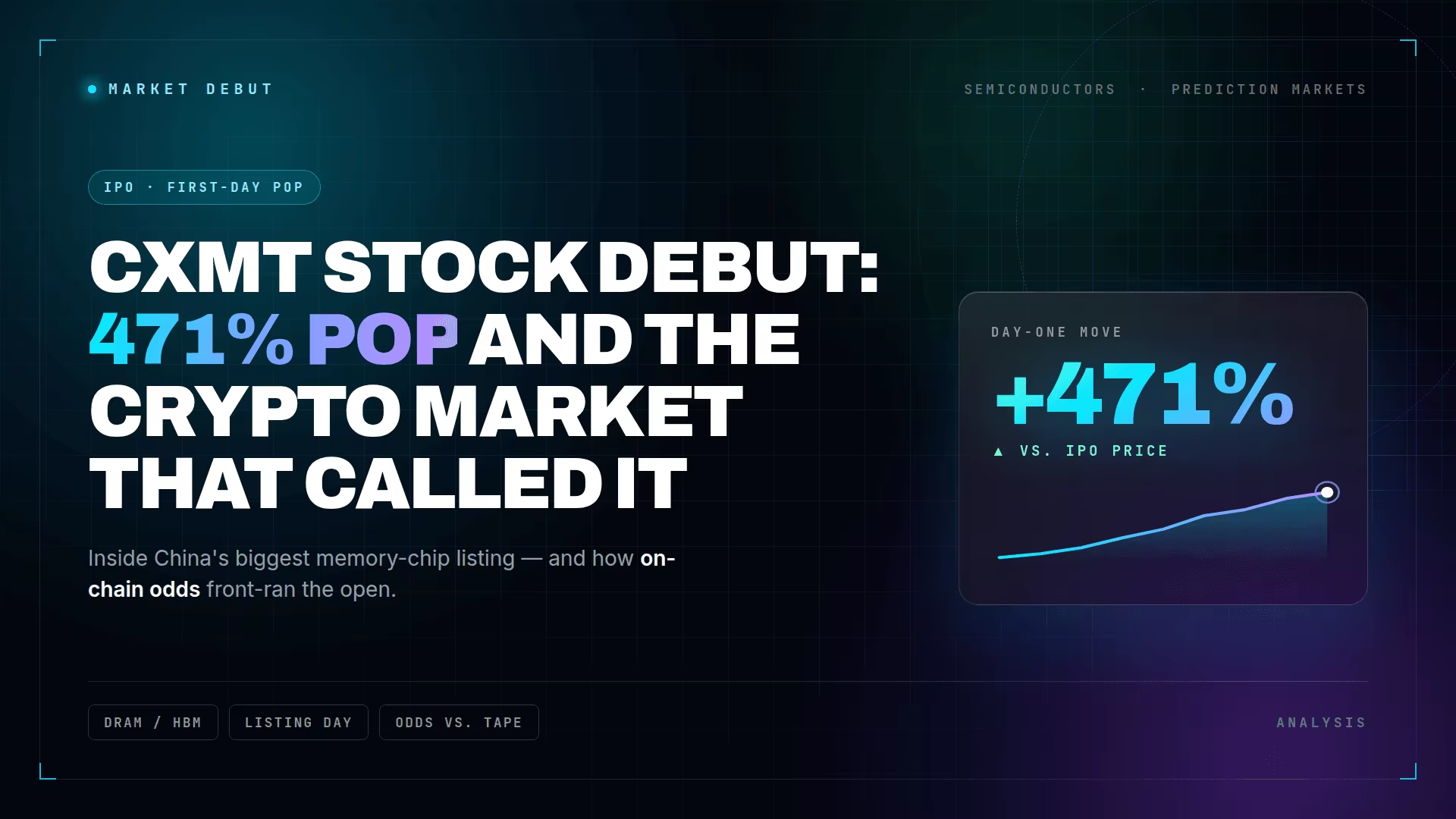
The financials behind the pop are real, and they are recent. CXMT reported a ¥19.23 billion net loss in 2023 and only ¥1.87 billion in attributable profit for full-year 2025. Then the memory cycle turned: Q1 2026 revenue hit ¥50.8 billion, up 719% year over year, with ¥24.76 billion in attributable profit. Company guidance points to ¥50–57 billion of net profit for the first half of 2026 alone — roughly ¥300 million a day.
That is why the 308x trailing P/E at the IPO price was never the operative number. Investors were buying a forward multiple on a memory super-cycle, and the IPO was priced against a trailing year that no longer describes the business.
Can you actually buy CXMT stock? Most people can't
This is the part the headlines skip. A STAR Market listing is not an open market. Individual investors need a minimum account balance of ¥500,000 (roughly $74,000) plus 24 months of trading experience to trade the board at all. That excludes the overwhelming majority of Chinese retail investors and effectively all overseas retail.
Foreign institutions can reach it through QFII. Northbound Stock Connect is the other route, but eligibility is not automatic for a new listing — a STAR Market stock has to qualify through index inclusion first, which takes time. There is no ADR, and no offshore listing.
So the practical access map for CXMT stock looks like this:
| Route | Who it's open to | What you actually own |
|---|---|---|
| Direct A-share purchase | ¥500k+ balance, 24 months experience, mainland account | Real equity, dividends, voting rights |
| QFII | Approved foreign institutions only | Real equity |
| Northbound Stock Connect | Eligible offshore investors, once the stock qualifies | Real equity |
| Pre-IPO / stock perpetual contracts | Non-restricted users on crypto venues | Price exposure only, no equity |
That last row is where the interesting story is.
How on-chain traders priced CXMT stock before the bell
On July 15 — one day before the A-share subscription even opened — trade.xyz deployed a CXMT pre-IPO perpetual on Hyperliquid under Hyperliquid's HIP-3 framework, symbol xyz:CXMT, settled in USDC. Gate later listed a USDT-settled CXMT pre-market perpetual of its own.
These are synthetic contracts. They carry no shares, no dividends and no voting rights. What they do carry is an opinion, backed by real money, about what CXMT stock is worth — expressed by a pool of traders that China's primary market deliberately excluded.
Here is how that opinion compares against the actual open:
| Price marker | Date | Per share | Implied market cap | vs. July 27 open |
|---|---|---|---|---|
| A-share IPO price | Jul 16, 2026 | ¥8.66 ($1.28) | ¥579 billion | −82.5% |
xyz:CXMT intraday peak | Jul 15, 2026 | $8.64 (≈¥58.5) | ≈¥3.91 trillion | +18.0% |
xyz:CXMT last pre-listing print | Jul 26, 2026 | $6.18 (≈¥41.8) | ≈¥2.80 trillion | −15.6% |
| A-share opening auction | Jul 27, 2026 | ¥49.58 ($7.32) | ≈¥3.32 trillion | — |
On-chain open interest in the contract grew from $2.41 million on launch day to $63.9 million by July 26. On $64 million of open interest, a market with no shares, no oracle and no arbitrage channel landed inside 16% of a ¥3.3 trillion opening print. The book-built IPO price, produced by regulated underwriters with full access to the company, missed by 82.5%.
The better reading is not that crypto traders are smarter. It is that they were the only participants in this deal allowed to express an unconstrained price. Chinese IPO pricing operates under valuation conventions that keep issue prices well below where the secondary market clears; the pop is a feature of that system, not a forecasting failure. The on-chain contract had no such constraint, and it produced a number close to the truth.
That distinction matters for how you read the next Chinese mega-listing. A 200-times-oversubscribed book tells you about allocation scarcity. An offshore synthetic market tells you about price.
How the CXMT pre-IPO perpetual works, and what changes now it's listed
The mechanics deserve more attention than they have been getting, because the contract's behaviour changes materially from today.
Before listing there was no external price to track, so trade.xyz used an internal oracle built from the order book's impact bid and ask, smoothed with a 30-minute exponentially weighted moving average. The mark price used for liquidations was the median of three inputs, with relayer updates capped at 0.5% each. A "Discovery Bound" allowed the reference price to re-anchor in 20% steps, up to seven times in each direction — which is why early trading climbed in a staircase pattern of $5 → $6 → $7.20 → $8.64 rather than a smooth curve. Those were system-imposed ceilings, not technical resistance.
| Parameter | Pre-IPO phase | After the STAR Market listing |
|---|---|---|
| Price source | Internal order-book oracle | A-share spot price, FX-converted, refreshed every 3s |
| Convergence limit | 20% Discovery Bound, 7 re-anchors | ±1% per oracle update |
| Funding multiplier | 0.005 (1% of standard) | 0.5 (standard) |
| Settlement asset | USDC | USDC |
| Max leverage | 5x | 5x |
| When A-shares are closed | n/a | Reverts to internal oracle |
| Fallback if listing had failed | Full-life TWAP settlement | n/a |
Two of those rows are where money gets lost. The funding multiplier jumping 100-fold means carry costs on a leveraged long went from negligible to normal overnight — a position that was cheap to hold last week is not cheap to hold this week. And the ±1% convergence cap means the contract does not snap to the A-share price; it walks there, update by update. Anyone sitting near maintenance margin during that walk can be liquidated on the journey even if their directional view turns out correct.
The pattern is not new. When SpaceX listed in June 2026, the pre-IPO contract converted into the live stock perpetual at the open, and traders who had not read the conversion terms discovered the funding and mark-price rules had changed under them. If you are new to this instrument class, the mechanics of stock and pre-IPO perpetual contracts are worth understanding before the position, not after.
What has to go right for CXMT stock to hold ¥3 trillion
A ¥3.3 trillion valuation prices CXMT as a structural winner, not a cycle beneficiary. The gap between those two readings is where the risk sits.
| Metric | CXMT | Leaders |
|---|---|---|
| Global DRAM share (Q1 2026) | ~8% (4th) | Samsung ~38%, SK Hynix ~29%, Micron ~22% |
| Wafer starts (12-inch equiv/month) | ~265k, targeting ~350k by end-2026 | Micron ~375k |
| HBM allocation | <2% of wafers; 55k wafers targeted by end-2027 | Mature HBM3E production |
| Process node | 16nm (G4), DUV multi-patterning | EUV-enabled leading nodes |
| Cost per bit | ~30% higher than the top three | Baseline |
Three constraints are hard rather than soft. CXMT has no EUV access under Dutch export controls, which caps how far DUV multi-patterning can economically scale. Its cost-per-bit disadvantage of roughly 30% means margin compresses faster than peers when DRAM contract prices fall. And it sits roughly three years behind on HBM — the one memory segment where AI capex is actually paying premium prices, and where CXMT currently allocates under 2% of its wafers.
Revenue mix reinforces the point: mobile DRAM was 60.4% of sales and servers 26.51%. This is a commodity memory business with an AI option attached, being valued closer to an AI company.
There is also a US overhang. CXMT was added to the Pentagon's Section 1260H list effective June 30, 2026, barring Department of Defense procurement, with Section 5949 extending restrictions across federal agencies from December 23, 2027. State entities and the national semiconductor fund held about 36.29% pre-IPO. None of that affects Chinese domestic demand, which is the bulk of the business — but it does cap the international addressable market and it is the kind of headline that moves a synthetic contract faster than it moves the underlying.
What traders usually get wrong with CXMT stock exposure
The recurring mistake with pre-IPO and stock perpetuals is treating the synthetic as a proxy for the share and ignoring the plumbing. Three specific traps:
Liquidity holes when the underlying is shut. The A-share market trades 09:30–15:00 Beijing time with a lunch break. Outside those hours the CXMT contract falls back to its internal order-book oracle. Thin books plus a 24/7 contract is exactly the condition under which a small size can drag the mark price, and the Discovery Bound only limits the damage — it does not prevent it.
First-week volatility on the underlying. STAR Market listings have no daily price limit for the first five trading days. A ¥49.58 open after a 471% pop means the reference price for every synthetic contract can move violently in either direction this week. Sizing built for a normal ±10% band is mis-sized here.
Confusing exposure with ownership. These contracts do not convert into CXMT shares, ever. There is no path from a USDC-settled perpetual to a registered A-share holding. If the goal is long-term equity ownership, this instrument does not deliver it — and if the goal is a trade, then funding, leverage and mark-price mechanics are the whole game. WEEX's guides on trading stock futures and on TradFi perpetual contracts cover how funding rates and leverage settings translate into holding costs.
CXMT stock after the pop: what to watch next
CXMT stock has done the easy part. The listing raised ¥57.9 billion — ¥13 billion earmarked for DRAM technology, ¥9 billion for R&D, ¥7.5 billion for manufacturing upgrades — against combined incumbent capex roughly 14 times that size. That funds the next two years of capacity, not a leapfrog.
Three things will settle whether ¥3.3 trillion was right: whether DRAM contract prices hold into 2027, whether HBM3E reaches volume production on schedule, and whether the wafer-start ramp to 350,000 per month lands without the cost-per-bit gap widening. Everything else is narrative.
For traders without A-share access, the honest framing is that synthetic CXMT exposure is now a leveraged bet on a stock you cannot own, priced off an oracle that converges 1% at a time, in a memory cycle near its high. That is a tradeable setup. It is not an investment in ChangXin Memory Technologies. The SpaceX listing in June 2026 is the closest precedent for how these contracts behave through a conversion, and it is worth reading before sizing anything here.
Frequently asked questions
1. What is CXMT's stock ticker?
CXMT trades as 688825 on the Shanghai Stock Exchange STAR Market. ChangXin Memory Technologies listed on July 27, 2026. There is no US listing, no ADR and no Hong Kong line.
2. Can foreign investors buy CXMT stock?
Not easily. Direct A-share purchase requires a mainland account with a ¥500,000 minimum balance and 24 months of trading experience. Foreign institutions can use QFII. Northbound Stock Connect access depends on the stock qualifying through index inclusion, which is not automatic for new listings.
3. Why did CXMT stock open 471% above its IPO price?
Chinese IPO pricing conventions kept the ¥8.66 issue price well below where the secondary market cleared. Online subscription demand ran 244 times the allocation with a fill rate under 0.5%, so essentially all unmet demand hit the open at once. The pop reflects the pricing mechanism as much as the fundamentals.
4. What is the CXMT pre-IPO perpetual on Hyperliquid?
A synthetic USDC-settled contract deployed by trade.xyz under the HIP-3 framework on July 15, 2026, offering up to 5x leverage on CXMT's expected share price. It confers no shares, dividends or voting rights. Since the July 27 listing it tracks the A-share price via an external oracle, converging at a maximum of 1% per update.
5. Was the on-chain market more accurate than the IPO price?
On the numbers, yes. The last pre-listing on-chain print of $6.18 on July 26 implied about ¥2.80 trillion of market value, roughly 15.6% below the ¥3.32 trillion opening print. The ¥8.66 IPO price implied ¥579 billion, 82.5% below. That reflects different pricing constraints rather than superior analysis.
6. Is CXMT a good long-term investment?
That depends on assumptions no one can currently verify: whether DRAM prices stay elevated through 2027, whether HBM3E ships in volume on schedule, and whether the roughly 30% cost-per-bit disadvantage narrows without EUV access. At a ¥3.3 trillion valuation the stock is priced for those things going right. This article is not investment advice.
Risk Warning
Trading CXMT stock exposure through synthetic or leveraged products carries substantial risk of partial or total loss of capital. Pre-IPO and stock perpetual contracts are derivatives: they confer no equity, dividends or voting rights, cannot be converted into A-shares, and may be settled, delisted or repriced by the issuing venue. Specific risks in this case include oracle-transition risk as the contract converges toward the A-share price at up to 1% per update, which can trigger liquidations even for correct directional positions; a 100-fold increase in the funding multiplier post-listing, raising the cost of carrying leveraged exposure; thin liquidity and elevated manipulation risk when the Shanghai market is closed and pricing falls back to an internal order-book oracle; and the absence of any daily price limit on STAR Market listings during their first five trading days. The underlying business is exposed to DRAM price cyclicality, a roughly 30% cost-per-bit disadvantage, restricted access to advanced lithography, and US federal procurement restrictions under Section 1260H and Section 5949. All figures are dated where cited and were accurate at the time of writing; prices and parameters change. Never trade with capital you cannot afford to lose, and use leverage only with a predefined liquidation and position-sizing plan.
Disclaimer: This content is provided for general branding and informational purposes only and doesn't constitute financial, investment, legal, or tax advice. Any events, rewards, online events, or related information mentioned herein should not be considered a recommendation, solicitation, or invitation to purchase, sell, trade, or otherwise deal in any crypto assets or to use any services. Crypto assets are highly volatile and may result in loss. WEEX services and online events may not be available in all regions and are subject to applicable laws, regulations, and eligibility requirements. You are responsible for ensuring that your use of WEEX services complies with local laws and for carefully assessing the risks before participating in any crypto-related activities.
You may also like

Do You Need a Crypto Broker? What They Are and Who Should Use One in 2026
What Is the Difference Between a Broker and a Market Maker? A Complete Guide
Argentina World Cup Final Controversy: What the On-Field Incidents Mean for the Team's Global Brand
Argentina World Cup 2030: Who Replaces Messi and Can They Ever Win Again?

Historical FIFA World Cup Evaluations: Where Does Spain 2026 Rank Among the Greatest Champions?

Oil Falls 7% as US Pauses Iran Strikes: Which Stocks Win and Which Lose Now
US Pauses Iran Strikes: What the Ceasefire Signal Means for Oil Prices and Stock Markets

Samsung Stock vs Samsung ETF: Which Is the Better Way for International Investors?
Samsung Stock Is 30% Below Its Peak: What Getting Back to Record Highs Actually Requires
Samsung Stock and the $200 Billion Broadcom Deal: What the Memory and Foundry MOU Means for Investors
SK Hynix Stock Before July 29 Earnings: What Investors Should Watch
New SK Hynix 2X ETFs Launch: Who Should Use Them and Who Should Not
SK Hynix Stock and Nvidia's $500 Billion SK Group Deal: What the 2027 Timeline Means for Investors
Tesla Stock After the 16% Crash: Price, Targets, and How to Trade It
WEEX Poker Party Series 4: Your First 24 Hours, Step by Step
Is XST Coin a Scam? XSolut Risks, Dump Concerns & Price Analysis
What Is XSolut (XST) Coin? Exploring AI Infrastructure and RWA Tokenization
WEEX TradFi Trading Fest: Trade Stock Futures and Share 50,000 USDT Rewards
STABLE Crypto Airdrop Guide: How to Claim 50,000 USDT Rewards on WEEX
What Is a Broker? The Complete Guide to Understanding Financial and Crypto Brokers
How to Compare Crypto Brokers: What the Rankings Don't Tell You and What Actually Matters
Oracle Stock Price Prediction 2026-2027: Can ORCL Reach $250 After the Pentagon Deal?
Is Oracle Stock a Buy After the $7 Billion Pentagon Deal? What the Defense Contract Changes
SPCX Stock Price Is Down $1 Trillion From Its Peak: Is Now the Time to Buy?
Is Tesla Stock a Buy at $320 After the Q2 Earnings Crash?
SPCX Stock Price and Starship Flight 13: What Tonight's Launch Needs to Deliver
Why Tesla Stock Crashed 14% on Record Revenue: What the 1.4% Operating Margin Actually Means
Tesla Stock Is Betting Everything on Robotaxi and Optimus: What Investors Are Actually Paying For
Intel Stock vs AMD Stock: Which Chip Giant Is the Better Buy After Q2?
Intel Stock Price Prediction 2026-2027: Can INTC Reach $150 After the Foundry Turnaround?
Do You Need a Crypto Broker? What They Are and Who Should Use One in 2026
What Is the Difference Between a Broker and a Market Maker? A Complete Guide
Argentina World Cup Final Controversy: What the On-Field Incidents Mean for the Team's Global Brand
Argentina World Cup 2030: Who Replaces Messi and Can They Ever Win Again?
Historical FIFA World Cup Evaluations: Where Does Spain 2026 Rank Among the Greatest Champions?
Oil Falls 7% as US Pauses Iran Strikes: Which Stocks Win and Which Lose Now


