
What Is the Difference Between a Broker and a Market Maker? A Complete Guide

 Prefer us on Google

The difference between a broker and a market maker is one of the most frequently confused distinctions in financial services, and the confusion is understandable because the two functions can appear identical from a client's perspective. A broker who routes your order to an exchange and a market maker who fills your order from inventory both result in a completed trade at a quoted price, which is why most participants in financial markets never develop a clear sense of which model they are actually using. What distinguishes the broker from the market maker is not the surface experience of the transaction but the economic function being performed, the capital being deployed, and the incentive structure that determines whose interests the intermediary is actually optimizing for when it makes decisions that affect your execution quality.
Understanding that distinction matters more in crypto markets than in traditional financial markets because the regulatory frameworks that force transparency about execution models in traditional brokerage are less consistently applied across crypto market participants.

The Broker Function: Connecting Clients to Markets
A broker's core function is intermediation between a client who wants to trade and the market or counterparty where that trade can be executed. The broker does not take the other side of the client's trade. It finds someone else to take the other side, routes the client's order to the appropriate venue, and earns revenue for facilitating the connection.
The broker's economic interest is aligned with client trading volume rather than with any particular directional outcome. A broker who earns revenue through fee sharing arrangements with execution venues generates more revenue when clients trade more, regardless of whether those trades are profitable for the client. This alignment creates an incentive structure where the broker benefits from client activity rather than from client losses, which is the defining characteristic that distinguishes the pure broker model from models with different incentive structures.
The broker's capital requirements are minimal relative to a market maker's because the broker does not hold inventory. A broker who routes a client's buy order to an exchange is not committing its own capital to the transaction. It is facilitating a transaction between the client and whoever is selling on the other side of the exchange's order book. The execution risk, meaning the risk that the price moves before the order is filled, belongs to the client rather than to the broker.
The Market Maker Function: Providing Liquidity Through Continuous Quoting
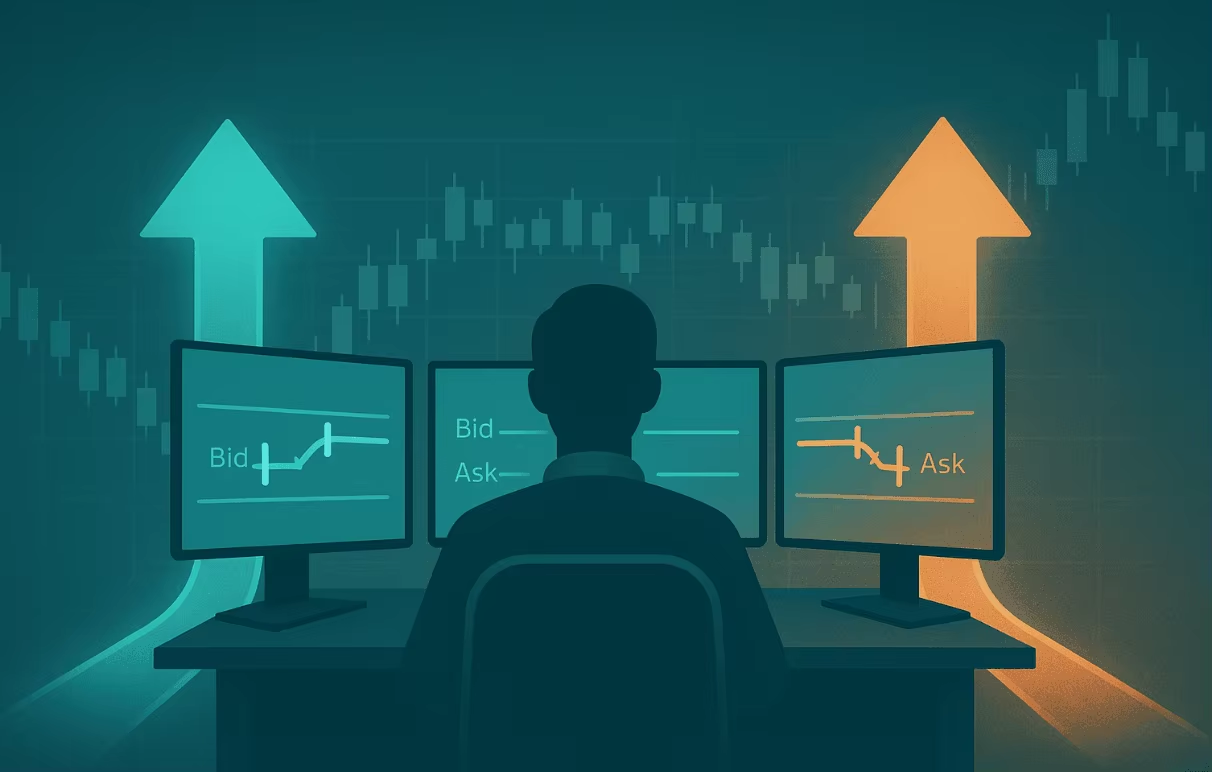
A market maker's core function is providing liquidity by continuously quoting both buy and sell prices for a financial asset, standing ready to trade at those prices with any counterparty who accepts them. The market maker takes the other side of client trades directly rather than routing them to an external counterparty.
When a client buys from a market maker, the market maker sells from its own inventory or creates a short position that it then manages in the broader market. When a client sells to a market maker, the market maker buys and holds the position until it can be offset at a favorable price. The market maker's revenue comes from the spread between the price it quotes to buy and the price it quotes to sell, capturing a small profit on each transaction regardless of the asset's directional movement.
The market maker's capital requirements are substantial relative to a broker's because holding inventory creates direct market risk. A market maker who buys a large position from a client and cannot immediately offset it in the market is exposed to the price movement of that position until the offset trade is executed. Managing that exposure requires both capital to absorb mark-to-market losses during the holding period and sophisticated risk management systems to monitor and hedge the aggregate inventory across all open positions.
The market maker's economic interest creates a specific tension with clients that the broker model does not have. A market maker earns the spread on every transaction, which means it earns more when the spread is wider and less when the spread is narrower. The client's interest is in narrower spreads. The market maker's interest is in wider spreads. This tension does not make market makers adversarial to clients in a harmful sense, because competition among market makers compresses spreads toward the minimum required to cover risk and generate acceptable returns. But it does mean the incentive alignment between market maker and client is fundamentally different from the incentive alignment between broker and client.
Where the Two Models Overlap and Create Confusion
The textbook distinction between brokers and market makers is clear. The practical landscape of financial services is less clean, and understanding where the models overlap helps explain why the distinction is so frequently confused.
Principal brokers operate as brokers in their client relationship but as market makers in their execution. A principal broker accepts a client's order, quotes a price for that order, and fills it from its own inventory rather than routing it to an external execution venue. From the client's perspective, the interaction looks like a broker interaction because the client is getting execution at a quoted price. From the market structure perspective, the interaction is a market making transaction because the broker is taking the other side of the trade from its own inventory.
The principal broker model creates the specific incentive conflict that pure agency brokerage avoids. When a broker fills client orders from its own inventory, it earns not only any commission charged to the client but also any favorable spread between the price it quoted the client and the price at which it can offset the position in the market. This dual revenue source means the principal broker has an incentive to quote prices that are slightly less favorable to clients than the best available market price, capturing the difference as inventory spread revenue in addition to any explicit commission.
Hybrid brokers use agency execution for some orders and principal execution for others, typically based on order size and market conditions. For smaller orders where the spread revenue from principal execution is meaningful, the hybrid broker acts as market maker. For larger orders where the market impact of principal execution creates unacceptable inventory risk, the hybrid broker routes agency-style to external liquidity.
The Crypto Market Context That Changes Both Models
The crypto market's specific structure has produced broker and market maker dynamics that differ from traditional financial markets in ways that matter for anyone building or evaluating crypto trading infrastructure.
Traditional financial markets have designated market makers who are obligated by exchange rules to continuously quote prices within specified spread limits during trading hours in exchange for specific privileges including reduced transaction fees and access to certain order flow. The obligation creates reliability of liquidity provision that market participants can depend on regardless of market conditions.
Crypto markets have no equivalent regulatory obligation for market makers. Liquidity in crypto markets is provided by professional trading firms that choose to make markets based on economic incentives rather than regulatory obligations, which means liquidity can disappear during periods of extreme volatility or market stress when making markets becomes unprofitable or too risky. The absence of obligated market making is one of the specific structural differences between crypto and traditional financial markets that creates the depth and reliability variation that crypto traders experience.
The crypto broker model has similarly evolved differently from the traditional model. The API broker program structure that has emerged in crypto allows platforms, communities, and technology products to access institutional grade liquidity through a single integration point rather than managing direct exchange relationships. This structure positions the API broker program provider as a liquidity aggregator that combines elements of the traditional broker function and the market making function within a single infrastructure relationship.
How to Identify Which Model You Are Actually Using
For traders and platform builders evaluating their current or prospective infrastructure relationships, several specific questions reveal which model is actually in operation regardless of how the relationship is described.
Who takes the other side of your trades is the most fundamental question. If your orders are routed to an exchange order book where an anonymous counterparty fills them, you are operating in an agency broker structure. If your orders are filled by the entity you placed them with from their own inventory, you are operating in a principal or market maker structure.
How revenue is generated by your infrastructure provider is the second question. Fee sharing arrangements where the provider earns a percentage of exchange fees generated by your trading activity indicate an agency broker model aligned with your trading volume. Spread capture where the provider earns the difference between the price quoted to you and the price at which they offset your order indicates a principal or market making model with the inherent spread tension described above.
What happens during market stress is the third revealing question. An agency broker whose revenue comes from fee sharing has no incentive to stop routing your orders during volatile periods because the fee sharing continues regardless of market direction. A market maker who is managing inventory risk during a volatile period may widen spreads significantly or stop quoting entirely if the risk management threshold is exceeded, which is the liquidity fragility that obligated market making requirements in traditional markets are designed to prevent.
What This Means for Building a Crypto Brokerage
For anyone evaluating crypto broker infrastructure for a platform or community that wants to embed trading execution, understanding the broker versus market maker distinction determines which infrastructure model matches their specific commercial requirements.
A platform whose users trade frequently in normal market conditions benefits most from an agency broker model where fee sharing economics are transparent and aligned with user activity. The platform earns revenue from its users' trading without taking any inventory risk, and the infrastructure provider earns revenue from the same activity without any conflict of interest around spread capture.
A platform whose users trade in large sizes or in less liquid markets may benefit from a hybrid model where the infrastructure provider uses market making capabilities to guarantee execution at quoted prices for sizes that an agency only model might struggle to fill at competitive prices in thin order books.
The specific infrastructure features that distinguish professional broker programs from superficial alternatives reflect this distinction. Real-time commission dashboards that show fee sharing accruals indicate an agency model with transparent revenue alignment. Customized risk controls that allow platform operators to set trading limits and leverage parameters provide the operational management that professional broker relationships require regardless of the underlying execution model. Settlement flexibility in multiple cryptocurrencies reflects operational maturity rather than execution model preference.
WEEX's broker program is designed for platforms and communities that want institutional grade liquidity access through an agency model with transparent fee sharing, providing the infrastructure layer that allows broker partners to build client facing services without managing direct exchange relationships or market making inventory risk.
Conclusion
The difference between a broker and a market maker is the difference between an intermediary whose revenue is aligned with client trading activity and an intermediary whose revenue comes from the spread between the prices it quotes and the prices at which it offsets client trades in the market. The broker earns more when clients trade more. The market maker earns more when spreads are wider.
In practice, the distinction blurs through principal broker models that combine both functions and through hybrid approaches that use agency execution for some orders and principal execution for others. Identifying which model is actually in operation requires asking who takes the other side of trades, how the infrastructure provider generates revenue, and what happens to liquidity provision during market stress.
For platform builders and community operators evaluating crypto trading infrastructure, the broker versus market maker distinction determines the incentive alignment of the infrastructure relationship and the specific commercial model that makes the most sense for their users' trading patterns and their own revenue requirements. Choosing the right model for the right use case produces better outcomes than accepting whatever model a given infrastructure provider defaults to without understanding its implications.
FAQ
1. What is the main difference between a broker and a market maker?
A broker connects clients to markets and earns revenue through commissions or fee sharing without taking the other side of client trades. A market maker provides liquidity by continuously quoting buy and sell prices, takes the other side of client trades from its own inventory, and earns revenue from the spread between bid and ask prices. The broker's revenue is aligned with client trading volume while the market maker's revenue creates a tension with clients over spread width.
2. Can a broker also act as a market maker?
Yes. Principal brokers accept client orders and fill them from their own inventory rather than routing to external execution venues, combining the client relationship of a broker with the execution function of a market maker. This hybrid model earns both explicit commissions and implicit spread revenue, creating an incentive structure that differs from pure agency brokerage where the broker earns only from fee sharing on exchange-executed trades.
3. Why does liquidity disappear in crypto markets during volatile periods?
Crypto markets have no regulatory obligation requiring market makers to continuously quote prices within specified spread limits. Professional trading firms provide liquidity voluntarily based on economic incentives, which means they can stop quoting or widen spreads significantly when market making becomes unprofitable or too risky during extreme volatility. Traditional financial markets use obligated market making requirements to prevent this liquidity fragility.
4. How can I tell whether my infrastructure provider is acting as a broker or a market maker?
Three questions reveal the actual model. Who takes the other side of your trades determines whether you are in an agency or principal structure. How the provider generates revenue distinguishes fee sharing from spread capture. What happens during market stress reveals whether the liquidity provision is aligned with your activity or subject to inventory risk management decisions that can restrict access at the moments you most need it.
5. What does the broker versus market maker distinction mean for building a crypto platform?
Platforms whose users trade frequently in normal conditions benefit most from agency broker models with transparent fee sharing aligned with user activity and no inventory risk for the platform operator. Platforms whose users trade large sizes or in less liquid markets may benefit from hybrid models where market making capabilities guarantee execution at quoted prices for sizes that agency only routing might struggle to fill competitively. The distinction determines the incentive alignment of the infrastructure relationship and the specific revenue model available to the platform operator.
Disclaimer: This content is provided for general branding and informational purposes only and doesn't constitute financial, investment, legal, or tax advice. Any events, rewards, online events, or related information mentioned herein should not be considered a recommendation, solicitation, or invitation to purchase, sell, trade, or otherwise deal in any crypto assets or to use any services. Crypto assets are highly volatile and may result in loss. WEEX services and online events may not be available in all regions and are subject to applicable laws, regulations, and eligibility requirements. You are responsible for ensuring that your use of WEEX services complies with local laws and for carefully assessing the risks before participating in any crypto-related activities.
You may also like

Do You Need a Crypto Broker? What They Are and Who Should Use One in 2026

Argentina World Cup Final Controversy: What the On-Field Incidents Mean for the Team's Global Brand

Argentina World Cup 2030: Who Replaces Messi and Can They Ever Win Again?

Historical FIFA World Cup Evaluations: Where Does Spain 2026 Rank Among the Greatest Champions?

Oil Falls 7% as US Pauses Iran Strikes: Which Stocks Win and Which Lose Now

US Pauses Iran Strikes: What the Ceasefire Signal Means for Oil Prices and Stock Markets

Samsung Stock vs Samsung ETF: Which Is the Better Way for International Investors?
Samsung Stock Is 30% Below Its Peak: What Getting Back to Record Highs Actually Requires
Samsung Stock and the $200 Billion Broadcom Deal: What the Memory and Foundry MOU Means for Investors

SK Hynix Stock Before July 29 Earnings: What Investors Should Watch
New SK Hynix 2X ETFs Launch: Who Should Use Them and Who Should Not
SK Hynix Stock and Nvidia's $500 Billion SK Group Deal: What the 2027 Timeline Means for Investors

CXMT Stock Debut: 471% Pop and the Crypto Market That Called It
Tesla Stock After the 16% Crash: Price, Targets, and How to Trade It
WEEX Poker Party Series 4: Your First 24 Hours, Step by Step
Is XST Coin a Scam? XSolut Risks, Dump Concerns & Price Analysis

What Is XSolut (XST) Coin? Exploring AI Infrastructure and RWA Tokenization
WEEX TradFi Trading Fest: Trade Stock Futures and Share 50,000 USDT Rewards
STABLE Crypto Airdrop Guide: How to Claim 50,000 USDT Rewards on WEEX
What Is a Broker? The Complete Guide to Understanding Financial and Crypto Brokers
How to Compare Crypto Brokers: What the Rankings Don't Tell You and What Actually Matters
Oracle Stock Price Prediction 2026-2027: Can ORCL Reach $250 After the Pentagon Deal?
Is Oracle Stock a Buy After the $7 Billion Pentagon Deal? What the Defense Contract Changes
SPCX Stock Price Is Down $1 Trillion From Its Peak: Is Now the Time to Buy?
Is Tesla Stock a Buy at $320 After the Q2 Earnings Crash?
SPCX Stock Price and Starship Flight 13: What Tonight's Launch Needs to Deliver
Why Tesla Stock Crashed 14% on Record Revenue: What the 1.4% Operating Margin Actually Means
Tesla Stock Is Betting Everything on Robotaxi and Optimus: What Investors Are Actually Paying For
Intel Stock vs AMD Stock: Which Chip Giant Is the Better Buy After Q2?
Intel Stock Price Prediction 2026-2027: Can INTC Reach $150 After the Foundry Turnaround?
Do You Need a Crypto Broker? What They Are and Who Should Use One in 2026
Argentina World Cup Final Controversy: What the On-Field Incidents Mean for the Team's Global Brand
Argentina World Cup 2030: Who Replaces Messi and Can They Ever Win Again?
Historical FIFA World Cup Evaluations: Where Does Spain 2026 Rank Among the Greatest Champions?
Oil Falls 7% as US Pauses Iran Strikes: Which Stocks Win and Which Lose Now
US Pauses Iran Strikes: What the Ceasefire Signal Means for Oil Prices and Stock Markets





