Samsung Stock and the $200 Billion Broadcom Deal: What the Memory and Foundry MOU Means for Investors

 Prefer us on Google
Samsung stock received a development on July 25 that arrived in the shadow of the Nvidia SK Group announcement and has consequently received less analytical attention than its commercial significance warrants. The San Francisco AI summit that produced the Nvidia SK Hynix $500 billion partnership also produced a Samsung stock catalyst of its own: a $200 billion memorandum of understanding with Broadcom covering memory and foundry technology collaboration that changes the competitive picture for Samsung stock in ways that the preliminary Q2 results and their subsequent 7% stock decline did not capture.
What the juxtaposition of both announcements at the same summit on the same day tells investors is that the AI chip market has grown large enough to require both Korean semiconductor giants as primary suppliers to different AI chip platforms, and that Samsung stock's narrative is more complex than the SK Hynix comparison that has dominated coverage since the SKHY Nasdaq listing.
What the Broadcom MOU Actually Covers
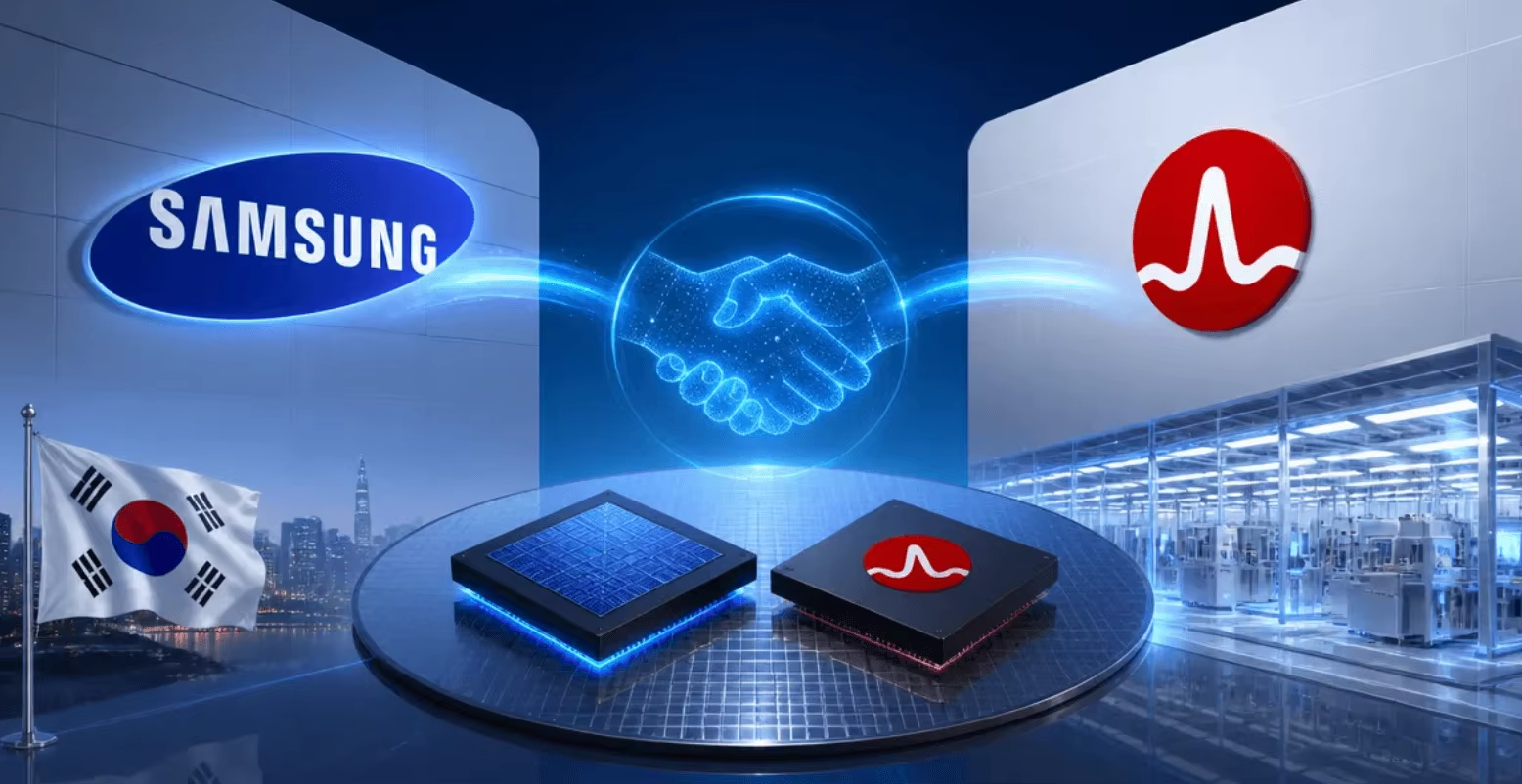
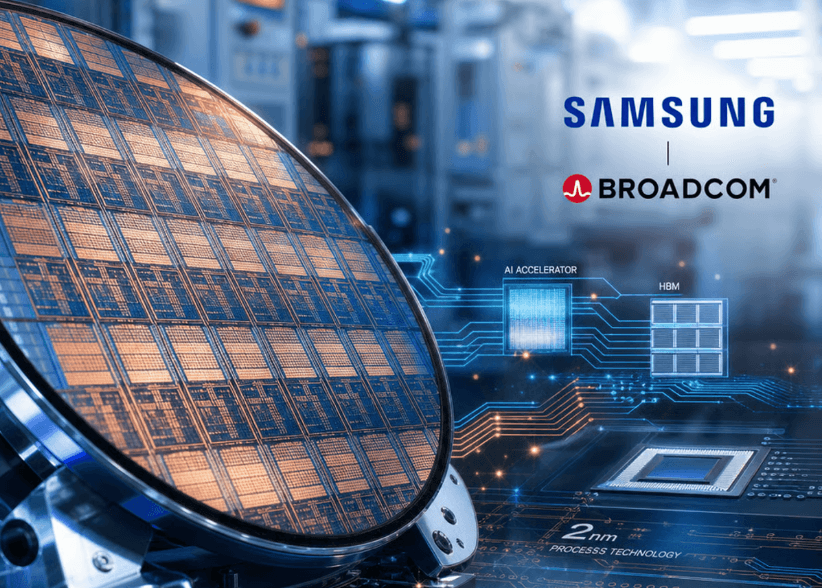
Samsung Electronics signed a memorandum of understanding with Broadcom to expand their collaboration across memory and foundry technologies, with the deal worth an estimated $200 billion to help support the next generation of AI infrastructure.
The MOU covers two distinct business segments within Samsung that have different competitive dynamics and different financial implications for the stock.
The memory component connects Broadcom's AI chip designs to Samsung's DRAM and HBM manufacturing. Broadcom is one of the world's largest designers of custom AI accelerators, producing the chips that Google's TPU platform and other hyperscaler custom silicon programs run on. Custom AI accelerators require the same HBM memory that Nvidia's GPUs use, and Broadcom's growing custom silicon business creates HBM demand that is additive to the Nvidia driven demand that has defined the HBM market narrative.
The foundry component is the dimension that most Samsung stock analysis has underweighted. Samsung Foundry is the company's contract chip manufacturing division that competes directly with TSMC for the business of chip designers who need advanced manufacturing without building their own fabs. Broadcom's foundry relationship with Samsung, if the MOU converts to production commitments, would represent a significant customer win for Samsung Foundry at a moment when the division has been struggling to close the technology and yield gap with TSMC.
Why the Broadcom Announcement Arrived Simultaneously With the Nvidia SK Hynix Deal
The timing of the Samsung Broadcom MOU announcement at the same summit and on the same day as the Nvidia SK Hynix partnership is not coincidental, and understanding why both announcements happened together illuminates the competitive structure of the AI supply chain that both deals reflect.
South Korean President Lee Jae Myung attended the San Francisco AI summit specifically to facilitate the announcement of major technology partnerships between Korean companies and US AI infrastructure leaders. The diplomatic context means both deals were coordinated around the summit date rather than announced independently at the moment each was commercially ready.
The simultaneous announcements create a specific competitive picture. Nvidia locked in SK Hynix as its HBM memory partner for the Vera Rubin platform and beyond. Broadcom locked in Samsung as its memory and foundry partner for its custom AI silicon roadmap. The two largest AI chip platforms have each established primary supply relationships with one of Korea's two dominant memory and semiconductor companies, dividing the Korean AI semiconductor supply chain between them in a way that suggests both partnerships are durable rather than opportunistic.
For Samsung stock investors, the Broadcom partnership arriving simultaneously with the Nvidia SK Hynix deal is not evidence that Samsung lost the Nvidia relationship. It is evidence that the AI chip market has grown large enough to require both SK Hynix and Samsung as primary suppliers to different AI chip platforms rather than choosing between them. A market where both Korean memory giants are locked into primary supply relationships with major AI chip designers is a market where supply security concerns are driving demand commitments rather than demand being taken for granted.
What the Broadcom MOU Changes About Samsung's HBM Competitive Position
The most specific implication of the Broadcom MOU for Samsung stock is what it reveals about Samsung's HBM competitive position relative to SK Hynix at the moment when HBM4 commercial shipments have just begun.
SK Hynix controls approximately 57% to 60% of global HBM revenue and has secured Nvidia's primary supply relationship for the Vera Rubin platform. Samsung has been attempting to close the HBM qualification and yield gap with SK Hynix across multiple product generations. The Broadcom MOU suggests that Samsung's HBM4 capability is at a level where a major custom AI silicon designer with Broadcom's technical sophistication is willing to commit to a multi-year supply relationship.
That validation matters for Samsung stock in a specific way. Samsung's Q2 preliminary results showed Device Solutions accounting for approximately 94% of total operating profit, with HBM being the primary driver within that segment. The HBM4 commercial shipments that began in Q2 represent Samsung's first opportunity to generate revenue from the next generation of high bandwidth memory before the product is fully qualified across the full range of potential customers.
A Broadcom commitment to Samsung HBM provides the qualification pathway that converts Samsung's HBM4 technology into contracted revenue rather than leaving it dependent on winning share from SK Hynix in the Nvidia supply relationship where SK Hynix has first-mover advantages. Broadcom's custom silicon customers are different from Nvidia's ecosystem customers, which means Samsung can grow its HBM revenue through the Broadcom relationship without needing to displace SK Hynix from Nvidia.
The Foundry Dimension That Nobody Is Analyzing
The foundry component of the Broadcom Samsung MOU has received almost no analytical attention despite representing the more strategically significant dimension for Samsung stock's long-term valuation.
Samsung Foundry has been in a structurally difficult competitive position relative to TSMC throughout the AI boom. TSMC manufactures Nvidia's GPUs, AMD's data center chips, Apple's processors, and virtually every other advanced chip that defines the AI hardware market. Samsung Foundry has been attempting to win foundry customers from TSMC through price competition and technology development while simultaneously managing the operational complexity of running both a leading memory business and a foundry business within the same corporate structure.
Samsung characterized the Broadcom arrangement as essential infrastructure for powering next-generation AI systems.
A Broadcom foundry commitment would represent the most significant Samsung Foundry customer win in the AI era. Broadcom's custom silicon volume is substantial, and a foundry relationship that produces Broadcom AI accelerators at Samsung's most advanced process nodes would validate Samsung Foundry's technology readiness for leading edge AI chip production in a way that smaller customer wins cannot.
The specific financial implication for Samsung stock is that foundry revenue carries different margin characteristics from memory revenue. A Samsung Foundry that is winning leading edge AI chip production contracts becomes a more valuable business unit than the current market assigns it, because the current Samsung stock valuation primarily reflects the memory cycle rather than the foundry potential. A Broadcom foundry commitment begins changing that valuation mix in ways that analyst models built on the memory cycle narrative have not incorporated.
What $200 Billion Actually Means and What It Does Not
The $200 billion figure attached to the Broadcom Samsung MOU requires the same honest treatment that the $500 billion Nvidia SK Group partnership required, because both numbers describe total potential value over a multi-year period rather than contracted near-term revenue.
An MOU is a statement of intent to negotiate specific terms rather than a binding purchase commitment. The $200 billion represents the total potential value of the collaboration if all contemplated activities are executed across the full timeline that the MOU envisions. The actual contracted revenue that Samsung recognizes in specific quarters depends on how quickly the MOU converts to binding purchase orders, what the specific pricing terms of those orders are, and how the delivery schedule aligns with Samsung's production capacity for both memory and foundry services.
For Samsung stock's July 30 earnings call, management is unlikely to provide specific revenue attribution to the Broadcom MOU because the MOU was announced five days before the earnings and the conversion to binding commitments would not yet have produced Q2 revenue. What management may provide is qualitative context about how the Broadcom relationship fits into Samsung's AI customer diversification strategy and what timeline the foundry component envisions for production volume.
The more useful financial question for July 30 is whether the Broadcom MOU changes the Q3 and Q4 guidance trajectory in ways that the preliminary Q2 results, which produced a 7% stock decline despite record profits, did not capture. If the Broadcom relationship is expected to contribute foundry volume in H2 2026, the guidance update on July 30 would be the first opportunity for that contribution to appear in forward-looking financial estimates.
How the Broadcom Deal Changes the July 30 Earnings Narrative
Samsung stock's preliminary Q2 results produced a 7% single day decline despite 1,800% year-over-year profit growth because the market had priced the record profits before they arrived and because the concentration of 94% of operating profit in the Device Solutions semiconductor segment raised concerns about exposure to memory cycle risk.
The Broadcom MOU announced five days before the July 30 full earnings changes the narrative context for interpreting whatever the full results show in two specific ways.
First it provides a specific large customer relationship that diversifies Samsung's AI revenue exposure beyond the HBM-to-Nvidia pathway that has dominated the semiconductor AI narrative. A Samsung that serves both the Nvidia-adjacent ecosystem through HBM supply and the Broadcom custom silicon ecosystem through memory and foundry is a Samsung with broader AI revenue exposure than the current stock price reflects.
Second it validates the foundry business at a moment when the market has been primarily valuing Samsung as a memory company. If the July 30 full results include segment level detail that shows Samsung Foundry's AI chip production contribution growing alongside the memory segment, the Broadcom MOU provides forward looking context for why that growth should continue rather than being a one-quarter phenomenon.
The 94% profit concentration in Device Solutions that concerned investors after the preliminary results looks different if the foundry component of Device Solutions is growing through a Broadcom relationship rather than being entirely dependent on memory pricing cycles. Memory pricing cycles are difficult to predict and historically volatile. Foundry revenue from a committed customer relationship is more predictable and commands different valuation multiples.
The Samsung vs SK Hynix Dynamic That Both Deals Clarify
One of the most analytically useful dimensions of reading the Broadcom Samsung MOU alongside the Nvidia SK Hynix partnership is what the two deals together reveal about the Samsung versus SK Hynix competitive dynamic in the AI memory market.
The dominant narrative in Samsung stock coverage has been that Samsung is losing the HBM race to SK Hynix and that this loss will compress Samsung's margins as SK Hynix captures the highest-value HBM revenue. The Broadcom MOU challenges that narrative by demonstrating that Samsung is winning HBM and foundry relationships with major AI chip customers rather than being displaced from the AI supply chain entirely.
The more accurate framing that both deals support is that SK Hynix has won the Nvidia relationship and Samsung has won the Broadcom relationship, creating two distinct AI chip supply chains that will each grow over the coming years. SK Hynix's advantage is its first mover position in HBM qualification with Nvidia and its 57% to 60% HBM market share. Samsung's advantage is its integrated memory and foundry capability that allows it to offer a comprehensive solution to custom silicon designers like Broadcom who need both advanced memory and advanced manufacturing.
For Samsung stock investors, this framing implies that the appropriate valuation framework is not Samsung versus SK Hynix as competitors for the same customer relationships but Samsung and SK Hynix as complementary suppliers to different segments of the AI chip ecosystem. A Samsung that wins the Broadcom ecosystem while SK Hynix wins the Nvidia ecosystem is a Samsung with a specific and growing AI revenue stream that is not contingent on closing the HBM gap with SK Hynix in the Nvidia relationship.
For those looking to participate in global financial markets, having access to the right trading platform matters. WEEX offers crypto and stock trading products, covering major global markets including US stocks and digital assets.
Conclusion
Samsung stock's $200 billion Broadcom MOU is the development that changes the investment narrative most significantly in the six days between the announcement and the July 30 full earnings report, because it provides a specific and named customer relationship that addresses both the HBM competitive positioning concern and the foundry business undervaluation that the current stock price embeds.
The memory component validates Samsung's HBM4 at a level where a technically sophisticated custom silicon designer is willing to commit to a supply relationship. The foundry component begins the process of changing how the market values Samsung Foundry as a business unit separate from the memory cycle dynamics that currently dominate Samsung stock's valuation.
What the Broadcom MOU does not change is the 94% Device Solutions profit concentration that concerned investors after the preliminary Q2 results, or the $270 billion southwest Korea manufacturing hub execution risk, or the mobile division's exposure to memory inflation costs. What it adds is specific AI customer diversification evidence that the market had been demanding before assigning Samsung a valuation that reflects its full AI supply chain participation rather than its memory cycle exposure alone.
July 30 is where the foundry and HBM4 contributions begin appearing in segment-level financial detail that the preliminary results did not provide. The Broadcom context makes that detail more significant than it would have been without the customer relationship to interpret it against.
FAQ
1. What is Samsung's $200 billion Broadcom deal and what does it mean for Samsung stock?
Samsung and Broadcom signed a memorandum of understanding worth an estimated $200 billion covering memory and foundry technology collaboration, announced at the San Francisco AI summit on July 25. For Samsung stock, the deal provides HBM customer diversification beyond the Nvidia-dominated narrative and begins the process of validating Samsung Foundry as a leading-edge AI chip production partner, which changes the valuation framework from a pure memory cycle story toward an integrated AI supply chain story.
2. Why was the Samsung Broadcom deal announced the same day as the Nvidia SK Hynix partnership?
South Korean President Lee Jae Myung attended the San Francisco AI summit specifically to facilitate major technology partnership announcements between Korean companies and US AI infrastructure leaders. The diplomatic coordination means both deals were announced together rather than independently. The result is a picture where Nvidia has locked in SK Hynix for HBM supply and Broadcom has locked in Samsung for memory and foundry services, dividing the Korean AI semiconductor supply chain between the two largest AI chip platforms.
3. What is the foundry component of the deal and why does it matter more than the memory component?
Samsung Foundry competes with TSMC for the contract manufacturing of advanced chips designed by companies like Broadcom. A Broadcom foundry commitment would be the most significant Samsung Foundry customer win in the AI era, validating Samsung's advanced process technology for leading-edge AI chip production. Foundry revenue carries different margin characteristics from memory revenue and commands different valuation multiples, which means a growing Samsung Foundry business changes how analysts value the company beyond the memory cycle that currently dominates.
4. Does the Broadcom deal mean Samsung lost the Nvidia HBM relationship?
No. The appropriate framing is that SK Hynix has won the Nvidia relationship and Samsung has won the Broadcom relationship, creating two distinct AI chip supply chains both growing simultaneously. Samsung's integrated memory and foundry capability offers custom silicon designers like Broadcom a comprehensive solution that differs from the Nvidia relationship that SK Hynix has captured. Samsung and SK Hynix are functioning as complementary suppliers to different segments of the AI chip ecosystem rather than competing for the same customer relationships.
5. What should investors watch for on July 30 related to the Broadcom deal?
The July 30 full earnings will include segment-level detail that the preliminary results did not provide, including Samsung Foundry's contribution within Device Solutions. If the foundry component is growing through AI chip production commitments that the Broadcom MOU validates, that growth changes the valuation framework for Samsung stock beyond the memory cycle narrative. Management commentary on the Broadcom relationship timeline and on whether the foundry component is expected to contribute H2 2026 production volume would be the most significant new forward-looking information the July 30 call can provide.
Disclaimer: This content is provided for general branding and informational purposes only and doesn't constitute financial, investment, legal, or tax advice. Any events, rewards, online events, or related information mentioned herein should not be considered a recommendation, solicitation, or invitation to purchase, sell, trade, or otherwise deal in any crypto assets or to use any services. Crypto assets are highly volatile and may result in loss. WEEX services and online events may not be available in all regions and are subject to applicable laws, regulations, and eligibility requirements. You are responsible for ensuring that your use of WEEX services complies with local laws and for carefully assessing the risks before participating in any crypto-related activities.
You may also like

Do You Need a Crypto Broker? What They Are and Who Should Use One in 2026
What Is the Difference Between a Broker and a Market Maker? A Complete Guide
Argentina World Cup Final Controversy: What the On-Field Incidents Mean for the Team's Global Brand
Argentina World Cup 2030: Who Replaces Messi and Can They Ever Win Again?

Historical FIFA World Cup Evaluations: Where Does Spain 2026 Rank Among the Greatest Champions?
Oil Falls 7% as US Pauses Iran Strikes: Which Stocks Win and Which Lose Now

US Pauses Iran Strikes: What the Ceasefire Signal Means for Oil Prices and Stock Markets

Samsung Stock vs Samsung ETF: Which Is the Better Way for International Investors?
Samsung Stock Is 30% Below Its Peak: What Getting Back to Record Highs Actually Requires
SK Hynix Stock Before July 29 Earnings: What Investors Should Watch
New SK Hynix 2X ETFs Launch: Who Should Use Them and Who Should Not
SK Hynix Stock and Nvidia's $500 Billion SK Group Deal: What the 2027 Timeline Means for Investors
CXMT Stock Debut: 471% Pop and the Crypto Market That Called It
Tesla Stock After the 16% Crash: Price, Targets, and How to Trade It
WEEX Poker Party Series 4: Your First 24 Hours, Step by Step
Is XST Coin a Scam? XSolut Risks, Dump Concerns & Price Analysis
What Is XSolut (XST) Coin? Exploring AI Infrastructure and RWA Tokenization
WEEX TradFi Trading Fest: Trade Stock Futures and Share 50,000 USDT Rewards
STABLE Crypto Airdrop Guide: How to Claim 50,000 USDT Rewards on WEEX
What Is a Broker? The Complete Guide to Understanding Financial and Crypto Brokers
How to Compare Crypto Brokers: What the Rankings Don't Tell You and What Actually Matters
Oracle Stock Price Prediction 2026-2027: Can ORCL Reach $250 After the Pentagon Deal?
Is Oracle Stock a Buy After the $7 Billion Pentagon Deal? What the Defense Contract Changes
SPCX Stock Price Is Down $1 Trillion From Its Peak: Is Now the Time to Buy?
Is Tesla Stock a Buy at $320 After the Q2 Earnings Crash?
SPCX Stock Price and Starship Flight 13: What Tonight's Launch Needs to Deliver
Why Tesla Stock Crashed 14% on Record Revenue: What the 1.4% Operating Margin Actually Means
Tesla Stock Is Betting Everything on Robotaxi and Optimus: What Investors Are Actually Paying For
Intel Stock vs AMD Stock: Which Chip Giant Is the Better Buy After Q2?
Intel Stock Price Prediction 2026-2027: Can INTC Reach $150 After the Foundry Turnaround?
Do You Need a Crypto Broker? What They Are and Who Should Use One in 2026
What Is the Difference Between a Broker and a Market Maker? A Complete Guide
Argentina World Cup Final Controversy: What the On-Field Incidents Mean for the Team's Global Brand
Argentina World Cup 2030: Who Replaces Messi and Can They Ever Win Again?
Historical FIFA World Cup Evaluations: Where Does Spain 2026 Rank Among the Greatest Champions?
Oil Falls 7% as US Pauses Iran Strikes: Which Stocks Win and Which Lose Now
Contents
Popular coins
Latest articles