
Trust Wallet Seed Phrase: How to Store It Safely and What Never to Do

 Prefer us on Google




The seed phrase is not a feature of Trust Wallet. It is the foundation of how self-custody crypto works across every wallet, every blockchain, and every asset you will ever hold in a non-custodial environment. Understanding it correctly changes how you think about crypto security at a fundamental level rather than just adding another item to a security checklist.
Most people who lose crypto to seed phrase compromise did not make obvious mistakes. They made specific and understandable decisions that seemed reasonable at the time and turned out to be catastrophic. This guide is built around those specific decisions and why each one creates the risk it does.
What a Seed Phrase Actually Is
A seed phrase is a sequence of twelve or twenty four words generated from a standardized list of 2048 possible words when you create a new wallet. The words are not random in the way a password is random. They encode a specific large number that serves as the master key from which every private key in your wallet is mathematically derived.
The private key for each address in your wallet is generated from this master number through a deterministic process. Deterministic means the same seed phrase always produces the same private keys, on any device, using any compatible wallet software, at any point in time. This is why you can restore your Trust Wallet on a new phone by entering your seed phrase and immediately see all your assets. The assets were never on your old phone. They are on the blockchain, controlled by private keys that your seed phrase can always regenerate.
The private key for any specific address is the proof of ownership that authorizes transactions from that address. When you send crypto, Trust Wallet uses your private key to create a cryptographic signature that the blockchain verifies. Nobody without the private key can create a valid signature, which means nobody without the private key can move your funds.
Your seed phrase generates all your private keys. Your private keys control all your funds. Your seed phrase is therefore the complete and irrevocable access to everything you hold in your Trust Wallet, with no expiration, no password, and no possibility of revocation or recovery if compromised.
The Storage Methods That Actually Work
The seed phrase storage question has a simple answer that experienced crypto users agree on almost universally and that beginners frequently deviate from because simpler-seeming alternatives appear to offer the same protection with less friction.
Paper remains the most reliable primary storage medium for most users. A seed phrase written on paper with a pen and stored in a secure physical location is not connected to any network, cannot be remotely accessed, cannot be hacked through software vulnerabilities, and does not require any powered device to read. Its weaknesses are physical rather than digital: fire, water, and physical theft. Each of those weaknesses has specific countermeasures that are worth implementing.
Writing on archival-quality paper rather than standard printer paper extends the physical durability of your backup significantly. Standard paper yellows, becomes brittle, and degrades over years in ways that archival paper does not. For something you may need to read years from now, the difference matters.
Laminating your paper backup provides water resistance and makes the paper considerably more durable against normal environmental exposure. It does not make the paper fireproof, but it eliminates the most common forms of environmental degradation.
Metal storage is the upgrade from paper that serious crypto holders implement for long-term seed phrase protection. Metal seed phrase storage products, where words are stamped or etched into stainless steel plates, are fireproof, waterproof, and physically durable in ways that paper cannot match. The temperature required to melt stainless steel far exceeds what a typical house fire produces. For seed phrases representing significant value, the modest cost of a metal storage solution is worth the protection it provides against the specific weaknesses of paper.
Multiple copies stored in separate physical locations address the single point of failure problem that any single storage location creates. If you have one paper backup in your home and your home burns down, your seed phrase is gone regardless of how carefully you wrote it. Two copies in two different locations mean a single catastrophic event cannot eliminate your only backup. The second location might be a trusted family member's home, a bank safe deposit box, or a fireproof safe at a separate property.
The Storage Methods That Seem Safe But Are Not
The specific storage methods that most commonly lead to seed phrase compromise are worth naming individually because each one appears reasonable in isolation and becomes dangerous only when you understand how it creates exposure.
Photographs on your camera roll create seed phrase exposure through several mechanisms that most people do not consider when they take the photo. Camera roll photos are frequently backed up automatically to cloud storage services including iCloud, Google Photos, and Samsung Cloud. That automatic backup sends your seed phrase to servers you do not control, accessible through your cloud account credentials. If your cloud account is compromised, your seed phrase is compromised. Many people have had their cloud accounts accessed through credential stuffing attacks using passwords reused from other breached services.
Screenshots carry the same risk as photographs and add an additional exposure vector. Screenshots on many devices are accessible to apps through the device's media permissions. Some apps with media access have been found to scan camera rolls for cryptocurrency-related content including seed phrases and private keys. The Trust Wallet Security Scanner protects against known scam tokens but cannot protect against an app that reads your screenshot through legitimate device permissions you granted.
Notes apps including Apple Notes, Google Keep, Samsung Notes, and third-party alternatives store their content in ways that create multiple exposure points. Notes synced to cloud accounts share the cloud account compromise risk of photographs. Notes apps on devices that are regularly connected to email and messaging services exist in an environment where malware that achieves any device access can read note contents. Notes apps protected only by the device passcode provide no additional encryption layer specific to the seed phrase content.
Password managers present a more nuanced case. Reputable password managers with strong encryption provide significantly better security than unencrypted notes apps. However, storing your seed phrase in the same password manager that holds your other credentials means a compromised password manager account exposes both your seed phrase and every other password simultaneously. Experienced crypto security practitioners generally recommend keeping seed phrase storage completely separate from password management to prevent this single point of failure.
Cloud documents including Google Docs, Microsoft Word files stored in OneDrive, Dropbox, and similar services share the cloud account vulnerability. They add the exposure of being accessible from any device logged into the account, which expands the attack surface beyond your primary device.
Email to yourself is one of the most common and most dangerous seed phrase storage mistakes. Email accounts are among the most frequently targeted accounts in credential-based attacks because they serve as the recovery mechanism for so many other services. A compromised email account typically leads quickly to compromised accounts across many other services. An email containing your seed phrase means that anyone who gains email access has immediate and permanent access to your crypto.

The Specific Threat of Social Engineering
Most seed phrase compromises do not involve sophisticated technical attacks. They involve someone convincing you to share your seed phrase by creating a scenario where sharing it seems necessary or safe.
The fake support representative scenario is the most common. A user posts a question about Trust Wallet on Reddit, Twitter, or a crypto Telegram group. Within minutes, a direct message arrives from an account with Trust Wallet branding, a professional-looking profile, and an offer to help resolve the issue. The conversation proceeds to a point where the representative asks for the seed phrase to verify the wallet or diagnose the problem. Trust Wallet has no direct message support function and never asks for your seed phrase under any circumstances. The word never is not a simplification. There is no legitimate scenario in which providing your seed phrase to anyone who contacts you is appropriate.
The fake wallet recovery website scenario involves users who have lost access to a wallet searching for recovery solutions. Search results for trust wallet recovery or similar terms surface websites that claim to offer recovery services and ask for the seed phrase as part of the process. No external service can recover a Trust Wallet using your seed phrase. They can only steal from it. Any website offering seed phrase-based wallet recovery is a theft mechanism.
The emergency scenario is a social engineering technique where urgency is manufactured to prevent you from thinking carefully. Messages claiming your wallet has been flagged for suspicious activity, that your funds will be frozen unless you verify immediately, or that a security breach requires immediate seed phrase entry are designed to bypass the rational evaluation that you would otherwise apply. Legitimate security alerts from Trust Wallet come through the app itself and never request your seed phrase.
Long-Term Seed Phrase Management
Seed phrase security is not a one-time setup task. It requires ongoing attention to specific situations that create new exposure risks over time.
Device replacement is one of the most common moments when seed phrase discipline breaks down. When you get a new phone and restore your Trust Wallet using your seed phrase, the temptation is to enter the phrase quickly from a digital source like a photo or notes app to save time. Retrieving your physical backup, entering the words from paper, and then securing the paper again is the right process even though it takes slightly longer.
Household changes including moving, relationship changes, and changes in who has access to your home require reviewing whether your physical seed phrase storage locations remain secure and accessible only to you. A seed phrase hidden in a location that was private in a previous living situation may not remain private after circumstances change.
Estate planning is a dimension of seed phrase management that most guides treat as outside their scope. If you were to die or become incapacitated, the people who should inherit your crypto assets need to be able to access them. That requires either a trusted person knowing where your seed phrase is stored or a documented process in your estate planning that reveals storage locations to the appropriate parties at the appropriate time. The specific mechanism depends on your personal circumstances, but ignoring this dimension means your crypto holdings could be permanently inaccessible to your intended beneficiaries.
Regular verification that your physical backup is intact and readable is a practice that experienced crypto holders implement periodically. Paper can be damaged, ink can fade, and storage locations can be disturbed without your immediate awareness. Checking that your backup is still complete and legible once or twice a year is a small habit that prevents the discovery that your backup is unusable only when you need it most.
What to Do If Your Seed Phrase Has Been Compromised
If you have reason to believe your seed phrase has been exposed to anyone or any system, the only effective response is immediate action rather than investigation.
Create a new wallet in Trust Wallet and generate a new seed phrase. Record the new seed phrase correctly using the paper storage method described above. Transfer all assets from the compromised wallet to the new wallet immediately. The transfer should happen before you do anything else because every minute of delay is time during which an attacker who has your seed phrase can drain your funds first.
Do not attempt to move assets gradually or to save transaction fees by batching transfers. Move everything as quickly as possible and accept whatever transaction fees the speed requires. The cost of transaction fees is small relative to the cost of losing assets to an attacker who acts while you are being careful about fees.
After your assets are secured in the new wallet, change the passwords for any accounts where you stored the compromised seed phrase digitally, whether that was email, cloud storage, notes apps, or any other service. This does not recover anything but prevents the same compromise vector from being used again.
For those looking to participate in global financial markets, having access to the right trading platform matters. WEEX offers crypto and stock trading products, covering major global markets including US stocks and digital assets.
Conclusion
Your Trust Wallet seed phrase is worth exactly what your crypto holdings are worth, permanently and without any possibility of recovery if lost or compromised. The storage decisions you make in the minutes after your seed phrase is first displayed determine whether it remains secure indefinitely or becomes vulnerable through a specific and preventable mistake.
Paper stored in multiple secure physical locations is the right starting point for most users. Metal storage adds meaningful protection against environmental risks for holdings that justify the additional investment. Digital storage in any form creates exposure through networks, devices, and accounts that exist in environments attackers regularly target.
The habit that protects seed phrases over the long term is simple to describe and requires only discipline to maintain: your seed phrase lives on paper, in secure physical locations, and nowhere else.
FAQ
1. What is a Trust Wallet seed phrase?
A seed phrase is a sequence of twelve words generated when you create a Trust Wallet. It encodes the master key from which every private key in your wallet is mathematically derived. Anyone with your seed phrase has complete and permanent access to all funds in your wallet regardless of any other security measures.
2. Where should I store my Trust Wallet seed phrase?
Write it on paper with a pen and store copies in two or more separate secure physical locations. For significant holdings, metal seed phrase storage products offer fire and water resistance that paper cannot provide. Never store your seed phrase digitally in any form including photographs, screenshots, notes apps, cloud documents, or email.
3. What should I never do with my seed phrase?
Never photograph it, screenshot it, type it into any website or app other than Trust Wallet during wallet restoration, share it with anyone claiming to offer support, store it in any digital format, or enter it anywhere that a support representative or recovery service requests it. These actions create exposure that can result in permanent loss of all funds.
4. What happens if someone gets my Trust Wallet seed phrase?
They have complete and irrevocable access to everything in your wallet. They can drain all funds immediately and you cannot prevent it or reverse it. There is no freeze mechanism, no customer support escalation, and no blockchain authority that can help. This is why seed phrase security is the single most important aspect of self-custody crypto.
5. What should I do if my Trust Wallet seed phrase is compromised?
Create a new wallet with a new seed phrase immediately and transfer all assets to the new wallet before doing anything else. Speed is the only variable that determines how much you can save. Move assets first, change compromised account passwords second, and investigate what happened third.
Disclaimer: This content is provided for general branding and informational purposes only and doesn't constitute financial, investment, legal, or tax advice. Any events, rewards, online events, or related information mentioned herein should not be considered a recommendation, solicitation, or invitation to purchase, sell, trade, or otherwise deal in any crypto assets or to use any services. Crypto assets are highly volatile and may result in loss. WEEX services and online events may not be available in all regions and are subject to applicable laws, regulations, and eligibility requirements. You are responsible for ensuring that your use of WEEX services complies with local laws and for carefully assessing the risks before participating in any crypto-related activities.
You may also like
Introducing Cash Cat ($CASHCAT): Robinhood Chain Meme Token and Price Prediction
Cash Cat is a Robinhood Chain meme token drawing attention after a fast market debut, a 1B supply, and sharp price swings.
LLY Stock Forecast: Can AI and Weight Loss Drugs Drive More Growth?
This article maps how Eli Lilly’s GLP-1 weight-loss franchise and AI-driven R&D could influence LLY’s traditional equity and…
CASHCAT Airdrop: How to Earn Up to 50,000 USDT in Rewards on WEEX
This guide breaks down how the CASHCAT Airdrop works on WEEX, the rewards on the table, and a…
What Is SOXS ETF? The 3X Bear Semiconductor ETF Explained
This guide breaks down SOXS—the Direxion Daily Semiconductor Bear 3X Shares—so you understand what a 3x inverse semiconductor…

Trust Wallet Transaction Stuck or Failed? Here's How to Fix It
A stuck or failed transaction in Trust Wallet is one of the most common problems crypto users encounter and one of the most misunderstood. The cause is almost always related to gas fees or network congestion rather than anything wrong with your wallet. This guide explains why transactions get stuck or fail, how to fix each situation, and how to prevent it from happening again.
Trust Wallet vs MetaMask: Which One Is Better for Beginners?
Trust Wallet and MetaMask are the two most widely used self-custody crypto wallets in the world. They serve different primary purposes and suit different types of crypto users. This guide compares them directly on the dimensions that matter most for beginners making their first wallet choice.

O Airdrop for New Users: Earn USDT Rewards on WEEX
New to trading O and looking for USDT rewards? This guide explains how the WEEX O Airdrop for…
How to Install Trust Wallet Safely: What Most Guides Leave Out
Most Trust Wallet installation guides tell you where to download the app and how to save your recovery phrase. Few explain the specific mistakes that result in lost funds, compromised wallets, and successful phishing attacks during the setup process. This guide focuses on what those other guides skip.

Samsung Stock vs SK Hynix Stock: Which Korean Memory Giant Is the Better Buy Right Now?
Samsung stock and SK Hynix stock are the two largest memory companies in the world and the two dominant forces in the AI memory boom of 2026. This guide compares the two specifically on the variables that matter for the buy decision rather than on company history or general descriptions.
What Is Trust Wallet? A Complete Beginner's Guide
Trust Wallet is a self custody crypto wallet used by more than 200 million people across more than 100 blockchains. This guide explains what Trust Wallet actually is, how it works, what is new in 2026, and what beginners need to know before using it.
Is Samsung Stock a Buy After Falling 15% From Its All Time High?
Samsung stock is trading approximately 15% below its all time high despite reporting the highest quarterly operating profit ever recorded by a technology company. This guide focuses on the buy decision specifically, examining what the 15% discount actually represents and whether the business case justifies buying at current levels.

How to Buy Samsung Stock: What Non-Korean Investors Need to Know
Samsung Electronics has no US-listed ADR and no direct equivalent to SKHY on any major Western exchange. Non-Korean investors who want Samsung exposure have four main options, each with different cost structures, accessibility levels, and risk profiles. This guide explains each option precisely and what the tradeoffs actually are.

Samsung Stock Falls 7% on Record Profit: Why 1800% Earnings Growth Was Not Enough
Samsung stock fell roughly 7% on July 7 after reporting Q2 operating profit of approximately $58 billion, a 19 fold increase from the same quarter a year earlier. The result beat analyst estimates. The stock fell anyway. This guide explains the specific mechanism that produced that outcome and what it means for investors watching the July 30 full earnings report.
Why Oil Prices Are Rising Again: The Iran Hormuz Crisis and What It Means for Your Portfolio
Oil prices surged more than 3% after the US and Iran exchanged fresh strikes and issued conflicting statements about whether the Strait of Hormuz remains open. Brent crude climbed toward $79 a barrel. This guide explains what the Strait of Hormuz crisis actually is, why it moves oil prices, and what the current escalation means for different parts of an investment portfolio.
Iran Crisis and Stock Markets: Which Sectors Win and Which Lose?
The Iran Hormuz crisis has been reshaping sector performance since February 2026. Not all stocks react the same way when oil prices spike. Some sectors benefit directly and immediately. This guide maps which sectors win, which lose, and why the current crisis is producing unusual patterns in some categories.
Bitcoin and the Iran Crisis: Does Crypto Act as a Safe Haven When Oil Spikes?
Oil prices surged more than 3% on July 13 after fresh US-Iran strikes raised new questions about Strait of Hormuz access. Bitcoin and crypto markets responded with characteristic ambiguity. This guide examines whether crypto genuinely acts as a safe haven during oil price shocks, what the historical evidence says, and what the Iran crisis specifically reveals about crypto's role in a geopolitical stress environment.
KOSPI Crash and SKHY: Why South Korean Stocks Fall While US-Listed ADRs Hold
The KOSPI fell more than 8% and triggered a circuit breaker on July 13 while SKHY held near $168 on Nasdaq. The same company's shares moving in opposite directions on two exchanges on the same day is not a contradiction. It is the result of three distinct mechanisms operating simultaneously. This guide explains each one.
What Is a KOSPI Circuit Breaker and Why Has It Triggered Seven Times in 2026?
The KOSPI circuit breaker triggered for the seventh time in 2026 on July 13, halting all South Korean stock trading for 20 minutes after the index fell more than 8%. This guide explains what the circuit breaker is, why it keeps triggering, and what it reveals about the specific structure of the Korean market.
SK Hynix Stock Price Prediction 2026–2030: Can SKHY Reach $500?
SK Hynix stock price is trading at approximately $168 after its Nasdaq debut. Getting to $500 by 2030 requires roughly 198% appreciation over four years. This guide examines what the path to $500 actually requires across four years and three independent growth drivers that operate on different timelines.

SK Hynix Stock Price History: From $40 to $168 in One Year, What Drove the Rally?
SK Hynix stock price was trading near $40 per Korean share equivalent less than a year ago. Today SKHY trades at $168 on Nasdaq after the largest foreign ADR listing in history. This guide maps what drove each phase and what it means for where SK Hynix stock price goes next.
Should You Still Buy SKHY? What SK Hynix Stock's 13% IPO Gain Tells Investors
SK Hynix stock price opened at $170 on July 10 and closed at $168.01, representing a 13% gain from the $149 IPO price. The stock is now trading under its permanent SKHY ticker after switching from SKHYV. This guide focuses on whether the 13% first day gain changes the buy decision and what the current SK Hynix stock price implies about the investment case.
SK Hynix Stock Falls 13% in Korea as SKHY Surges in the US: What Just Happened?
SK Hynix stock fell more than 13% on the Korea Exchange on Monday, triggering a circuit breaker that briefly suspended trading of the entire KOSPI index. This guide explains why the same company's shares moved in opposite directions on two exchanges simultaneously and what it means for investors holding either.
SK Hynix Stock in Korea: Price, Drivers, and How to Buy It
SK Hynix stock (KRX: 000660) is Korea's most valuable listed company on the AI memory boom. See the price, drivers, risks, and how foreign investors can buy it.
Stock Futures Explained: What They Are and How to Trade Them
Stock futures let traders lock in an index price today and preview the market open. Learn how stock futures work, how to read them, and their risks.
BATRA Stock: Price, Forecast, and How to Trade Atlanta Braves Holdings in 2026
BATRA stock explained — Atlanta Braves Holdings price, share classes, 2026 forecast, and how to trade equity exposure via tokenized stocks.
TSMC Stock (TSM): Price, 2026 Forecast, and How to Get Exposure
TSMC stock trades near $434 in July 2026. See TSM's valuation, dividend, analyst price targets, how to buy it, and the key risks before you invest.
GDWR Coin (Global Digital Water Reserve): Legit or Hype?
Is GDWR coin legit? Global Digital Water Reserve is a Solana narrative token with no water backing. See its price, supply, risks, and how to buy safely.

USOH Crypto Scam or Legit? A Complete Risk Analysis
Is USOH Crypto legit or a scam? Explore United States Oil Holdings, its tokenized oil reserve claims, on-chain data, key risks, and investment considerations.
GDWR Crypto Scam or Legit? A Complete Risk Analysis
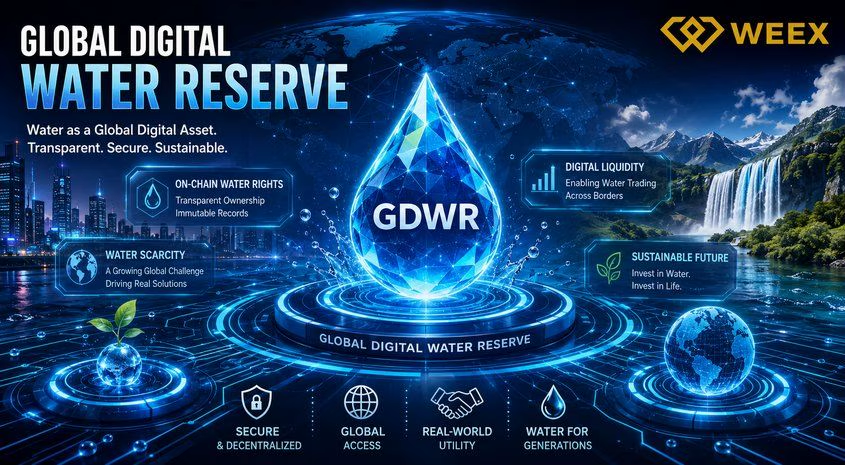
Is GDWR Crypto legit or a scam? Learn what Global Digital Water Reserve is, review its on-chain data, risk factors, and whether the project is backed by real-world water assets.

AI Stock Outlook: Will Iran Tensions Change the Market Outlook?
Explore how Iran tensions, rising oil prices, interest rates, and Big Tech AI spending could shape the next phase of the AI stock rally.
Introducing Cash Cat ($CASHCAT): Robinhood Chain Meme Token and Price Prediction
Cash Cat is a Robinhood Chain meme token drawing attention after a fast market debut, a 1B supply, and sharp price swings.
LLY Stock Forecast: Can AI and Weight Loss Drugs Drive More Growth?
This article maps how Eli Lilly’s GLP-1 weight-loss franchise and AI-driven R&D could influence LLY’s traditional equity and…
CASHCAT Airdrop: How to Earn Up to 50,000 USDT in Rewards on WEEX
This guide breaks down how the CASHCAT Airdrop works on WEEX, the rewards on the table, and a…
What Is SOXS ETF? The 3X Bear Semiconductor ETF Explained
This guide breaks down SOXS—the Direxion Daily Semiconductor Bear 3X Shares—so you understand what a 3x inverse semiconductor…
Trust Wallet Transaction Stuck or Failed? Here's How to Fix It
A stuck or failed transaction in Trust Wallet is one of the most common problems crypto users encounter and one of the most misunderstood. The cause is almost always related to gas fees or network congestion rather than anything wrong with your wallet. This guide explains why transactions get stuck or fail, how to fix each situation, and how to prevent it from happening again.
Trust Wallet vs MetaMask: Which One Is Better for Beginners?
Trust Wallet and MetaMask are the two most widely used self-custody crypto wallets in the world. They serve different primary purposes and suit different types of crypto users. This guide compares them directly on the dimensions that matter most for beginners making their first wallet choice.
Contents
Latest articles


Latest coin listings on WEEX


